[PENSACOLA, Fla.] — Florida homeowners are set to receive significant property tax relief after voters approved Amendment 3 in the Nov. 3 general election. But the decision has left cities and counties facing a difficult question: How will they continue paying for essential services with less tax revenue?
According to official results from the Florida Division of Elections, Amendment 3 received 4,922,720 yes votes, or 61.98%, compared with 3,019,811 no votes, or 38.02%. The measure needed at least 60% approval to pass.
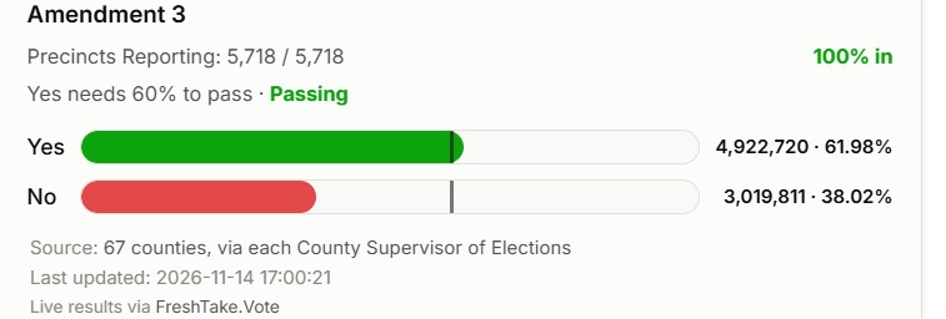
Photo Credit: www.wusf.org/ Bar Graph Depicting Amendment 3 Being Passed in Florida
The amendment will increase the homestead property tax exemption for non-school taxes to $150,000 in 2027 and $250,000 in 2028, with inflation adjustments beginning afterward.
The increased exemption will not affect property taxes collected for public schools.
The amendment also reduces the annual cap on assessment increases for non-homestead properties from 10% to 5%.
Public Safety Funding Raises Questions
There has been considerable debate over whether the reduction in property tax revenue could lead to cuts in public safety services.
The Florida Constitution, as amended, restricts how local governments can use property tax revenue. Permitted uses include police, fire and emergency medical services, along with education, infrastructure, natural resources and other government operations.
However, the amendment does not guarantee that public safety departments will maintain their current funding levels.
Gov. Ron DeSantis defended Amendment 3 during an Aug. 14, 2026, news conference, saying the measure would provide additional protection for homeowners.
DeSantis also acknowledged that the amendment did not go as far as he had hoped. He argued that opponents were placing the needs of government ahead of taxpayers.
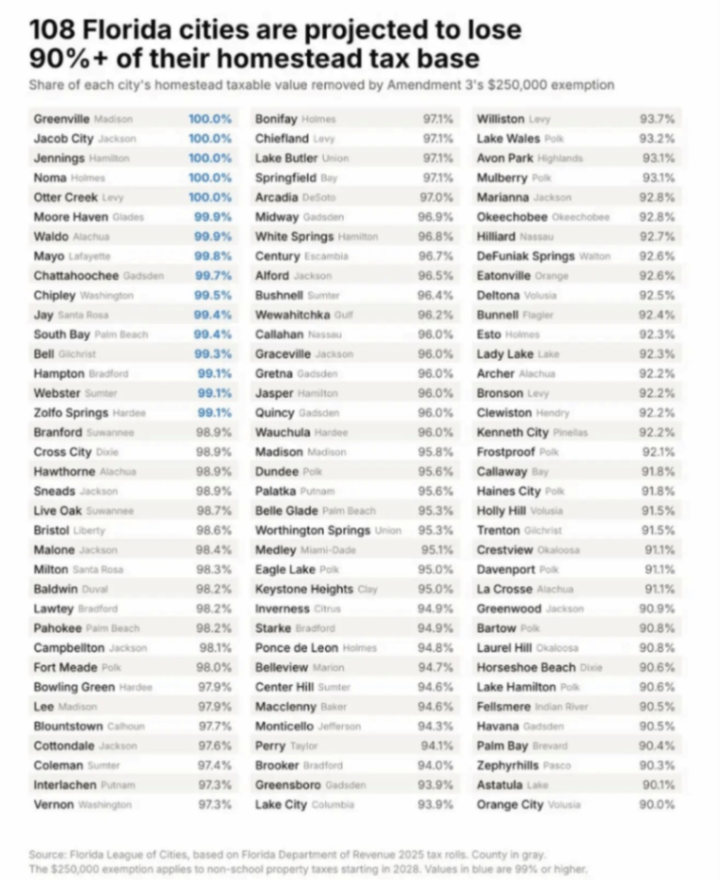
The Florida League of Cities, a statewide association representing more than 400 cities, towns and villages, released projections showing that 108 municipalities could lose at least 90% of their homestead taxable value.
The projected losses concern taxable property value, not total city revenue. Still, the reductions could place financial pressure on communities that rely heavily on residential property taxes.
Residents Question Government Spending
Following the election, Floridians shared their opinions on Facebook, with several questioning how local governments manage taxpayer money.
OpGov.News asked residents whether they supported the amendment and if they believed the reduction could lead to higher taxes or additional fees.
Anthony Pugliese of Spring Hill questioned whether local governments were making good use of the property taxes they already collected.
“Was the local government doing their jobs with the funds from property taxes? Are the parks in good repair? Are the medians mowed? Is crime under control? Are the parks cleaned and maintained?”
Pugliese answered his own questions with a no, adding that if local governments were not doing their jobs with the money collected, residents should question why they should continue paying.
Antoni Vieira of Jacksonville directed his comments toward elected officials, saying, “It’s about time politicians re-think their lavish spending. There IS plenty of money if spent wisely.”
Bud Weiser also expressed support for the vote, saying, “Government needs to be on a budget as everyone else.”
He criticized rising property taxes and questioned government spending on surveillance cameras and football stadiums.
Larry Callahan had a similar message for officials: “Better learn how to balance a check book and not outspend your budget.”
The comments reflect frustration among some residents over how their tax dollars are spent, although they do not represent the views of all Florida voters.
Could Other Taxes and Fees Increase?
Another concern is whether cities and counties will attempt to recover lost revenue through higher fees or other taxes.
The amendment does not automatically increase sales taxes or require local governments to introduce new charges.
However, municipalities may consider adjustments to property tax rates, utility fees, service charges or spending as they prepare future budgets, subject to applicable laws.
The financial impact will vary depending on each community's property values, commercial development and existing revenue sources.
Voters Had the Final Say
There appeared to be some confusion in online discussions, with residents attributing the amendment's approval to either Democrats or Republicans.
While state lawmakers placed the measure on the ballot, Florida voters made the final decision.
Nearly 7.94 million votes were cast, with 61.98% supporting the amendment.
What Happens Next?
As OpGov.News previously reported, Amendment 3 increases the homestead property tax exemption for non-school taxes to $150,000 in 2027 and $250,000 in 2028, with annual inflation adjustments beginning in 2029.
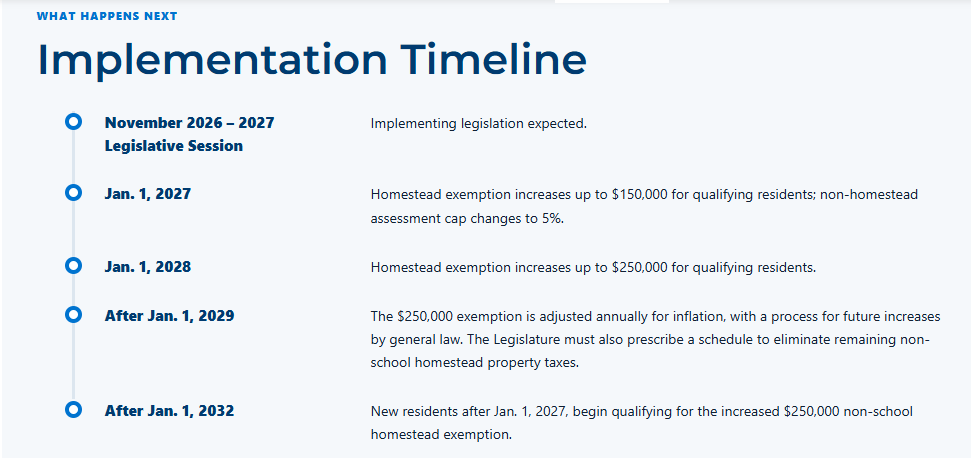
Photo Credit: https://www.flchamber.com
The amendment also reduces the annual assessment-growth cap for non-homestead properties from 10% to 5% and includes additional eligibility requirements for certain new Florida residents.
DeSantis has called for a special legislative session to address implementation before his term ends in January 2027.
Local governments may now have to review their budgets, reconsider spending, or look at other revenue sources to maintain services.
Only time will tell whether Amendment 3 provides meaningful tax relief to homeowners or creates additional financial strain on local governments.
OpGov.News will continue monitoring Amendment 3's implementation and its impact on communities across Escambia and Santa Rosa counties.
To submit corrections or additional information about this report, email james.b@lead4earth.org or leave a comment below.
0
0

Comments