(PENSACOLA, Fla.) — Florida residents will have much more than a governor and city officials to vote for on Nov. 3, 2026. Residents will also vote on Amendment 3, a yes-or-no vote on a complex, much-debated issue.
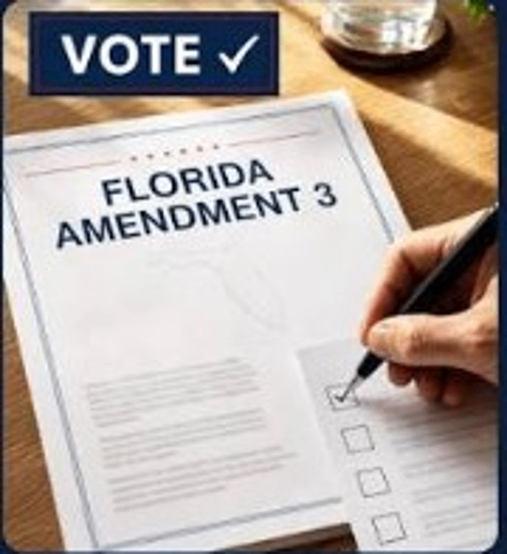
Origins of Florida's Homestead Exemption
Florida's tax system dates to 1830.
"Over the years, the homestead exemption has become a key aspect of the state's property tax framework. It serves to protect homeowners' primary residences from high taxation and potential forced sales for debt recovery, subject to the constitutional and statutory requirements governing these protections." (Florida Homestead Exemption: History and Savings Explained)
Florida has had a homestead exemption for more than 90 years. The exemption dates to the 1930s, with implementation beginning in 1935. Its purpose was to provide significant property tax relief for homeowners.
Since its inception, the exemption has undergone several changes, including increases approved by Florida voters. The exemption was expanded from $25,000 to $50,000 through changes to the state's property tax system.
Current Florida Homestead Exemption
Article VII, Section 6 of the Florida Constitution allows qualifying homeowners to subtract a portion of their permanent residence's assessed value before property taxes are calculated.
The traditional homestead exemption provides up to $50,000 in reductions to assessed value, with inflation adjustments applying to part of the exemption beginning in 2025.
"The first $25,000 applies to every taxing authority: county, school board, city, and special districts alike. The second $25,000 only applies to assessed value between $50,000 and $75,000, and it skips the school district's levy entirely. That second layer is worth less in raw dollars." (Florida homestead exemption: what it is, who qualifies, and how to...)
Once a homeowner qualifies for a homestead exemption, the property's assessed value generally cannot increase by more than 3% annually or the rate of inflation measured by the Consumer Price Index, whichever is lower.
Overall, the homestead exemption and related assessment limitations continue to function as tools for preventing sudden and excessive property tax increases for Florida homeowners, supporting housing affordability in the state.
These measures reflect ongoing efforts to balance tax policy with the interests of property owners relying on their homes as a primary asset.
Current Florida Homestead Exemption Savings
The formula for calculating a homeowner's exemption savings is to multiply the applicable exemption amount by the millage rate and divide by 1,000.
The millage rate is the property tax rate set by local taxing authorities. One mill equals $1 in taxes for every $1,000 of taxable property value.
Millage rates vary by county and are set by local taxing authorities, including counties, cities and school districts.( A Florida Homeowner’s Guide: Millage)
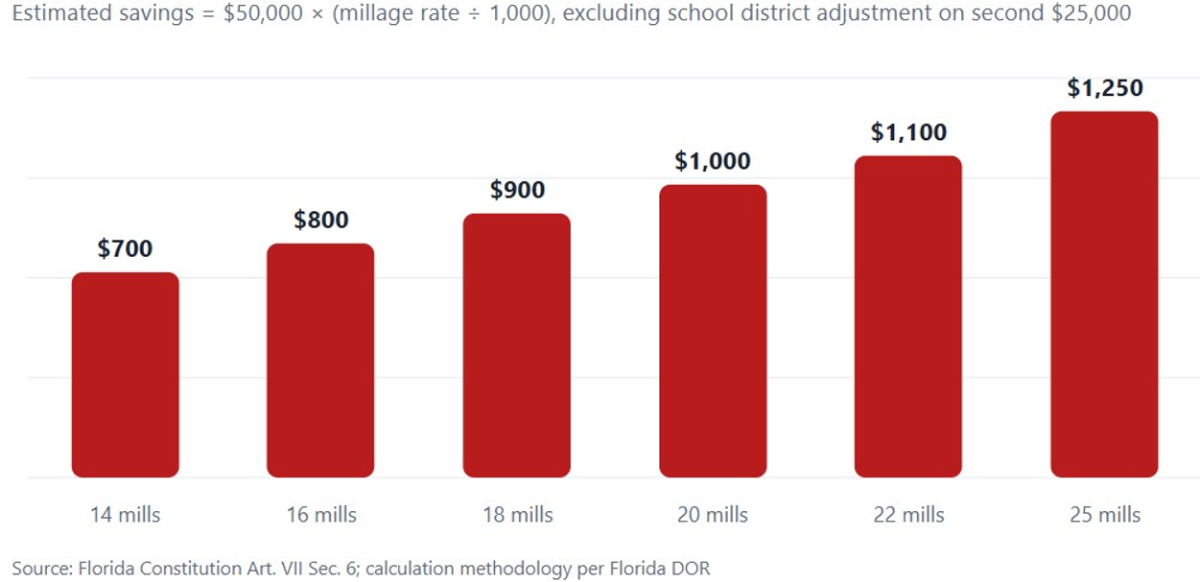
The guide to millage rates is attached to this report.
Here is an example of how to calculate a homeowner's potential savings:
$50,000 (exemption) × 22 (mills) ÷ 1,000 = $1,100 annually.
This is an illustrative calculation. Actual savings depend on the applicable exemption, property value and taxing authorities because the additional homestead exemption does not apply to school district taxes.(Florida Amendment 3, Homestead Tax Exemptions, Property Assessments, and Spending Restrictions Amendment (2026) - Ballotpedia)
What Are the Proposed Homestead Exemption Changes?
Florida Amendment 3 would raise the homestead exemption for non-school property taxes to $150,000 in 2027 and $250,000 in 2028.
Beginning in 2029, the larger exemption would be indexed to inflation.
The amendment would also lower the annual non-homestead assessment increase cap from 10% to 5%.
For qualifying rental properties, second homes and commercial properties, the maximum annual assessment increase would decrease from 10% to 5%.
A change in the residency rule would apply to people who are not Florida residents as of Dec. 31, 2026. New residents would initially receive the existing homestead exemption upon qualifying, with eligibility for the larger exemption beginning in their fifth year of exemption, subject to constitutional requirements.
The proposal would also require the Legislature to establish a uniform procedure allowing counties and municipalities to increase homestead exemptions up to the full assessed value for their respective taxes. Special districts could do the same with referendum approval.
Counties and municipalities would be required to use property tax revenue for specified public purposes, including public safety, education, infrastructure, natural resources, flood control, bond debt service, retirement benefits and government operations. The amendment also allows certain other expenditures unless prohibited by state law.
(Florida Amendment 3, Homestead Tax Exemptions, Property Assessments, and Spending Restrictions Amendment (2026), Ballotpedia; Florida Department of State)
The proposed constitutional amendment requires at least 60% voter approval to pass.
Arguments From Supporters
Supporters of Amendment 3 say the proposal would:
Provide direct tax relief to homeowners facing rising costs.
Help retirees and fixed-income residents by reducing taxable property values.
Provide more predictable assessment limits for rental and commercial property owners.
(Florida Amendment 3 could cut taxes for homeowners, spark local service funding debate | firstcoastnews.com)
Arguments From Opponents
Opponents of Amendment 3 say the proposal:
Could reduce local government revenue by billions of dollars, with some estimates projecting up to $12 billion in recurring losses.
May force cuts to public services or increases in other taxes and fees.
Could shift costs to renters, consumers and small businesses.
(Voter Guide: What Floridians Should Know About Amendment 3)
The amendment has drawn both positive and negative responses.
Margy Grant, CEO of Florida Realtors, has expressed support for the proposal, saying it could make homeownership more affordable. She also expressed "full faith and confidence" in elected officials' ability to implement it without harming needed services.
(Florida Amendment 3 could cut taxes for homeowners, spark local service funding debate)
U.S. Rep. Byron Donalds, the Republican gubernatorial nominee, has said the amendment's language would ensure local governments prioritize law enforcement, fire departments and emergency personnel, and that public safety funding would be protected.
” (FL’s Amendment 3 would cut property taxes. Could it gut local police, fire, emergency money? | WLRN)
Gov. Ron DeSantis has championed the measure, calling property taxes "the worst way to tax" homeowners and saying the proposal would ease the burden on Floridians.
Florida’s Senate president says he’s against Amendment 3 - AOL)
DeSantis has also argued that the state could offset the effects on local services through grants.
Although the amendment has many supporters, there are also those who oppose it.
Brian Lamb, president of the West Palm Beach firefighters union, warned that the amendment would not deliver tax relief without raising other fees, potentially harming public safety.
(Florida officials discuss Amendment 3’s impact on property taxes and local services - WPBF)
Florida Senate President Ben Albritton, a Republican from Wauchula, voted against the measure, warning it could "eliminate up to 30 percent of resources" for rural counties, potentially harming law enforcement, emergency response and infrastructure.
(Florida’s Senate president says he’s against Amendment 3 - AOL)
U.S. Rep. Lois Frankel, a Democrat representing part of Palm Beach County, called the proposal "a short-term gain for very few and long-term pain for many."
(Florida officials discuss Amendment 3’s impact on property taxes and local services - WPBF)
Gov. Ron DeSantis Addresses Amendment 3
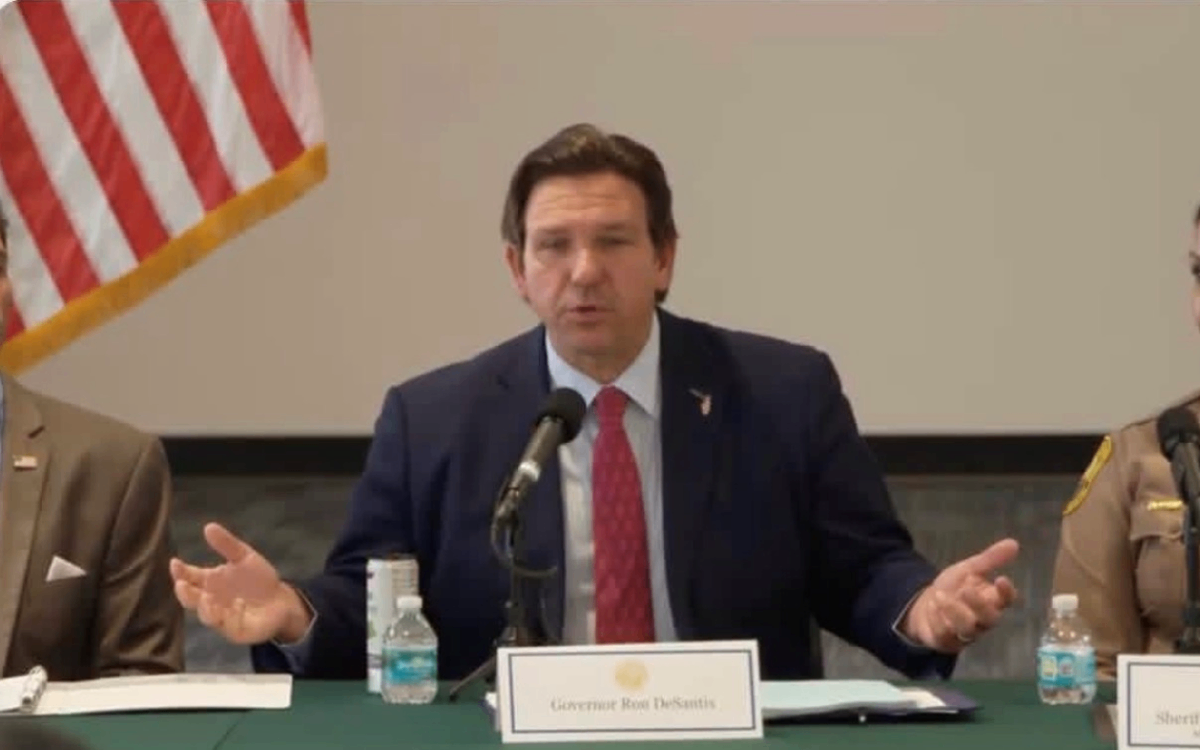
Photo credit: Florida's Voice. Florida Gov. Ron DeSantis addresses Amendment 3.
Gov. Ron DeSantis had a message for Florida voters during an appearance on Florida's Voice.
DeSantis addressed warnings from local governments that Amendment 3 could force cuts to public services.
He said local officials were "trying to tell people that the sky is going to fall, and I really want to commend folks here who work in local government who are just saying the opposite.
They're saying we reject fearmongering. We reject some of these fake narratives."
Florida Voters Will Decide
Ultimately, Florida voters will decide whether Amendment 3 passes.
Supporters say the proposal would provide property tax relief, while opponents remain concerned about its potential effect on local government revenue and public services.
Every vote matters. Florida voters will have the opportunity to cast their ballots on Nov. 3, 2026.
To submit a correction or additional information about this report, contact james.b@lead4earth.org or leave a comment below.
Florida Guide To Millage Rate
Florida Guide To Millage Rate.pdf
0
0

Comments