(SACRAMENTO, Calif.) — Federal Bureau of Investigation investigators in Sacramento have identified at least 800 scam victims who collectively lost more than $150 million, as federal prosecutors highlight a series of fraud cases involving investment schemes, cryptocurrency, embezzlement and government impersonation.
The U.S. Attorney’s Office for the Eastern District of California announced Nov. 24 its participation in the Justice Department’s nationwide anti-scam surge, an effort targeting domestic and international criminal networks responsible for online fraud and other financial schemes.
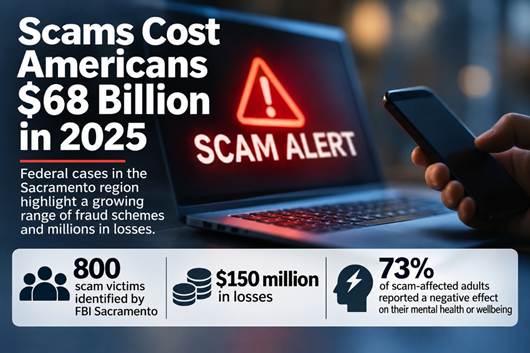
Graphic: OpGov.News, Ai generated.
The announcement highlighted 13 cases prosecuted in the Eastern District involving millions of dollars in losses and hundreds of victims. The cases include multimillion-dollar Ponzi schemes, fraudulent investment opportunities, cryptocurrency scams, payment-processing fraud and the theft of money from a local church.
“Fraud schemes can devastate victims, costing them not only their savings but also their sense of security and peace of mind,” U.S. Attorney Eric Grant said.
“The cases highlighted here demonstrate our Office’s commitment to aggressively pursuing scammers whether they operate from across the globe or within our own communities,” Grant said.
Investment schemes cost victims millions
Several of the cases involved investment schemes in which defendants promised unusually high returns, misrepresented their financial performance or used money from new investors to pay earlier investors.
One of the largest involved David Hardcastle, a hard-money lender who induced investors to turn over approximately $45 million through false representations about loan interest rates. He pleaded guilty April 20, 2026.
Matthew Piercey, 49, of Palo Cedro, was sentenced May 21 to 30 years in federal prison for operating a $35 million investment fraud scheme and attempting to interfere with witnesses.
According to the DEA, Piercey’s court documents revealed he solicited money through his purported investment companies, Family Wealth Legacy and Zolla, while making false statements about investment strategies, trading algorithms and the financial stability of the businesses.
He marketed an automated trading fund called Upvesting, claiming it had a successful track record. However, Piercey privately acknowledged to an associate that the fund did not exist.
Piercey used money from some investors to pay others and ultimately returned only about $8.8 million of the approximately $35 million invested. He spent additional money on business and personal expenses, including purchasing two residential properties.
His arrest in November 2020 involved an unusual escape attempt. When federal agents tried to arrest him, Piercey fled in a vehicle, leading officers on a chase through residential neighborhoods and onto a highway. He abandoned the vehicle and entered Lake Shasta using an underwater submersible device. After about 20 minutes in the water, he resurfaced and was arrested.
Another Sacramento-area case involved Maria Dickerson, 49, of Sacramento, who pleaded guilty March 10 to wire fraud and securities fraud in connection with a $10 million investment scheme involving approximately 156 victims.
Dickerson, also known as Dulce Pino, operated the scheme through a shell company called Creative Legal Fundings of CA from 2020 through 2024.
According to the DEA, her court documents revealed that she promised investors returns of at least 10 percent per month and falsely claimed their investments were safe and secure. She also told some investors the company was associated with the CEO of a multinational casino and resort corporation.
Dickerson used new investor money to pay earlier investors and finance personal expenses, including vacations, gambling, private jet travel, Mercedes-Benz vehicles and a Sacramento home.
Antonio Honorato Silveira, 50, of Turlock, pleaded guilty Oct. 26 to wire fraud in a scheme that left approximately 89 investors owed $7.19 million.
Silveira worked as a tax preparer and accountant and promised clients annual investment returns of 13 to 17 percent. Between 2019 and 2025, investors gave him approximately $11.03 million.
He consistently lost money trading stocks but continued soliciting investors. To conceal the losses, he used approximately $3.84 million in investor funds to make payments to other investors, falsely presenting them as investment returns.
More than 25 investors experienced significant financial hardships, including losing retirement savings or college funds, delaying retirement and selling their homes, according to court documents.
Cryptocurrency and foreign exchange fraud
Federal prosecutors also highlighted cases involving cryptocurrency trading platforms and foreign exchange investments.
Daniel Chartraw, 53, formerly of South Lake Tahoe and Lodi, was convicted by a federal jury June 18 following an eight-day trial involving multiple cryptocurrency and investment fraud schemes that caused nearly $1 million in losses.
According to evidence presented at trial, Chartraw and an associate controlled companies including Crypto-Pal LLC and TDA Global LLC. Investors were told Crypto-Pal operated a cryptocurrency trading platform that guaranteed high returns without risk.
Chartraw also claimed TDA Global supplied jet fuel to airlines or operated its own cryptocurrency trading platform.
He used aliases including Leonard and Leon, fabricated account statements and false assurances of investment growth to persuade victims to invest. Prosecutors said none of the money was invested as represented, and victims received neither investment returns nor their original principal.
Eshaq M. Nawabi, 27, of Salida, was indicted Aug. 27 on eight counts of wire fraud in connection with an alleged foreign exchange investment scheme that defrauded investors of at least $2.7 million.
According to the DEA, Nawabi’s court documents revealed he convinced investors that he was a successful foreign currency exchange, or forex, trader. Between October 2019 and February 2022, investors gave him thousands of dollars, receiving monthly statements showing what appeared to be substantial profits.
Prosecutors allege Nawabi fabricated the statements and never invested the money. Instead, he spent the funds on personal expenses and to keep the scheme operating.
He leased luxury vehicles, including multiple Lamborghinis, a Ferrari and a McLaren, according to the indictment.
The FBI is seeking additional victims who may have invested through companies operating as Nawabi Enterprises or Hyperion Consulting Inc. Information can be submitted through the FBI’s victim information form.
Scams involving impersonation and fraudulent businesses
Other cases involved defendants who used false identities, fraudulent business arrangements or impersonation tactics to obtain money.
Marlon Solis Bonilla pleaded guilty Sept.15 to participating in a transnational timeshare and government impersonation fraud scheme that caused approximately $36 million in losses and affected more than 400 victims.
Bonilla and his co-defendants posed as attorneys and targeted older adults with false promises of recovering money from previous timeshare transactions. Victims were instructed to wire money to accounts controlled by the conspirators to receive restitution.
In a separate government impersonation scheme, Binghui Liu pleaded guilty Oct. 5 to laundering proceeds from a fraud operation in which victims were falsely told they faced criminal charges and needed to surrender their savings for “safekeeping.”
The scheme involved approximately $597,100 in losses and 24 victims.
Richard Best and Shawn Sawa used fraudulent business contracts to obtain and sell canola oil belonging to victim companies, causing approximately $5 million in losses. Best was sentenced April 27 to three years in prison and ordered to pay $2 million in restitution. Sawa was sentenced Dec. 8, 2025, to 18 months in prison.
Thomas Emil Eide, 51, formerly of South Lake Tahoe, pleaded guilty Aug. 21 to conspiring to defraud banks through a scheme involving fake companies and payment-processing accounts.
According to the DEA, Eide’s court documents revealed his co-conspirators recruited individuals to serve as nominal owners of fictitious companies and open bank accounts. They then allowed merchant clients who otherwise might not have qualified for accounts to process transactions through them.
The group also manipulated chargeback rates through high volumes of small-dollar transactions, making businesses appear less risky to banks than they were.
More than $111 million in transactions were processed on behalf of Eide's clients. Some businesses charged consumers for goods or services that were unauthorized or never provided, resulting in more than $3.3 million in consumer-initiated refunds and chargebacks.
The U.S. Postal Inspection Service is seeking additional victims. Consumers can review a list of fictitious CB Surety companies and submit restitution claims through the Justice Department’s victim information website.
Prosecutors also highlighted a cannabis investment fraud case involving Keinyatey Deboros Chambers, who allegedly promised investors returns of 200 percent. The scheme targeted victims throughout California and involved estimated losses of approximately $1.3 million and 50 victims. Chambers was arraigned May 22 and ordered detained pending trial.
Former South Lake Tahoe mayor embezzled from church
One of the cases involved a former elected official in South Lake Tahoe.
Tamara Le Ann Wallace, 56, of South Lake Tahoe, pleaded guilty Oct. 29 to wire fraud after embezzling approximately $390,000 from a local church where she worked as a part-time bookkeeper.
According to the DEA, Wallace’s court documents revealed she began working for the church in 2018 and was responsible for managing finances, paying bills, monitoring the budget and maintaining digital financial records.
Between April 2019 and September 2025, she issued reimbursement checks to herself for expenses she had never incurred and made unauthorized electronic transfers into accounts she controlled. She also falsified accounting entries to conceal the theft.
Wallace spent the money on personal expenses, including rent and travel.
Her actions nearly forced the church to close, requiring it to reduce programming, take out multiple loans and pay late fees and interest on overdue bills.
Wallace resigned from public office in October 2025.
The FBI and El Dorado County District Attorney’s Office investigated the case.
Scams cost Americans $68 billion in 2025
The cases highlighted by federal prosecutors reflect a much broader problem nationwide.
An estimated 15 million U.S. adults were personally scammed in 2025, while another 4 percent said someone else in their household was victimized, according to a June report by Gallup and the Stop Scams Alliance.
Altogether, 10 percent of U.S. adults experienced a scam either directly or through someone in their household.
The report, United States of Scams: The Financial and Emotional Fallout, estimates Americans lost $68 billion to scams in 2025, an average of approximately $186 million every day.
More than half of the scams reported involved losses of $500 or less. However, the average loss per scam was $5,578, reflecting cases in which victims lost tens of thousands of dollars.
The consequences extended beyond financial losses. Among adults in scam-affected households, 21 percent reported severe financial hardship and another 25 percent reported moderate financial hardship.
The emotional impact was also widespread. Nearly three in four adults in scam-affected households, or 73 percent, said the experience negatively affected their mental health or well-being. That included 28% who described the impact as very negative and 45 percent who reported a moderately negative effect.
The impact extended to people who were not directly targeted. Among adults whose household member was the primary scam victim, 65 percent reported a negative effect on their own well-being.
The findings were based on a nationally representative survey of 5,173 U.S. adults conducted Jan. 8 through Feb. 18, 2026.
Nearly one in four U.S. adults said they had personally experienced a scam at some point during their adult lives, including 10 percent who had been victimized more than once.
Officials warn consumers about holiday scams
Federal officials are urging consumers to remain alert during the holiday season, when scammers often increase their activity as people become busy and spend more money.
Common warning signs include promises of guaranteed or unusually high investment returns, pressure to act quickly or keep an investment secret, and official-looking documents or financial statements that cannot be independently verified.
Officials also warn about impersonation schemes in which someone claiming to be law enforcement or an attorney instructs a victim to move money to another account for “safekeeping.”
Consumers should stop and independently verify suspicious requests before sending money, investing or sharing financial information. Officials also recommend discussing questionable financial opportunities or requests with someone they trust.
Suspected fraud can be reported to the FBI’s Internet Crime Complaint Center at ic3.gov.
Adults 60 and older who believe they have been targeted by fraud can also contact the National Elder Fraud Hotline at 1-833-FRAUD-11.
The Justice Department said its nationwide anti-scam surge began March 6 and involved prosecutors in 85 federal districts. During the effort, 30 defendants were extradited to face scam-related charges in U.S. courts.
The initiative was coordinated by the Justice Department’s Criminal Division and involved multiple federal agencies, including the FBI, Department of Homeland Security, U.S. Secret Service, U.S. Postal Inspection Service, Federal Trade Commission and Securities and Exchange Commission.
More information about the cases and the Justice Department’s anti-scam effort is available at justice.gov/usao-edca.
An indictment is an allegation, and defendants are presumed innocent until proven guilty beyond a reasonable doubt in court.
If you’d like to add or correct anything in this report, feel free to reach out to me or leave a comment below. Submit tips and story ideas to Sarah Denos at sarahkdenos@gmail.com.
Stop_Scams-Gallup-Report
Stop_Scams-Gallup-Report.pdf
0
0

Comments