(OPGOV GLOBAL) – Exercise can be a breaking point for many people suffering with endometriosis. For some, certain exercises can bring about a flare-up, bringing with it pain and cramping, nausea, and other unpleasant symptoms. For others still, exercising at all can be a trigger.
Most endometriosis patients have probably heard at least once from a physician that diet and exercise are the keys to managing symptoms, but this rather broad advice with no real direction or instruction can be frustrating – and lead to negative thinking pathways that do more harm than good.
Your average fitness trainer won’t have any specialized knowledge about how to exercise with endometriosis, either. “Listen to your body” is such a common phrase in the endometriosis community that it’s become redundant, but there’s real value in it.
The fact is that no two women with endometriosis suffer in the exact same ways. Everyone experiences a different version of the pain, inflammation, and myriad of other symptoms that can accompany a flare-up. That’s why there’s no “right” answer to the question, “what’s the best way to exercise with endometriosis?”
However, researchers are still working on answers to that question. Most recent studies and cumulative reviews focus on whether exercise is beneficial for endometriosis, but there’s very little research into what type of exercise, exactly, is beneficial to women with endometriosis for managing symptoms and maintaining a measure of quality of life.
What we do have thus far is a questionnaire designed to measure the subjective quality of life of endometriosis patients called the Endometriosis Health Profile (EHP-30). A set of 30 questions analyze several keystone factors of a patient’s life and are categorized into sections including pain, control and powerlessness, social support, emotional wellbeing, and self-image. The idea is to identify which areas a patient needs support in for their specific case.
This instrument has been used outside the medical office in clinical research to some avail.
The research currently available on exercising with endometriosis is largely comprised of systematic reviews and meta-analyses, which are ways of gathering and assessing all the available data on the subject. That’s not to say these types of published works aren’t important; they’re helpful for researchers to quickly access historical data.
There aren’t many recent clinical studies actually measuring the impact of exercise on endometriosis symptoms; even other researchers are calling for more endometriosis research, citing a severe lack of funding in the field.
Upon a rather deep dive into the most recent research on this particular topic, however, was one study that did look rather informative.
A study published in Archives of Physical Medicine and Rehabilitation in 2023 carefully measured the effects of specific pelvic-floor training and exercises in a randomized, controlled trial of 31 women with endometriosis, about half of which served as the “control group” and the other half received the intervention (exercise).
The intervention itself consisted of nine weeks of a highly-curated set of physical exercises performed by physiotherapists with over five years of training experience. It’s called the "Physio-EndEA" program, and it was designed specifically for “women with endometriosis unresponsive to conventional therapy,” according to researchers.
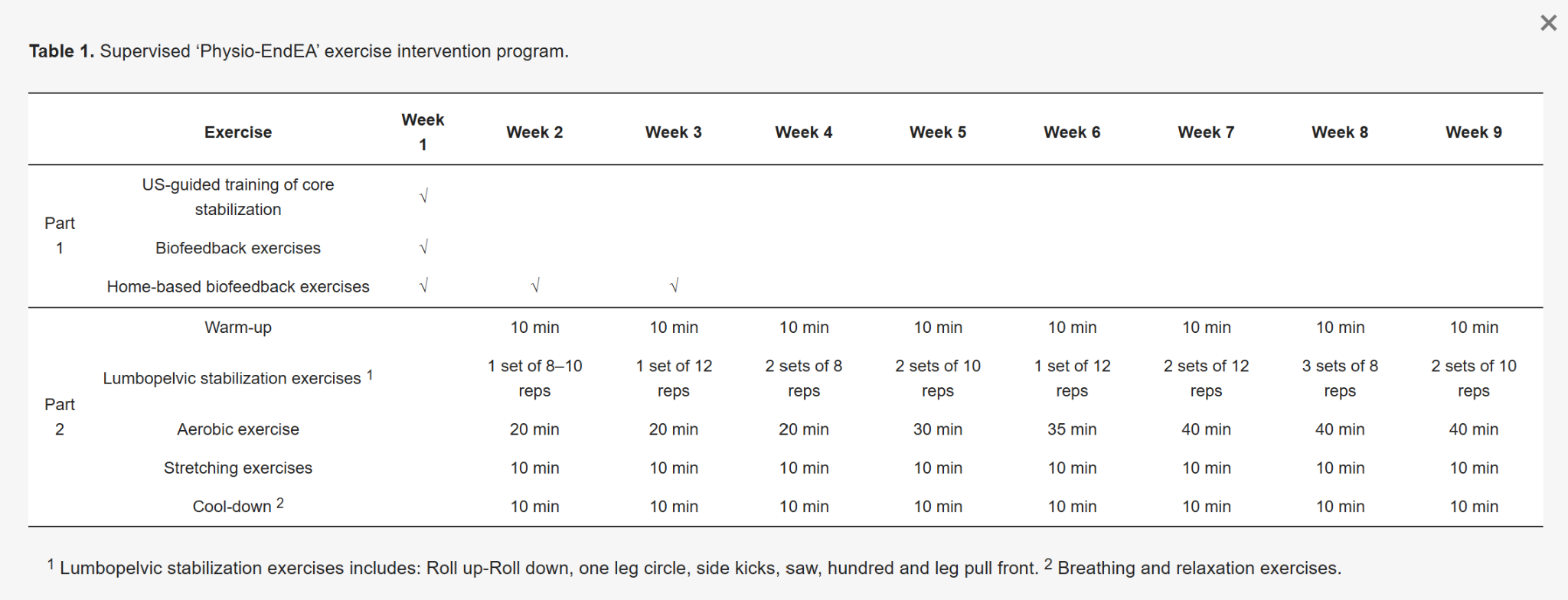
Photo Credit: MDPI / 10.3390/ijerph19031738
The intervention is characterized by a guided set of exercises spanning over the nine-week period, though specific exercises are vaguely referred to in research with names such as “lumbopelvic stabilization exercises”, “aerobic exercises”, and “stretching exercises”, making the experiment difficult to reproduce on its own without the expertise of the physiotherapists involved in the study.
This quality immediately drives down the real-world value of research like this for clinicians looking for answers for their patients. The gap between research and clinical practice for endometriosis is still about seven to ten years, after all.
With no luck on specific exercises from clinical research studies, the next place to turn is specialists in the field with their suggestions for exercise based on their own practices and research.
Board-Certified Endometriosis Specialist Dr. Rachel Haverland suggests several low-impact exercise activities that she believes can help strengthen the core, support pelvic health, and improve circulation in women with endometriosis.
These include activities such as swimming, walking, cycling, simple stretches, and gentle yoga poses intended to provide certain respective benefits. Dr. Haverland suggests that gentle exercises which strengthen the pelvic floor, such as kegels, can help support lower abdominal organs that are affected by endometrial lesions.
There are exercises that should be avoided in general, according to Dr. Haverland, with endometriosis. Certain exercises that put significant pressure or strain on abdominal muscles can make matters worse.
“Running on hard surfaces, jumping classes and heavy lifting can increase pelvic pain and strain inflamed tissues. Many benefit more from gentler exercise,” she says.
After a deep dive into what exercises experts and researchers recommend for endometriosis patients, we have a conclusion: there is no right answer.
The best advice we could find across numerous blogs, platforms, media outlets, and online forums leads back to the same thing: listen to your body. This means avoiding exercises that are painful to do, getting in touch with how your body feels after each workout, and taking time to recover when needed.
Chances are, every day will feel different. Every week will bring a different challenge. The most important exercise we can do is the one that feels right for us, doesn’t adhere to any particular set of rules or influencer trends, and allows us the space to recover when needed.
Until we have enough real, credible research in this field, we can keep writing articles, making social media posts, and spreading awareness in hopes that someone with the resources and influence makes the right decision when it comes to endometriosis research.
To add to or correct any information in this report, please contact me at tracy.t@lead4earth.org.
0
0

Comments