(ESCAMBIA COUNTY, F.L.) ---This year marked the 25th anniversary of the catastrophic events of September 11, 2001.
The Pensacola Naval Air Station Aviation Museum conducted a commemoration ceremony honoring those who lost their lives that fateful day, including first responders, civilians, aircrew, and the soldiers who later served our country in Afghanistan in support of Operation Enduring Freedom.
The ceremony included two guest speakers, Vice Admiral John B. Totushek, USN (Ret), and CDR Steve Scheibner, USN (Ret). There was a bell toll conducted by CDR Charles Giacomo, USN (Ret), and former New York Firefighter.
The Bell Tolls represented 8:46 a.m., when American Airlines Flight 11 crashed into the North Tower; 9:03 a.m., when American Airlines Flight 175 hit the South Tower; 9:37 a.m., when American Airlines Flight 77 crashed into the Pentagon; and 10:03 a.m., when United Airlines Flight 93 crashed into a field near Shanksville, Pennsylvania.
A moment of silence was observed, the guest speakers spoke, and a wreath was laid.
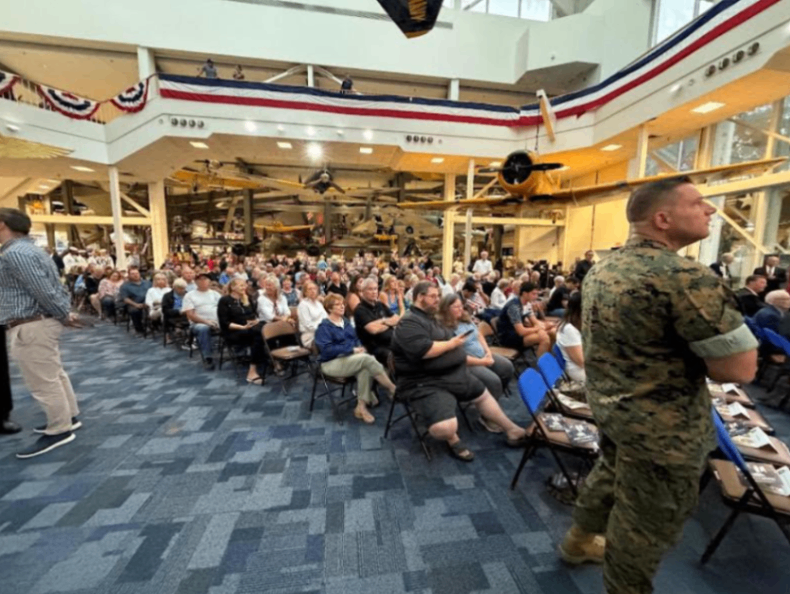
Photo Credit: James Borchardt / Full house of attendees at the 9-11 25th Commemoration Ceremony
The Naval Aviation Alumni Choir sang “The Peace of God”, “Eternal Father, Strong to Save”, and “America the Beautiful”. Taps was played to end the ceremony, then the colors were retired.
Gulf Coast Weekly spoke with Charles Giamom, a Gulf Breeze resident and retired Navy CDR, who served in Desert Storm, and a former New York City Firefighter. He was a first responder when the tragic events occurred.
Giamom was working a 5 a.m. fire on 9/11 when he got a phone call saying the towers were hit.
"It was pure chaos," Giamom said on the first scene. "There was over one foot of ash on the ground; firefighters were missing.”
Hopeless is the word that first came to Giamom, but the fear led to fight.
“I felt helpless, but I wasn’t scared," the first responder said. "I wanted to save as many people as we could.”
Giamom explained that he suffers from permanent lung damage and that he just had a friend pass away who was also a first responder.
“He was only 50 pounds when he died. He developed a cancerous tumor on his heart related to the debris and ash that was inhaled during rescue operations," Giamom said.
When asked what we could do today to help first responders who have become ill, Giamom named two groups.
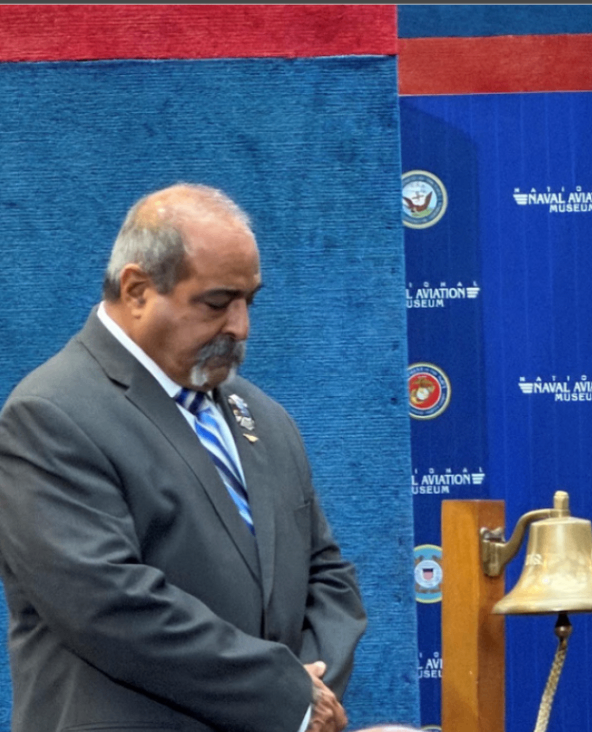
Photo Credit: James Borchardt / Charles Giamom was the Bell Toll, ringing the bell representing each one of the hijacked planes that struck the towers, pentagon, and crashed in Pennsylvania.
"Assist the September 11th Foundation and the Tunnels to Towers," Giamom said. "They have done so much for all of us.”
Tommy Ruiz, who served in the Navy from 1980-1988 and as a Police Officer from 1986-2018, wore a police badge with a black line across it representing the loss of officers.
When Gulf Coast Weekly asked Ruiz what true honor for 9-11 victims looks like, he said first to "remember Police Officers and all first responders and all of the countless lives that were affected.”
“I’ve heard about Pearl Harbor and could not believe that I lived through a similar event," Ruiz said, adding that 9-11 should become a federal holiday.
“People take holidays like this for granted," Ruiz said. "Over time, they don’t remember what the holiday is for. The new generation doesn’t grasp what happened on that day.”
Ruiz ended, noting, "When I heard it on the radio, I thought it was an advertisement for a movie."
"I did not think this was really happening," Ruiz said.
Retired CDR. Steve Scheibner, known as “Captain Steve" for his famous YouTube channel, said he was supposed to be the captain of United Airlines flight 175, but when he woke up, his friend, a fellow pilot, was assigned instead.
After the plane crashed into the tower, he checked his computer and saw no names listed as operating that flight. That meant the flight did not make it to its destination. Scheibner immediately hugged his wife, then began grieving the loss of his fellow pilot.
9/11 changed the way Scheibner began to think about life, leaving him with four questions each of us should ask ourselves, beginning with: Who have you hugged recently?
"Bitterness towards our country is what drove the hijackers to follow through with their mission," Scheibner said.
The next question led to purpose, with Scheibner asking, "What are you doing here; what are you doing to make something better?
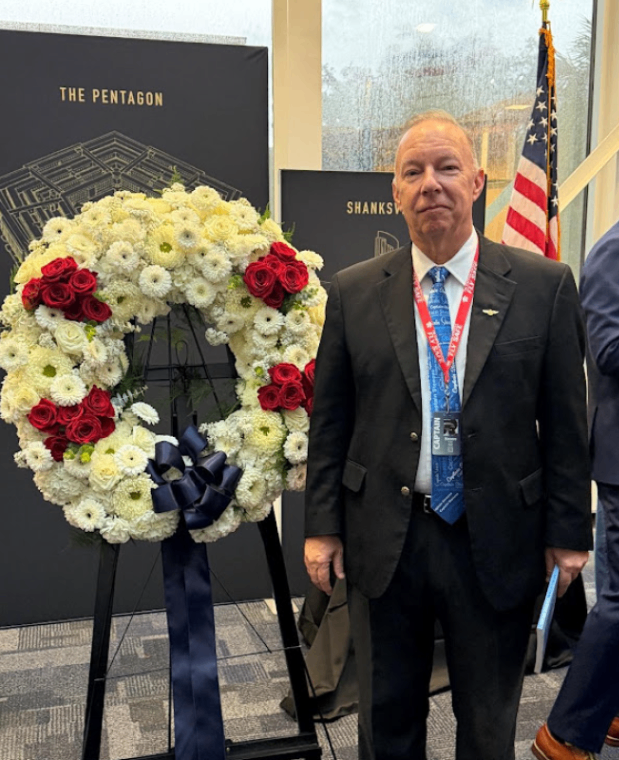
Photo Credit: James Borchardt / Retired CDR Steve Scheibner, USN Stands next to the wreath that was laid in remembrance those who lost their lives on 9-11
“It’s so easy to tear something down," Scheibner said. "The towers fell in seconds, but took years to rebuild.”
The last two questions, "where do you serve and who are plugged into," have easy answers.
"There is always someone in need; someone else is worse off than you are," Scheibner said. "You do not always need to worry about your own needs, and you should always be involved in something bigger than yourself.”
Retired Vice Admiral John B. Totushek was in the Pentagon when Flight 77 crashed into the building, recalling seeing Flight 175 crash into the second tower, thinking, "We were at war.”
“I was sitting at my desk when the plane hit," Totushek said. "I felt the percussion more than there was a sound."
The Pentagon never really planned on a full evacuation since the Cold War, according to Totushek. 25,000 people were running out of the building.
Totushek remembers how the Pentagon took over the Marriott hotels nearby for family members of the missing and injured, saying wives of soldiers and Department of Defense personnel were at the hotels, assisting their family members.
“It took several days to get accountability of everyone,” Totushek said, adding that the way he deals with 9-11 is never to forget.
When the ceremony was complete, many in attendance shook hands and hugged each other; mostly strangers. To this day, the events of 9-11 still bring people together: survivors, first responders, widows, widowers, past and current service members.
With ceremonies like this and others held across the country, 9-11 will never be forgotten. As one attendee stated, “It may not stay fresh in our minds as we grow older, but it will be like a stain on a T-shirt. It might fade, but it will never go away.”
To add to or correct any information in this report, please get in touch with me at james.b@lead4earth.org.
0
0

Comments