(ESCAMBIA COUNTY) --- If you don’t speak at the early-morning Escambia County Planning Board meeting, you are not allowed to speak on the same agenda item before the Board of County Commissioners.
The Escambia County Planning Board meeting starts at 8:30 a.m. on a weekday. However, that’s when people are at work, dropping kids off at school, or clocking in for hourly jobs. In quasi-judicial proceedings like the recent July 7 Jacks Branch Road opt-session, timing matters.
“With the quasi-judicial proceedings, you can't say what you don't say here,” Development Services Director Horace Jones told one speaker.
According to Jones, the record needed to reflect the speaker's position, which is why a notator is at the meetings. According to staff at the meeting, “we have to hear essentially from all three sides, from the public, staff and the applicant,” noting that testimony is used to make land development code decisions.
“They have to use the evidence that we hear today to inform their decision and not allow new evidence in at that point in time once they go to make a decision,” according to staff present.
Translation: Miss the 8:30 a.m. meeting, lose your voice. That’s not accessibility; instead, it’s a filter process. One more way of complicating your voice being heard.
The Agenda: Hard to Read, Hard to Find, Subject to Change
When a layperson attends their first planning board meeting, the agenda is hard to understand, with terms like Land Development Codes (LDC), parcel IDs, and more legalese that only confuses the matter. There is no plain-language summary, no map saying it like it is.
They change the order of agenda items at meetings, further confusing matters. You might take off work for Item D, only to find it moved to the end of a seven-hour meeting, as seen at the July 7 meeting.
Resident Jason Weidlich ran into that wall. Not only did he have to wait hours to speak, but once he told members he was only there to gather information, he was also told he had to declare whether he was “for” or “against” the item to get on the record.
“I guess I'm unclear, so if you have to withdraw me, I guess that's what you have to do, but that's not what I really wanted,” Weidich said as staff persisted in asking if he was in favor of or opposed to the agenda item.
Resident Keith Bowe walked up and suggested that Weidlich state that he “adopt all views of all the speakers for further consideration.”
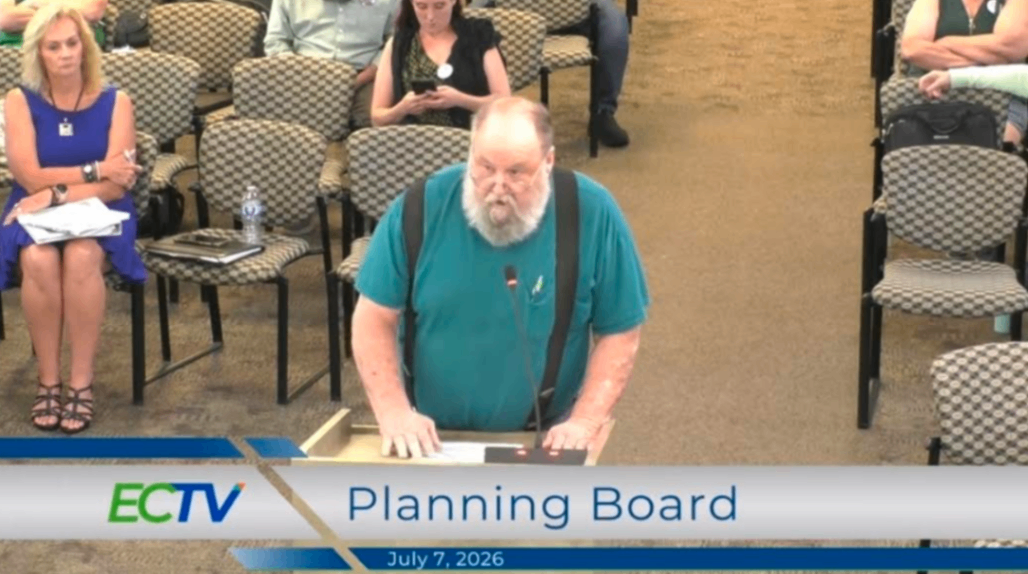
(Photo: Resident Keith Bowe takes the podium at the July 7 Escambia Planning Board meeting to assist another resident)
Weidlich expressed later that it's hard to know where he stands on the planning board matter with so little information. It seems that, in Weidich’s case, the lack of transparency, clarity, and public notice is the status quo for the Escambia County Planning Board.
Signing Up: No “Other” Box, No Help Desk
If the timing and agenda were not enough to deter a citizen from speaking, the sign-up sheet is, which a couple of speakers noted on Tuesday. Not only does the sheet list only “for” and ‘against,’ without offering an “other” option, but no staff is present to explain the process, as seen with the Jacks Branch Road vs OLF-8.
OpGov.News asked Bowe for comment on the process.
“I’ve witnessed this rule previously during the BCC Public Forums multiple times, and it’s always an issue,” Bowe said, admitting there should be an additional box on the speaking form. “Very few decisions are black and white, so ‘other” is necessary for the shades of gray to decide what is closer in making a judgment call.”
Notice to the Public: Roadside Signs You Can’t Read at 10+ Miles Per Hour
The only notice that Beulah residents appeared to receive was a couple of signs on the side of the road that are hard to read as you drive by. No mailers, plain-language postcards or text alerts.
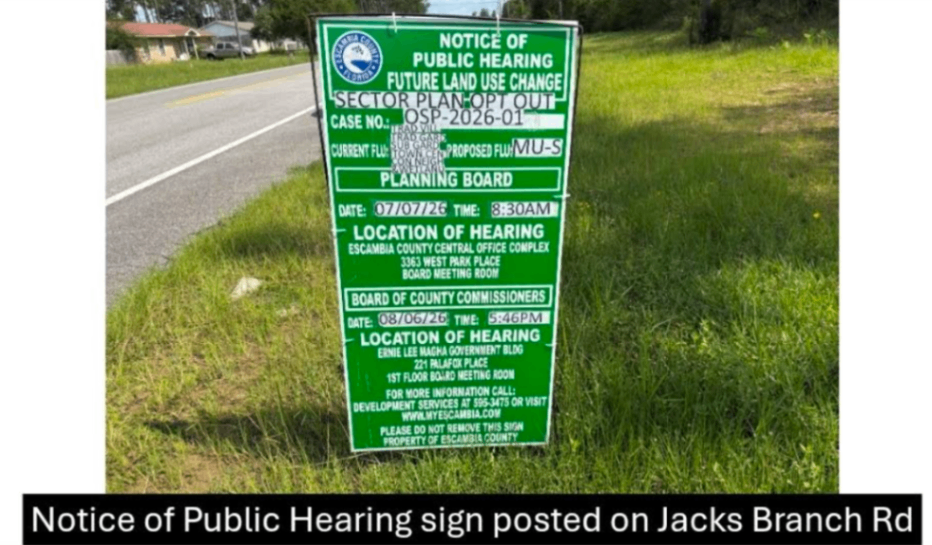
(Photo: Signage is the only notice given to residents who live near an area that may be developed)
Quasi-judicial proceedings should be better announced. These hearings take property rights, rezonings, and water decisions out of the public’s hands if the public doesn’t know how to play by the legal rules.
The Video Problem: If It’s Not Recorded, Did It Happen?
This isn’t a Planning Board issue. Pensacola Economic Development Committee and FloridaWest meetings often have no video. No archive. If you can’t attend at 8:30 a.m., you won’t be able to watch later. You can’t hear what Chris Plate, CEO of Florida West, said. You can’t show your neighbor what happened.
Transparency means a record. Accessibility means on-demand. Escambia has the technology but not the will to use it for key economic, planning, and development boards.
An Undemocratic Process
A quasi-judicial hearing is supposed to be a mini-trial. But trials have discovery, lawyers for both sides, and judges who explain the rules. Here, the public is expected to act as their own attorney at 8:30 a.m. with no notice, no help, and no second chance.
While developers bring lawyers, residents bring questions, and the board votes anyway. On July 7, every item passed despite overwhelming public opposition.
If you don't tell someone to follow regulations, they won't. The same is true for the public. If you don’t tell people how, when, and why to participate, they won’t. And the county can say, “We held a public hearing,” even though the public was at work.
What Would Fix It
· Plain-language agendas with maps, impacts, and deadlines posted 14 days out.
· Evening or Saturday hearings for any quasi-judicial item.
· Staff at sign-in to help residents, with an “other” option.
· Video for all boards, including PEDC and FloridaWest, with timestamps per agenda item.
· End the Board of County Commissioners' gag rule and let residents speak at the commissioner meeting even if they missed the Planning Board meeting.
· Mailed notice for rezonings and opt-outs within 3,000 feet, not just a roadside sign.
· Simplify agenda items into easier language to understand.
· Do not change the sequence of agenda items, and if they are changed, give a disclaimer and 72 hours' notice.
Clarity is the foundation of transparency, and transparency is the foundation of democracy. Yet, Escambia County has built a quasi-judicial system that uses inaccessible meeting times, indecipherable legal language, and procedural traps to suppress citizen input, making the process opaque by design and undemocratic in practice.
1
2

Comments