(OPGOV GLOBAL) – The U.S. Department of Education removed disparate impact regulations from its Title VI enforcement rules Thursday, ending a policy that allowed federal investigators to review whether school policies created unequal effects among students based on race, color, or national origin.
The final rule changes how the department’s Office for Civil Rights evaluates certain discrimination complaints involving federally funded education programs.
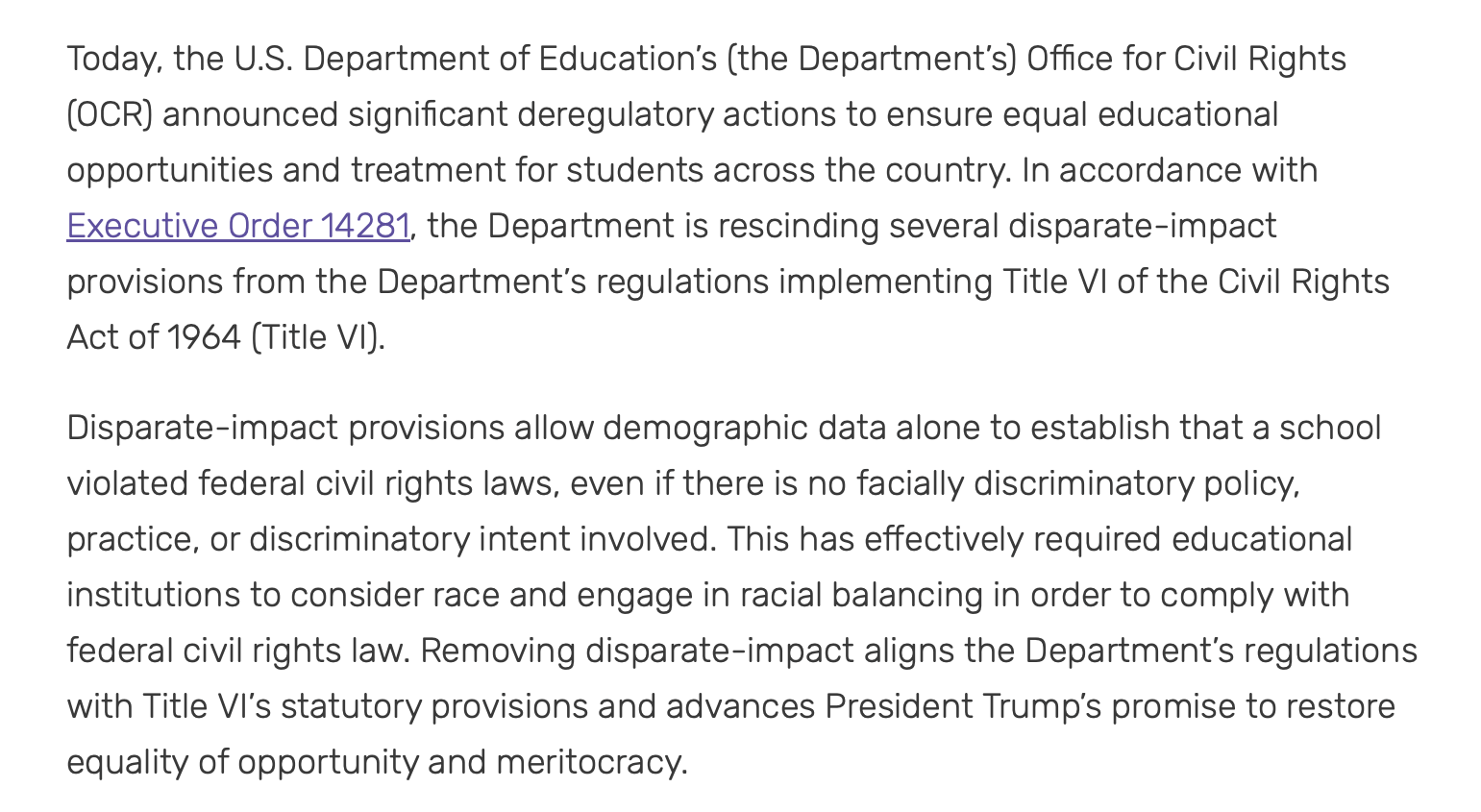
An official press release excerpt outlines the Department of Education’s decision to rescind Title VI disparate impact regulations in accordance with executive action.
Photo Credit: Website/U.S. Department of Education
The Department of Education said the updated regulations align Title VI enforcement with cases involving intentional discrimination rather than policies that result in different outcomes among student groups.
The department said the previous regulations exceeded the authority granted under Title VI and could encourage schools to consider race when developing policies to avoid federal enforcement.
Title VI of the Civil Rights Act of 1964 prohibits discrimination based on race, color, or national origin in programs and institutions that receive federal funding. Under the previous disparate impact standard, federal officials could investigate policies that appeared neutral but disproportionately affected certain groups of students.
The standard was used in reviews involving areas such as school discipline, student placement, and school closures.
Supporters of the policy said it helped identify barriers that may not have been created through intentional discrimination but still resulted in unequal educational opportunities.
The Department of Education said Title VI protections remain in place and that the Office for Civil Rights will continue investigating complaints involving intentional discrimination.
Assistant Secretary for Civil Rights Kimberly Richey said the department’s decision would allow schools to address educational issues without facing enforcement actions based solely on statistical differences among student groups.
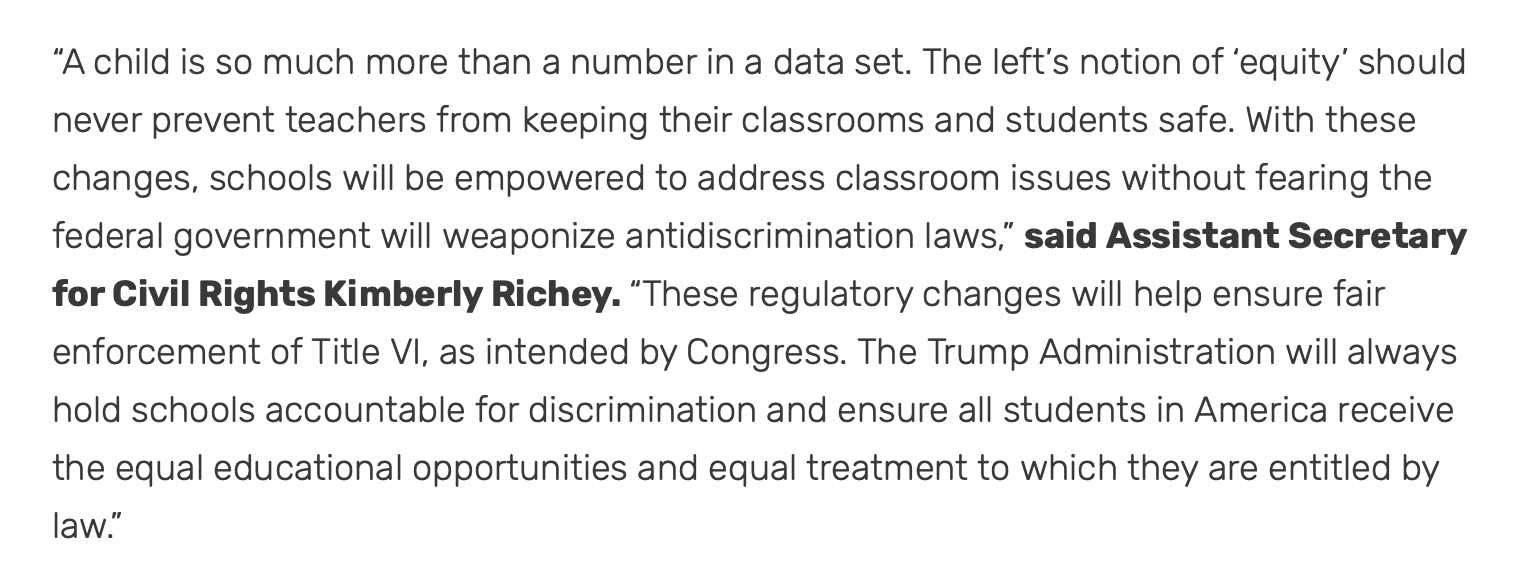
Assistant Secretary for Civil Rights Kimberly Richey emphasizes focusing civil rights enforcement on equal treatment and intentional discrimination.
Photo Credit: Website/U.S. Department of Education
The policy change followed President Donald Trump’s April 2025 executive order, Restoring Equality of Opportunity and Meritocracy, which directed federal agencies to reduce the use of disparate impact analysis in civil rights enforcement.
The order argued that federal enforcement should focus on equal treatment under the law rather than statistical disparities between groups.
The U.S. Department of Justice later issued a similar rule affecting its own Title VI regulations.
In Department of Justice Rule Restores Equal Protection for All Civil Rights Enforcement, the department said the change would remove disparate impact liability from its Title VI regulations while continuing to prohibit intentional discrimination.
Civil rights organizations criticized the Department of Education’s decision, arguing that removing disparate impact protections could make it more difficult to address policies that unintentionally create unequal outcomes.
A coalition of 60 civil rights and education organizations released a joint statement condemning the Department of Education’s final rule, calling for the reinstatement of disparate impact protections under Title VI.
In the statement, the organizations said, “Every student, no matter their background, has the right to pursue their education free from discrimination.”
The coalition also stated, “The disparate impact tool is designed to remove unjustified barriers in education and ensure that all students have an equal opportunity to learn and succeed.”
The groups argued that policies involving school discipline and school closures may appear neutral while disproportionately affecting Black, Latino, Asian American, Pacific Islander and Native American students.
The Education Department’s decision comes as states and communities continue addressing questions surrounding education access, student outcomes and inclusion.
In “New Mexico Battles Low Education Ranking as the New School Year Approaches,” reported by OpGov.News journalist Jorden Hampton, the publication examined New Mexico’s efforts to address education challenges as the state faced concerns surrounding academic performance and national rankings.
The official emblem of the U.S. Department of Education, which oversees federal civil rights compliance across school districts nationwide.
Photo Credit: Website/U.S. Department of Education
The discussion surrounding equal access and inclusion has also continued at the local level.
In “Tippin Park Inclusivity Workshop in August,” reported by OpGov.News journalist Angela Underwood, the publication highlighted a community effort focused on inclusion and accessibility through a planned workshop designed to encourage participation and engagement.
The Department of Education’s rule change represents one of several recent federal actions affecting civil rights enforcement and education policy.
School districts, education leaders and advocacy organizations are expected to continue reviewing how the updated regulations may affect future discrimination investigations and compliance efforts.
As federal agencies continue adjusting civil rights enforcement policies, officials and community groups remain divided over whether the changes provide clearer legal standards or reduce protections for students.
To add to or correct any information in this report, please contact me at victoria.o@lead4earth.org.
Thumbnail Photo Credit: Website/Cato Institute
0
0

Comments