DUBLIN, Calif. — All five Dublin City Council members on Tuesday directed staff to bring back a 45-day moratorium on data centers, even though no one has proposed building one in the city.

Photo Credit: Dublin City Council Meeting (Nov 17, 2026)
Vice Mayor Jean Josey, who asked for the discussion in September, said the point was to act before that changes.
"I think it's a good idea for us to get ahead of it before anybody's beating down our door to put in a data center," Josey said at the Nov. 17 meeting.
No vote was needed. After each council member said they supported a pause, Mayor Sherry Hu asked whether the item required a formal vote and was told the council had provided direction.
The land in question
Josey said she is not worried about the city's older industrial pockets around Sierra Court, Clark Avenue and the west side. Her concern is the open land east of Fallon Road, where the city has planned industrial and commercial uses.
"As other cities are limiting data centers," she said, that "greenfield development looks very attractive to the small and medium-sized data centers."
She said she wants rules in place so the city never has to deny a conditional use permit and get sued for it. She proposed borrowing from Hayward and Oakland, the two Alameda County cities that have already adopted moratoriums and are studying impacts. "Crib their homework," she said.
Josey also noted that her time on the council is ending, and that the pause would give her colleagues time to decide whether to ban data centers outright or regulate them.
What staff found
Community Development Director Amy Million told the council that Dublin's zoning code does not mention data centers. That means one could only open if her office found it consistent with the zoning district and the General Plan. Staff said that would be difficult because power and water demand, generator noise and diesel emissions likely conflict with the plan's policies. Plans for the Fallon East Economic Development Zone also favor uses that create jobs.
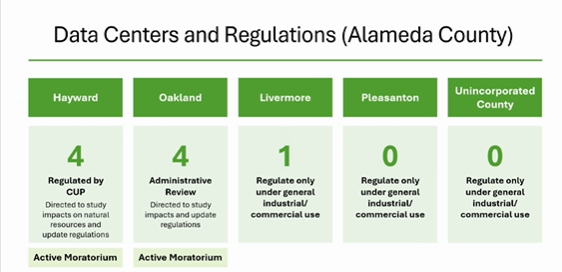
Photo Credit: Dublin City Council Meeting (Nov 17,2026)
Possible benefits include property tax, taxes on equipment and utility franchise fees. The city's finance director said Dublin collects 2% of gross on gas and electric service and received $890,000 in electric franchise fees this past year.
Steve Windsor, the city's chief information security officer, gave a blunter assessment. A 50-megawatt data center typically takes about 40 acres, he said, with buildings of 250,000 to 500,000 square feet. Dublin's water comes from Zone 7 and the Dublin San Ramon Services District and runs short in droughts, so an operator would have to recirculate cooling water, which uses even more power.
Windsor said he would not consider Dublin a great place for one. "Our power is sketchy," he said.
He warned that operators seek agreements putting them ahead of residents when power runs short, and that their backup diesel generators are loud.
Council concerns
Councilmember Kashef Qaadri listed electricity demand, water use and noise. "If a company is going to come and consume enormous amounts of our local resources, I feel our city, our community should receive meaningful economic and public benefits," he said. He also warned staff that newer AI facilities pack equipment more densely than the acreage estimates suggest.
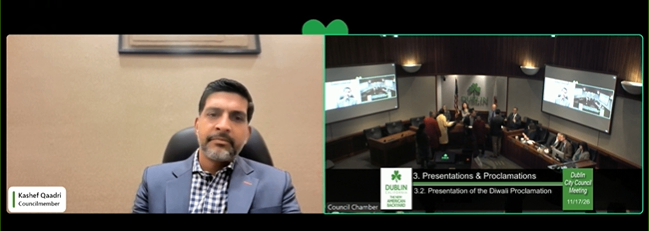
Photo Credit: Dublin City Council Meeting (Nov 17,2026)
Councilmember John Morada, who disclosed that he sits on the board of Ava Community Energy, said a friend who manages data center relationships in Loudoun County, Virginia, snickered at the idea of a 20-megawatt facility in Dublin when operators there build at 100 megawatts. Million said the Bay Area's scarce, expensive land is why sprawling facilities go elsewhere.
Hu said she supported the pause over energy, water, noise and jobs. "They wouldn't be able to create as many jobs as if we support other industries," she said.
Josey said several residents emailed the council before the meeting, one asking if members were "out of your minds" for considering data centers. None of them spoke at the meeting, which drew no public comment on the item.
What comes next
State law lets a city adopt an initial 45-day moratorium and extend it to a maximum of two years. Staff will draft the 45-day ordinance and return it to the council for a vote.
0
0

Comments