Editors Note : On Oct 12, 2026 Pleasanton Weekly conducted Candidate forum for candidates running for Dublin City Council and Mayor. This article currently covers the Mayor forum for council candidates it will be available soon.
Dublin’s mayoral candidates agreed that residents deserve safer streets, a stronger local economy, and a Downtown worth visiting. The disagreement was over whether City Hall is delivering—or simply explaining why residents are still waiting.
At the forum, Mayor Sherry Hu defended her record, Councilmember Michael McCorriston emphasized his financial experience, and challenger Kiran Mohammad argued that the city needs better follow-through. Their answers offered three different accounts of the same city.
A surplus today, a problem ahead
The sharpest exchange concerned Dublin’s finances.
Hu pointed to a reported $36 million General Fund surplus last year and a projected $20 million surplus this year. She argued that the city remains financially strong and opposed the proposed hotel-tax increase because hotels are still struggling.
McCorriston pushed back on how the numbers were being discussed.
“We’re mixing in the capital budget with the operating surplus,” he said, emphasizing that the concern is a future structural operating deficit. He defended the unsuccessful hotel-tax proposal as a way to replace declining development-related revenue.
That distinction matters. But McCorriston’s own introduction—40 years in corporate finance and six years on the Council—also invites a question: what has that experience changed about Dublin’s long-term financial position? His answer emphasized planning ahead, scrutinizing spending, and finding revenue. Voters must decide whether that is a convincing next step or an argument they should have heard acted on sooner.
Mohammad described the situation differently: “Dublin isn’t broke, it’s drifting.” She argued that the city should reassess existing projects and use available savings before asking for more money. Her figures and proposed funding sources deserve verification, but her argument was clear: examine priorities before increasing revenue.
Downtown: planning is not the same as delivery
Asked when Dublin would finally have a true Downtown, Hu acknowledged the gap between planning and visible results.
“Nothing has built on the ground,” she said, while pointing to a planning framework, reviewed proposals, and $45 million reserved for the project. McCorriston called for more city control and community input into the design.
Both described work still to come. Neither offered a firm delivery date in that exchange.
Mohammad focused instead on vacant buildings, commercial development keeping pace with housing, and temporary uses such as food carts in empty parking lots. Her proposals were not a construction schedule either, but they shifted the discussion toward what could happen while the larger project remains unresolved.
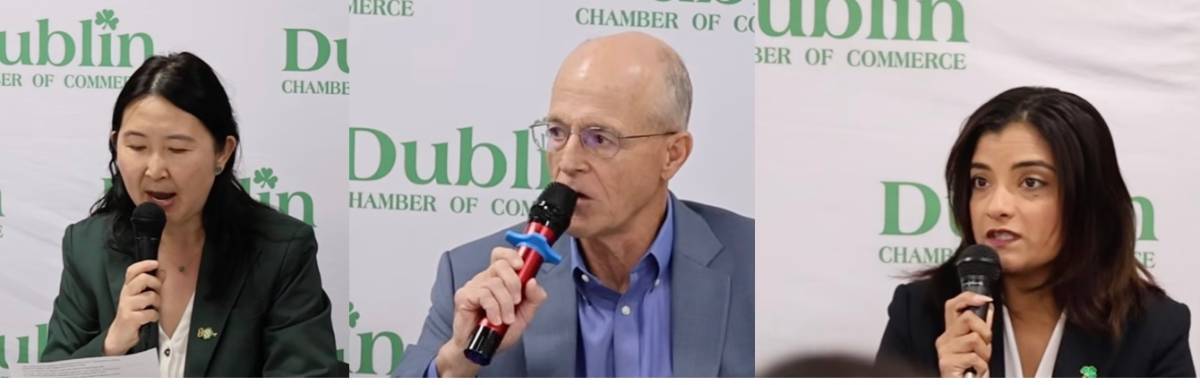
Credit : OpGov.News Team covering the forum.
This forum is made available for everyone here.
The distinction was straightforward: Hu and McCorriston explained the development process; Mohammad challenged what residents are getting from it.
Mohammad offered a challenge—not a guarantee
Mohammad’s most specific accountability proposal was a public scorecard showing every city goal met or missed, with an explanation. She also proposed quarterly district town halls and plain-language summaries of major votes.
Those are commitments voters could measure. They are not proof that she can deliver everything she described. Her budget assumptions, transportation ideas, and ability to move projects through the Council deserve the same scrutiny applied to the incumbents.
But Hu and McCorriston face a different burden. They are not just explaining what they would do. They are defending what has happened while they have held office.
The forum did not settle who should become mayor. It did clarify the question voters should ask: when candidates promise results, what will residents actually see—and when?
0
0

Comments