
Photo Credit: YouTube
(SAN RAMON, CA.) – Plans for a 45-unit townhome development faced pushback during a June 2 San Ramon Planning Commission meeting, where concerns were voiced over environmental impacts and the effects on local businesses.
Developing this lot comes with immediate complications. The biggest issue is managing stormwater runoff on a property limited by a mandatory 100-foot creek setback. With permanent structures banned in that zone, engineers are left trying to find alternative solutions.
A traditional, large drain basin won't work because the site is too cramped. Instead, the developer plans to break up the water management across the property using smaller rain gardens, grassy ditches, and porous pavement. Once they run out of surface room, the only option left is to build underground storage tanks. These underground systems add a lot of extra cost to the project, but it’s the only way to make the small site work.
That’s the main reason this lot has stayed vacant for a decade. A project was approved here back in 2016, but it sat untouched because costs changed. In 2023, the development team tried to turn the site into a 100 percent affordable housing project, but they ran into a $20 million funding gap. Local rents simply couldn’t keep up with the soaring cost of construction. Ultimately, getting city approval is only the first step and if the market math doesn't line up, nothing gets built.
Over the years, the project completely changed directions, dropping the original retail plans to become strictly residential. While city commissioners and neighbors often push for live-work spaces to keep a commercial feel, forcing retail onto a cramped lot creates a logistical nightmare for parking and deliveries.
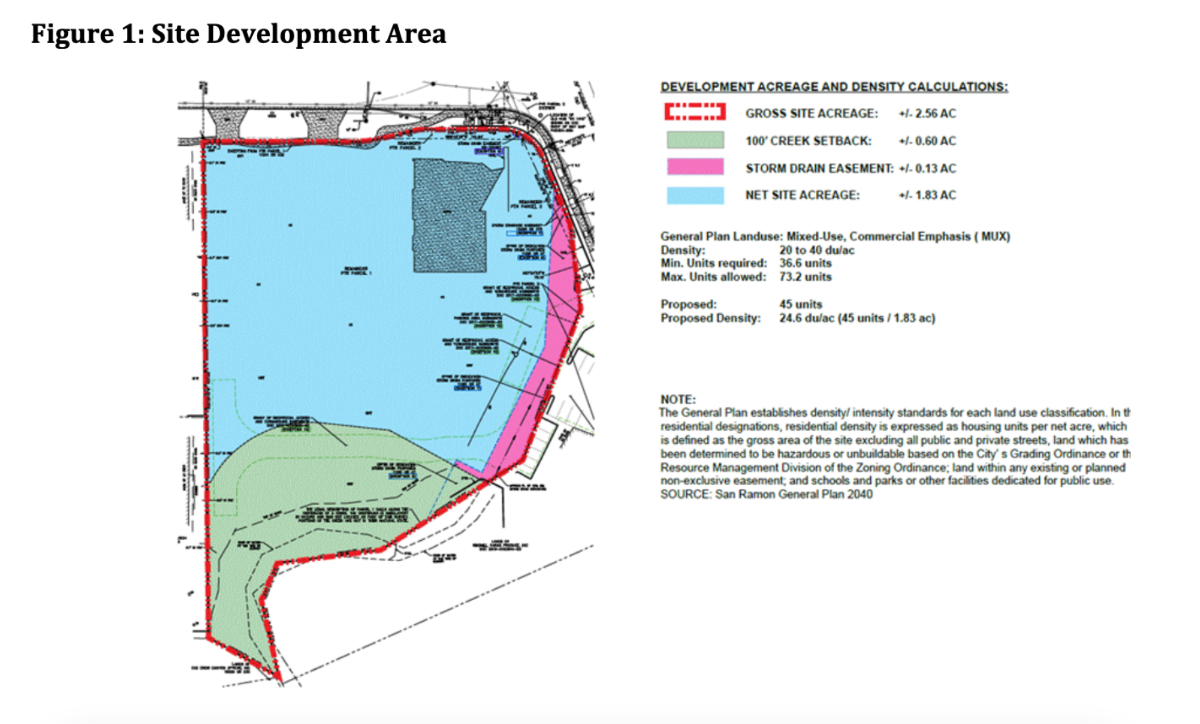
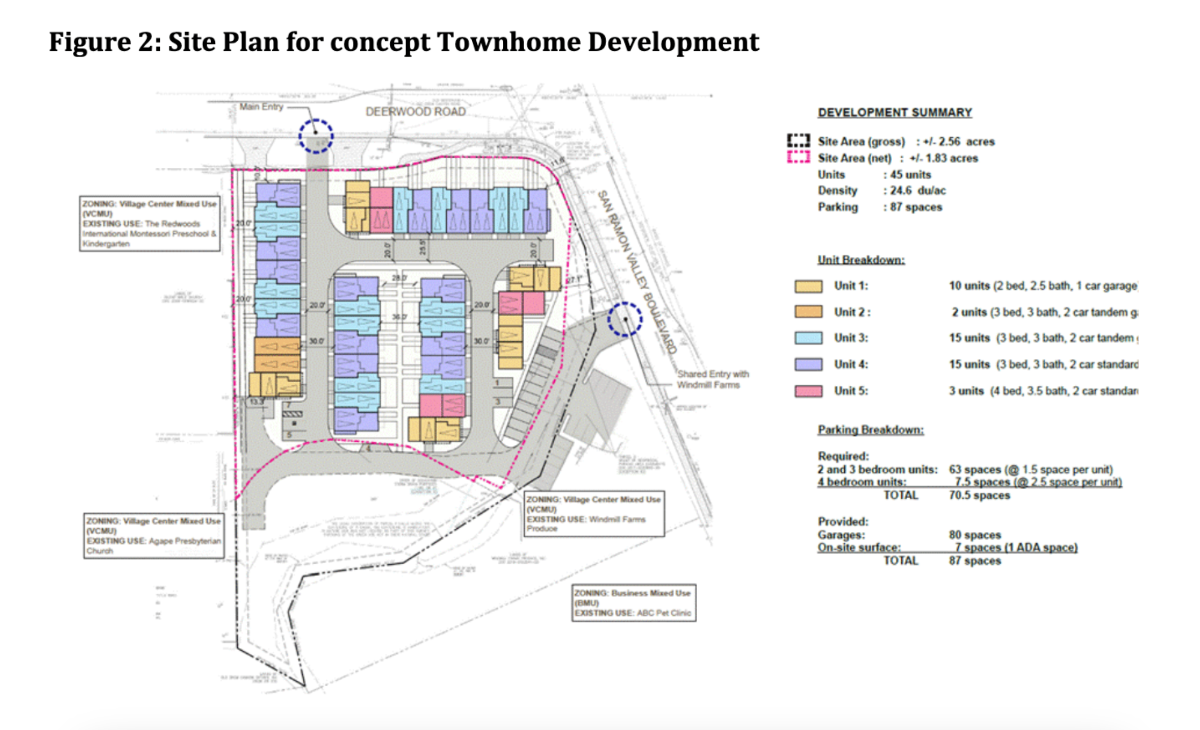

Photo Credit: City of San Ramon Planning Commission Agenda
Under the city's plan, the required density is calculated using the full 2.5-acre lot. Because the creek setback cuts the buildable land down to 1.8 acres, those 45 units have to be closer together, pushing the real density up to nearly 38 units per acre on the usable ground. Forcing retail into that space would mean adding commercial parking that won't fit. On top of that, affordable housing lenders typically avoid dealing with mixed-use retail components. Instead, the developer is offering a middle ground, townhomes with flexible ground-floor spaces that buyers can use as home offices.
The debate showed a major conflict between local rules and state law. The city’s General Plan calculates density using net acreage, which subtracts the creek, while the San Ramon Village Specific Plan uses gross acreage, counting the creek zone. Because the creek takes up more than three-quarters of an acre, forcing the developer to use the specific plan's definition would cut the unit count so much that the project would lose money before it even started.
The Housing Accountability Act might let developers use favorable density rules during conflicts, but environmental regulations still apply. City staff verified that state laws don't override local rules in this case, so the 100-foot creek buffer is still required.
As summarized in the OpGov.News summary, "the project site, a designated housing opportunity site, was previously approved in 2016 for 169 units but was never built due to economic factors. The current proposal is for 45 townhome units, which represents a significant reduction in housing density (124 fewer units) compared to the prior approval, raising critical concerns about the city's housing goals and tax revenue." Now, planners are going to have to rezone other neighborhoods to hit their legal housing targets. Another problem brought up is that the creek right next to the property is home to the protected California red-legged frog.
During public comment, Windmill Farms accountant Kathy Edwards Riker warned that the proposed shared driveway agreement is a major safety hazard. “We see a lot of problems now if you have a car coming in and a car going out,” she said. “Now, if we’re going to have 45 units with families coming in and out, there’s going to be a lot of times when people are going to be coming and going out of that driveway on San Ramon Valley Boulevard.” She added a blunt warning, “I just feel that it’s an accident waiting to happen.”
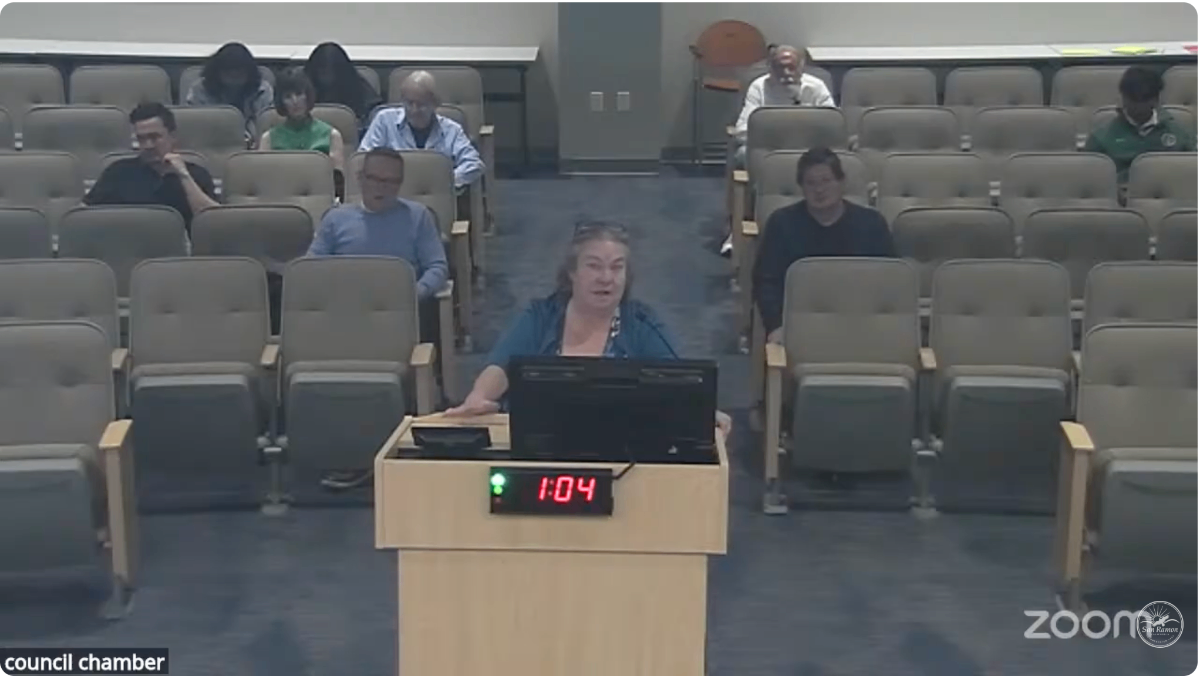
Photo Credit: YouTube
The Planning Commission wrapped up by setting clear expectations for the upcoming formal application. While commissioners acknowledged that state law gives the developer the right to skip the retail space and build strictly housing, they challenged the team to deliver a design that does justice to such a visible neighborhood gateway.
The commission pushed for a classic residential architectural style over a flat-roofed corporate look. To help ease the city's housing deficit, they also urged the developer to replace several large three-bedroom layouts with smaller two-bedroom units, increasing the total number of homes on the site.
Instead of leaving the 100-foot creek buffer as empty dirt, commissioners want to see it used. They suggested adding walking paths, seating, and a public easement to hook it up to the city's trail system. On the street side, they urged the team to rethink the corner. Given the busy In-N-Out right across the street, they pitched adding tiny retail spaces, like a record store, a small bike shop, or live-work units, to actually get people engaging with the space.
While city staff works through the exact parking constraints and density math for the final report, the developer has to figure out how to handle the community's concerns on traffic, architecture, and the creek habitat. Once they submit an official application, we'll finally see if this vacant lot actually gets transformed.
If you have any questions or comments, please email me at kathleen.p@lead4earth.org or comment below.
0
0

Comments