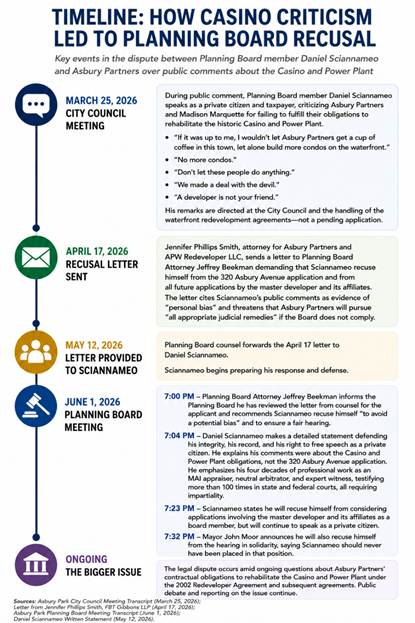
(ASBURY PARK, N.J.) — A Planning Board member's public criticism of Asbury Park's long-delayed Casino and Power Plant redevelopment escalated into a legal confrontation that ultimately led Daniel Sciannameo to recuse himself from future applications involving Asbury Partners and its affiliated developers.
The dispute, documented through City Council transcripts, a formal legal demand letter, Planning Board proceedings, and Sciannameo's written response, offers a rare glimpse into the tension between a public official's First Amendment rights as a private citizen and the impartiality expected of members serving in quasi-judicial roles.
Although Sciannameo's recusal occurred during the Planning Board's June 1 meeting, the issue has taken on renewed significance as OpGov.News continues its investigation into the competing legal interpretations of Asbury Partners' contractual obligations to rehabilitate the Casino and Power Plant under the City's waterfront redevelopment agreements.
(Image Credit: OpGov.News graphic.)
Criticism Focused on Historic Redevelopment Obligations
The controversy traces back to the March 25 Asbury Park City Council meeting.
Speaking during the public comment portion of the meeting, Sciannameo identified himself not as a Planning Board member, but as a private citizen and longtime taxpayer frustrated by what he viewed as the City's failure to hold Asbury Partners accountable for restoring the Casino and Power Plant.
His remarks focused on what he believed was the City's failure to enforce redevelopment obligations involving the historic Casino and Power Plant—not the 320 Asbury Avenue redevelopment application that later became the subject of the recusal request.
"All we wanted was for our historic buildings to be rehabilitated," Sciannameo told the City Council. "Twenty-four years later they are still not done."
He argued that while new condominium projects had continued throughout the Waterfront Redevelopment Area, the redevelopment obligations involving the Casino and Power Plant remained unresolved.
Sciannameo accused the developers of "running the clock out" before delivering the comments that would later become the focus of a legal challenge.
"If it was up to me, I wouldn't let Asbury Partners get a cup of coffee in this town, let alone build more condos on the waterfront," he said.
He also stated:
"No more condos."
"Don't let these people do anything."
"We made a deal with the devil."
"A developer is not your friend."
Developer Seeks Recusal
On April 17, Jennifer Phillips Smith, a partner with FBT Gibbons LLP representing Asbury Partners and APW Redeveloper LLC, sent a formal letter to Planning Board Attorney Jeffrey Beekman demanding Sciannameo's recusal.
The letter argued Sciannameo's public comments demonstrated "a personal bias against the Master Developer and against any projects associated with the Master Developer within the Waterfront Redevelopment Area."
Smith cited multiple New Jersey court decisions addressing planning board impartiality and argued Sciannameo had publicly announced a predetermined position against future development by Asbury Partners.
"The issue here is not simply that Mr. Sciannameo dislikes our clients' project," Smith wrote. "Rather, it is that he has announced, publicly and in advance, that he would deny the Applicant further development approvals as a matter of principle."
The letter demanded Sciannameo recuse himself not only from the pending 320 Asbury Avenue application but also from future applications involving the master developer and its affiliates. It further warned that if the Planning Board declined to require his recusal, the developer would pursue judicial relief.
Sciannameo: "I Merely Recited Facts and the Truth"
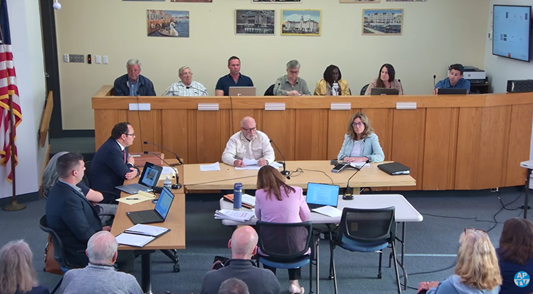
The dispute came to a head during the June 1 Planning Board meeting, where Beekman informed members that he had reviewed the developer's letter and recommended Sciannameo recuse himself "to avoid a potential bias" and ensure a fair hearing. Beekman also emphasized that Sciannameo retained every right to participate in the meeting as a member of the public.
(Image of June 1 Planning Board Meeting. Credit: APTV YouTube.com.)
Before stepping aside, Sciannameo delivered an extensive statement defending both his professional integrity and his constitutional right to speak as a private citizen.
He said the recusal request stemmed from comments he made "as a private citizen, and an Asbury Park taxpayer for 22 years" regarding what he believed was Asbury Partners' and Madison Marquette's failure to meet their obligations to restore the City's historic boardwalk buildings.
"My comments were clearly made to the City Council and how they should deal with Asbury Partners and Madison Marquette's failure to meet their obligations under the waterfront redevelopment agreement within the scope of the law," Sciannameo wrote in a prepared statement. "I merely recited facts and the truth, and that seems to be very unpopular today."
He characterized the recusal demand as an example of "powerful entities using bullying tactics to squash free speech they do not like."
Four Decades Built on Impartiality
Sciannameo also rejected the allegation that his public comments demonstrated an inability to fairly evaluate development applications.
He noted that, during his tenure on the Planning Board, he had not voted against any project submitted by Asbury Partners or its affiliated entities.
To support his position, Sciannameo described his four-decade career as a real estate valuation expert whose profession depends upon impartiality.
He said he holds the prestigious MAI designation from the Appraisal Institute, is licensed as a Certified General Real Estate Appraiser in both New York and New Jersey, serves on the roster of neutrals for the American Arbitration Association, and has testified as an expert witness in more than 100 proceedings.
According to Sciannameo, he has worked on numerous high-profile matters, including the Hudson Yards redevelopment, Atlantic Yards, the Second Avenue Subway, the Gateway Tunnel Project, and valuation work involving the World Trade Center following the September 11 attacks.
"My career for four decades has been dependent upon my unbiased actions and the recognition of the real estate and legal industry of my competence and integrity," Sciannameo wrote.
"I am quite capable of expressing my personal opinions as a private citizen and taxpayer... and at the same time to fairly fulfill my obligations under the Municipal Land Use Law... as a Planning Board member."
Despite defending his ability to remain impartial, Sciannameo ultimately agreed to recuse himself. He said his decision was driven not by an admission of bias but by the appearance of bias created after the developer threatened litigation.
"I understand that it is not only actual bias, but the appearance of such that may matter," Sciannameo wrote. "And since Asbury Partners and its counsel has now unfortunately raised the ugly specter of such bias and has threatened to sue this board if I do not recuse myself, I will agree to do so to spare this board and my fellow members such unnecessary drama."
He concluded by saying he would continue participating in City affairs as "a private citizen and taxpayer."
The recusal prompted an unusual response from Mayor John Moor, who also serves on the Planning Board. Moor said he had researched the issue and was unable to identify another instance in which a planning board member had been disqualified solely for making general comments during a City Council meeting.
"I've known Dan for years. He's a man of tremendous honesty and integrity," Moor said. "He like every other citizen of Asbury Park should be free to express their opinion on matters in our city."
Moor then announced he would also recuse himself from the hearing in solidarity with Sciannameo.
A Broader Debate
The recusal dispute unfolded as questions continue over Asbury Partners' obligations to rehabilitate the Casino and Power Plant under the City's redevelopment agreements.
In recent weeks, OpGov.News has reported on conflicting legal opinions regarding the 2002 Redeveloper Agreement, the 2006 Dispute Resolution Agreement, the 2007 Estoppel and Consent Certificate, and related documents governing the waterfront redevelopment.
The dispute over Sciannameo's comments unfolded while retired New Jersey Supreme Court Justice Lee Solomon was separately evaluating the City's legal options regarding the Casino redevelopment agreements—a review that has since produced conflicting interpretations among attorneys representing the City, residents, and the developer.
Whether the City can compel completion of the historic rehabilitation—or declare a default under those agreements—remains one of the central legal questions in Asbury Park's ongoing redevelopment debate.
OpGov.News reached out to Jennifer Phillips Smith seeking comment regarding the April 17 recusal letter, the legal basis for the recusal request, and whether Asbury Partners continues to believe Sciannameo should be disqualified from future applications involving the master developer and its affiliates. Any response received will be published in a follow-up report.
If you’d like to add or correct anything in this report, feel free to reach out to me or leave a comment below. If you have any Asbury Park story tips or ideas, please reach out to Sarah Denos at sarahkdenos@gmail.com.
0
0

Comments