From rural Georgia to upstate New York, residents across the political spectrum are blocking data centers not just over water and power, but over who pays and who profits.
The Pattern: Public Pays, Tech Billionaires Gain
In the first quarter of 2026, nearly 75 data-center projects worth $130 billion were blocked or delayed by local opposition, according to Data Center Watch. Between May 2024 and June 2025, at least 36 U.S. data center projects were delayed or blocked, disrupting $162 billion in investment. The pushback is nonpartisan because the funding model is the same: public dollars, private profits, no vote.
Ratepayers Cover the Grid Upgrades While Tech Companies Get the Power
The deals aren’t just secret. Electric bills subsidize them.
Utah: Rocky Mountain Power asked state regulators to make ratepayers cover $3.2 billion in transmission upgrades for a Meta data center. The Public Service Commission rejected it in 2025, saying Meta should pay its own costs. If approved, every Utah household would have seen higher bills for Meta’s servers.
Ohio: American Electric Power proposed a data center tariff that would have left residential and small-business customers covering 85% of transmission costs for new data centers. State lawmakers intervened after public outcry. AEP is now in settlement talks after the Public Utilities Commission of Ohio paused the plan.
New York: In Genesee County, residents fighting a 500-megawatt data center at STAMP say the same thing: “It’s going to draw power, and that power is going to be paid for by us”. Stream Data Centers says it will pay for infrastructure. Residents don’t believe it because the same promise was made on the last project before approvals were rescinded.
Utah: Rocky Mountain Power tried to make ratepayers cover $3.2 billion in grid upgrades for a Meta data center. The utility commission rejected it. In Ohio, AEP’s proposed data center tariffs would have left consumers covering 85% of transmission costs. Lawmakers intervened. That fear is now being introduced into federal policy. Senators Josh Hawley, of Missouri, and Richard Blumenthal, of Connecticut, introduced legislation to protect ratepayers from energy bill spikes tied to data centers. The National Governors Association and the National Association of Regulatory Utility Commissioners both adopted resolutions to shield consumers from data center grid costs.
Quasi-Public Boards Spend Tax Dollars Without Public Notice
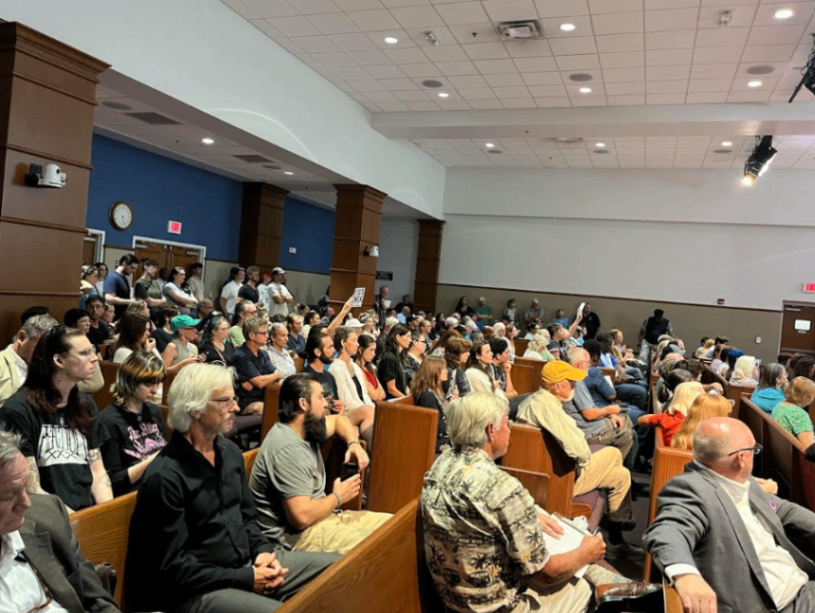
(Photo: Escambia County Board of County Commissioners' June meeting that drew out dozens of residents protesting a local data center)
Data center deals are often brokered by economic development organizations that blend public and private money and operate outside open-meeting laws.
Example 1: FloridaWest, Escambia County, FL.
Feb. 1, 2026 emails show FloridaWest CEO Chris Plate coordinating with Commissioner Mike Kohler and Nanda Bhagi, President of Tesla Group, on a “Smart City initiative” with an AI data center. FloridaWest is a “nonprofit” that receives public funds through the Pensacola-Escambia Promotion and Development Commission to do development to help build the community. In a later statement, Kohler said that if there’s an NDA, it’s standard practice to keep the public in the dark until the deal is signed.
Example 2: STAMP, Genesee County, N.Y.
The $19.5 billion Stream data center is sited in the Science & Technology Advanced Manufacturing Park. The Genesee County Economic Development Center, a public-benefit corporation, runs STAMP. A prior data center on the same site had its approvals rescinded after the Tonawanda Seneca Nation and Sierra Club sued, alleging it hadn’t undergone required environmental reviews. Local authorities came back later with a proposal twice as big.
Example 3: Project Sail, Louisiana
Meta’s $10 billion data center in Richland Parish will receive 30 years of sales tax exemptions and a state electricity rate that is 27% lower than the national average. Louisiana Economic Development negotiated the deal before local residents knew the project existed. Entergy Louisiana is raising rates on all customers to cover transmission upgrades for Meta and other hyperscalers.
NDAs Hide the Deals Until it’s Too Late
In Beaver Dam, Wisconsin, a $1 billion Meta data center project was initially developed in secret using nondisclosure agreements. The Beaver Dam Area Development Corp. signed an NDA with a shell company named Balloonist LLC, concealing Meta's identity and the data center's true scope for over a year. This $ 1 billion data center promises only 100 jobs once operational in 2027. In Caledonia, Wisconsin, Microsoft planned a multi-billion-dollar AI data center, brokered through the Racine County Economic Development Corporation and Milwaukee, both public-private development groups. The project was negotiated under nondisclosure agreements. Residents didn’t learn details until the village board was set to vote on rezoning and infrastructure agreements.
How Many Places Are Saying No
State level: Since January, fifteen U.S. states have introduced legislative proposals to pause or halt new data center construction. Eleven states are considering restrictions or bans.
Local level: As of June 2026, there were 78 measures covering active bans, proposed restrictions, expired pauses, and exploratory discussions. Michigan has close to 50 municipal or county-level bans. At least 188 local opposition groups now operate across 40 states.
The cross-party result:
The fights unite groups who agree on little else: The Tonawanda Seneca Nation and Sierra Club suing in New York. Bernie Sanders and AOC are proposing a federal halt. Rural Georgia counties are enacting bans that remain in effect until March 2027.
The common thread: Residents didn’t vote to subsidize data centers for tech billionaires. But they’re still being asked to pay for them. Data centers don’t benefit the working class in any way. That’s why Socialists, Republicans, Libertarians, Independents, Communists, Democrats, lawmakers, farmers, moms, journalists and any other type of person you could think of agree. They don’t want data centers.
0
0

Comments