Danville will not lose its small-town character through one dramatic act. It will lose it through a succession of approvals in which elected officials acknowledge the consequences, invoke legal constraints and vote yes anyway.
The Community Presbyterian Church Legacy Project is the latest—and one of the clearest—examples.
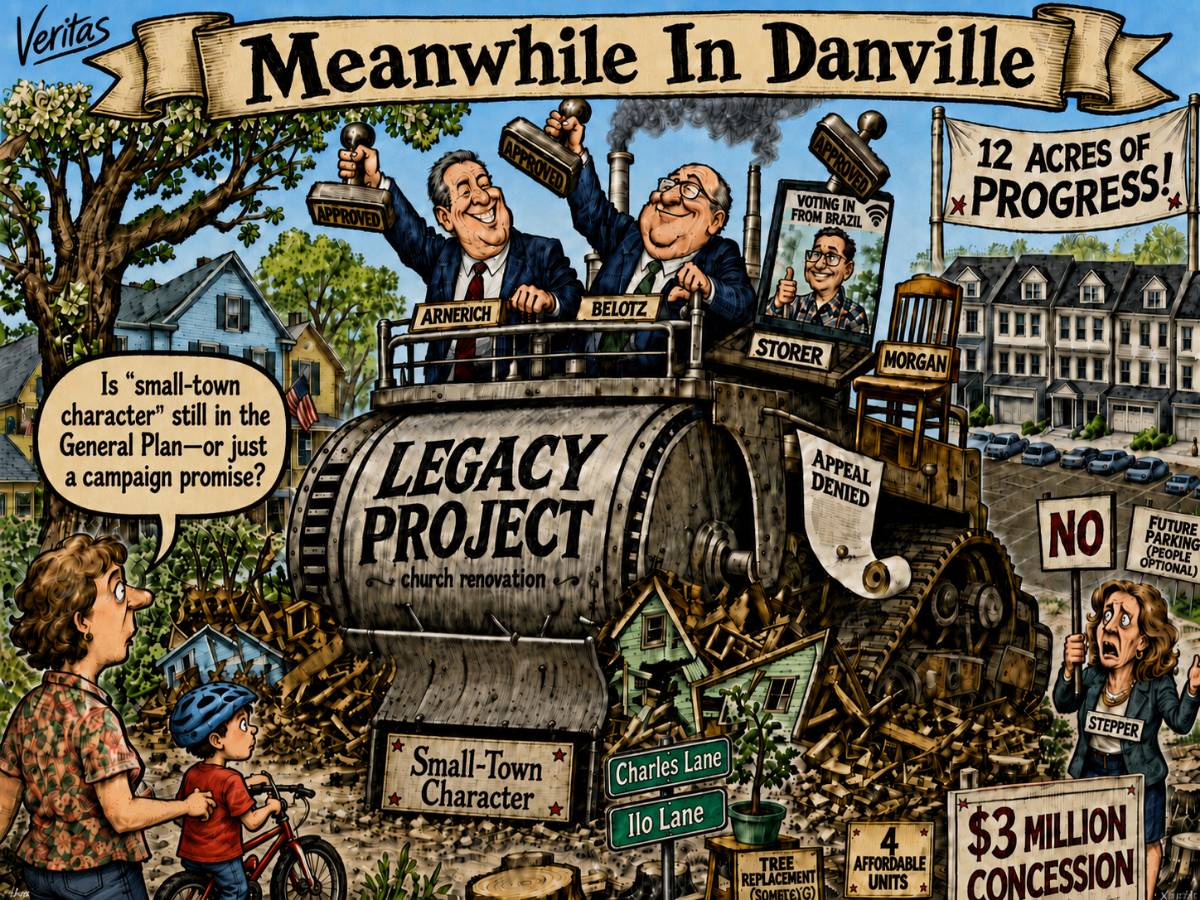
Editorial cartoon: “Meanwhile in Danville.” by Veritas
The proposal covers approximately 12 acres near West El Pintado, Ilo Lane and Charles Lane. It would demolish 21 existing residences and replace them with 49 three-story townhouses containing 19 attached accessory dwelling units. It also includes a new 26,866-square-foot youth and ministry building, a sanctuary and lobby expansion, 225 additional sanctuary seats, a pavilion, sports facilities and substantially expanded parking.
When completed, the expanded church complex would encompass approximately 125,000 square feet, and the project would remove 269 out of 303 site’s inventoried trees.
Calling this a church renovation is like calling a bulldozer a gardening tool.
This is a sweeping residential, institutional and recreational redevelopment that will permanently alter the streets, traffic patterns, tree canopy and character of an established Danville neighborhood. Community
Presbyterian Church proposed it. Its development team designed it.
On July 21, 2026 - Newell Arnerich, Mark Belotz and Robert Storer approved it. Karen Stepper
voted no. Renee Morgan was absent.
Those names matter because responsibility should not disappear behind the collective phrase “the Town Council.” The Council was the final local decision-maker, and the members who voted yes must answer for what they approved.
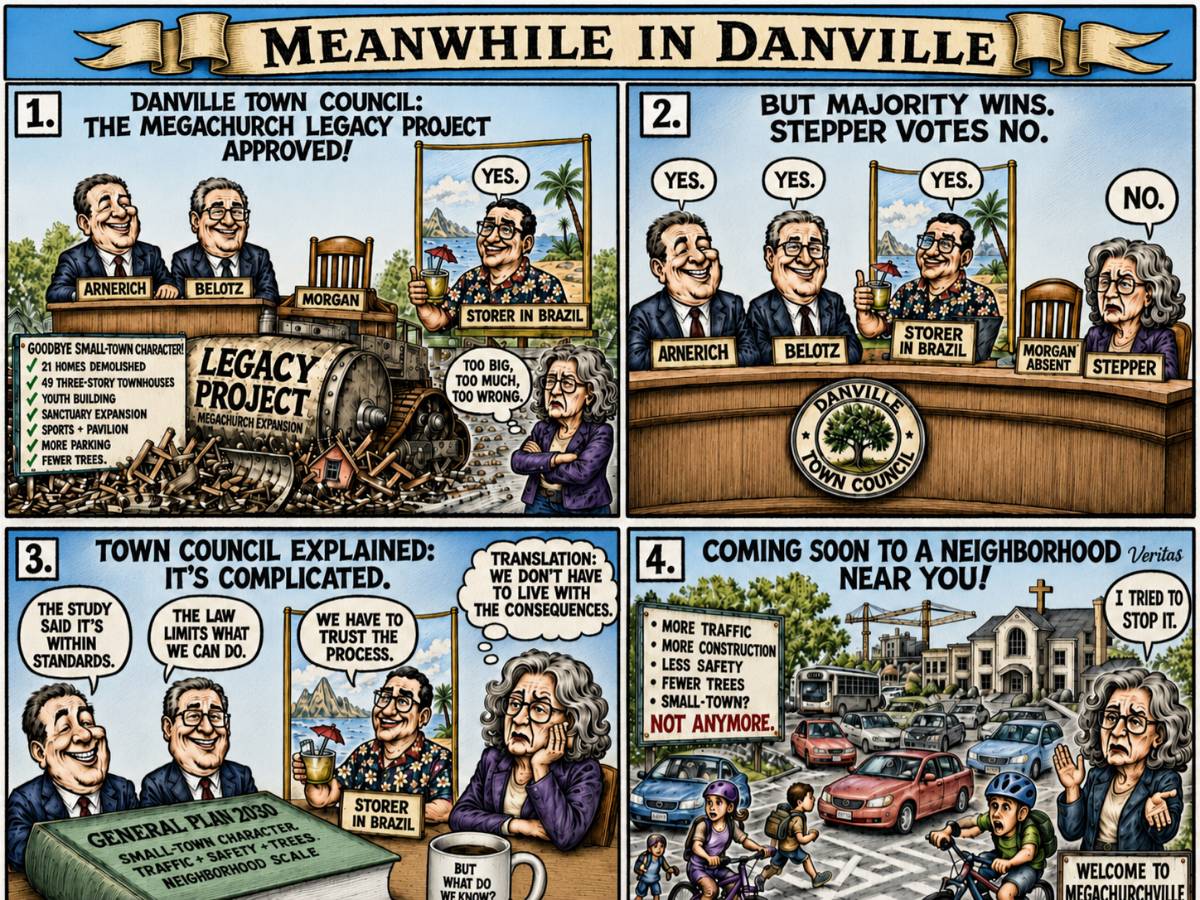
Comic strip depicting the approval by Veritas
The Final Vote
Resolution No. 66-2026 denied the residents’ appeal and upheld the Planning Commission’s approval of Development Plan DEV25-0013, Major Subdivision SUB25-0011 and Tree Removal Request TR26-0020.
It passed 3–1, with Arnerich, Belotz and Storer voting yes, Stepper voting no and Morgan absent.
That vote authorized the demolition of 21 homes, 68 new dwellings, a substantially expanded church complex, sports and youth facilities, expanded parking, the removal of hundreds of trees and substantially more activity on narrow neighborhood streets.
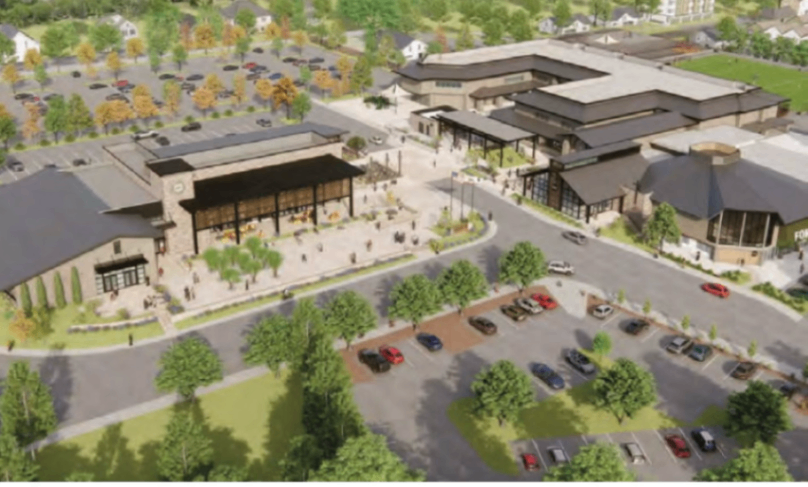
Project rendering of the expanded church complex.
The project will not remain a line on a planning map. Residents will experience it through additional vehicles, new buildings, lost homes, removed trees, prolonged construction and a permanent change in neighborhood scale.
West El Pintado, Ilo Lane and Charles Lane are constrained residential streets. Adding traffic from 68 dwellings, an expanded sanctuary, a major youth building, sports programs, employees, deliveries and large events is not a minor circulation adjustment.
It is a fundamental change in how those streets will function.
Vehicle Capacity Is Not Child Safety
The most serious issue is whether the surrounding streets can safely absorb the additional traffic, especially during school arrival and dismissal.
Children cross between parked vehicles. Parents queue and make hurried turns. Bicyclists and e-bike riders share the same constrained streets.
A traffic study may determine that cars can move through an intersection without unacceptable delay.
That is not the same as determining whether a child can walk or bicycle home safely.
Vehicle capacity is not child safety.
The Legacy Project will add hundreds of daily vehicle trips to a constrained neighborhood already serving a school. Yet the traffic study does not estimate how that added traffic could affect collisions or injuries, nor does it separately evaluate the risks posed by teenage drivers using the new youth center.
Children will continue navigating parent queues, parked cars, turning vehicles, bicycles and e-bikes while school, church, residential, recreational and youth-center traffic overlap. Those concerns are heightened by the limited or missing sidewalks along West El Pintado, Ilo Lane and Charles Lane.
Before approving the project, the Council should have required a comprehensive school-hour and neighborhood safety analysis addressing queues, curbside loading, illegal stopping, sight distance, crossings, bicycle routes, emergency access and traffic from overlapping uses.
Residents did not simply oppose the Legacy Project. They identified specific weaknesses in the traffic analysis and proposed practical safeguards. They warned that regional traffic averages could mask congestion and queuing on West El Pintado, Ilo Lane and Charles Lane, and questioned whether the
study adequately considered overlapping school, church, youth-program and special-event traffic.
They asked for on-site pickup and drop-off queuing, continuous sidewalks and lighting, emergency-access analysis and enforceable construction-management rules.
These were not unreasonable demands or an attempt to stop all development. They were requests to make a massive project safer and more compatible with an established neighborhood.
Instead, the approval refers to sidewalks and accessible curb ramps only “as required by the City Engineer,” without clearly guaranteeing continuous pedestrian facilities.
Essential safety protections should have been enforceable conditions of approval, not matters left for later review.
Homes, Parking and the Meaning of Housing
The project receives protections available to a housing development while proposing to demolish 21 existing residences. Some would be removed partly to accommodate expanded parking.
The youth and ministry building would displace approximately 122 parking spaces, while the sanctuary expansion and additional activities would create more demand. The proposal therefore adds approximately 206 spaces, primarily through the demolition of residences along Ilo Lane.
Only in contemporary land-use politics can homes be bulldozed for parking and the result still be promoted as a housing achievement.
The relevant question is not whether a church may expand or whether Danville should accommodate housing. It is whether this particular project was scaled, designed and conditioned to respect the neighborhood.
Could the institutional expansion have been smaller? Could shared, off-site or structured parking have preserved more homes? Could stronger pedestrian protections and greater tree preservation have been required?
These are planning questions, not anti-church or anti-housing questions.
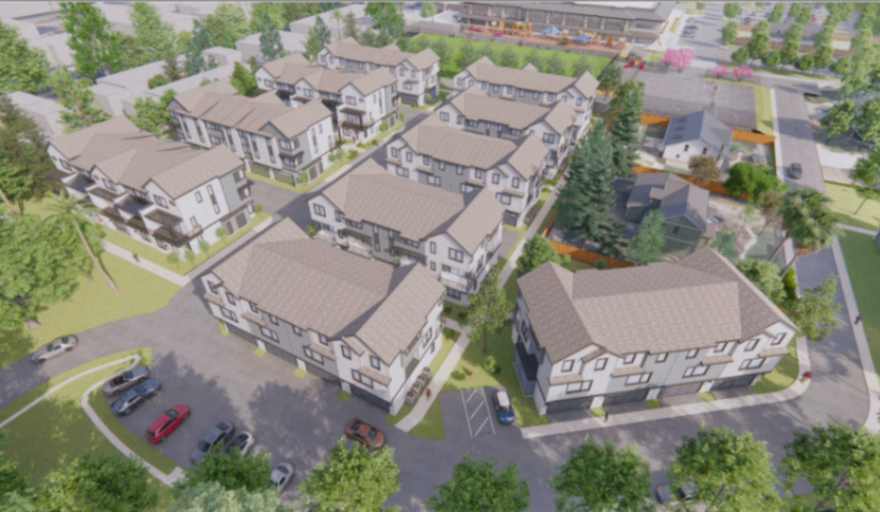
Project rendering of the proposed townhouse component.
A “Legacy” Measured in Tree Stumps
The site contains 303 inventoried trees, and the project proposes removing 269 of them, including 47 protected trees. Only 18 protected trees would remain.
Replacement trees are promised, but a sapling is not a mature valley oak in a smaller container. It does not provide the same canopy, habitat, shade, screening or neighborhood identity.
A planting formula can replace a number on a spreadsheet. It cannot replace decades of natural growth.
A project called “Legacy” should leave behind something more meaningful than a carefully mitigated field of stumps.
Arnerich, Belotz and Storer approved the tree-removal request and must own that consequence.
How Housing Law Shaped the Approval
The project receives important protections under California housing law because at least 75 percent of its proposed new floor area would be residential.
Of the 68 proposed dwellings, four attached accessory units would be restricted for very-low-income households if rented.
Those four units qualify the project for a density-bonus concession allowing Community Presbyterian Church to avoid undergrounding overhead utility lines along Ilo Lane—work its contractor estimated would cost approximately $3 million.
Four affordable accessory units. One estimated $3 million concession.
That may satisfy the letter of state law, but minimum legal compliance is not the same as maximum public benefit.
State law may have limited some of Danville’s discretion. It did not require councilmembers to stop asking questions or abandon the strongest legally permissible protections for the neighborhood.
The Financial Architecture Remains Unclear
The public record identifies Community Presbyterian Church and the People Meeting Christ Foundation as owners and applicants.
Yet available documents do not clearly disclose who will finance, construct, market and sell the townhouses—or whether CPC has entered into an option, purchase agreement, joint venture or other arrangement with an outside developer.
The public has not been shown the complete project budget, anticipated townhouse proceeds, relevant development agreements or the full financial benefit flowing from the residential component.
Residents will absorb the permanent physical consequences. They were entitled to understand the project’s financial architecture before the Council approved its physical architecture.
Asking how much money, land value or other benefit CPC will receive is not an accusation. It is a legitimate public-interest question.
Four Meetings for a Generational Change
The formal review identified in the public record consisted of two Design Review Board meetings, one Planning Commission meeting and one Town Council hearing following the neighbors’ appeal.
Four meetings for a 12-acre transformation involving demolished homes, new housing, an approximately 125,000-square-foot church complex, hundreds of tree removals, expanded parking and major changes to neighborhood circulation.
California law may limit the number of hearings and narrow local discretion. Limits are not instructions to hurry.
The Council hearing could have been used to demand stronger pedestrian guarantees, a genuine school-hour safety analysis, greater tree preservation, clearer financial disclosure and serious consideration of alternatives.
The Project Was Approved Before It Was Sent Back
After denying the appeal and adopting Resolution No. 66-2026, the Council sent the Legacy Project back to the Design Review Board for limited design adjustments.
That distinction is essential.
The Council did not reopen the project’s fundamental size, density, institutional scale or neighborhood impact. It did not reconsider whether 21 homes should be demolished, whether 269 trees should be removed, whether an approximately 125,000-square-foot church complex belonged in the neighborhood
or whether the surrounding streets could safely absorb the traffic.
Those decisions had already been made.
The appeal had been denied. The development plan, major subdivision and tree-removal request had been upheld. The Legacy Project had been approved.
The Design Review Board could consider matters such as architecture, exterior treatments, landscaping and rooflines. It was not being asked to reconsider the demolition of homes, removal of hundreds of trees, overall density, institutional expansion or traffic and pedestrian-safety consequences.
Conditions and design refinements matter, but they do not erase an approval.
Changing a roofline or landscaping detail cannot restore demolished homes, preserve trees already authorized for removal or eliminate traffic generated by 68 dwellings and a greatly expanded institutional complex.
For residents, this was not another opportunity to save their neighborhood.
It was an approval stamp followed by instructions to make adjustments around the edges.
That approval stamp belonged to Newell Arnerich, Mark Belotz and Robert Storer.
The Vote That Changed
Before the final resolution, the Council considered whether to bring the matter back for further discussion.
Morgan was absent, and Storer participated by Zoom from Brazil, roughly 5,000 miles from Danville.
Storer and Stepper initially supported bringing the matter back.
Arnerich and Belotz opposed it, producing a 2–2 tie.
After Town Manager Tai Williams discussed the workload already on her calendar, Storer subsequently changed his vote, creating a 3–1 majority to adopt the resolution.
Storer should explain what caused his reversal and how he evaluated extensive testimony, technical exhibits and competing expert opinions while participating remotely from another continent.
Remote participation may be legal, but legal permission does not answer whether the public received the depth of engagement a generational land-use decision deserved.
"Physical distance does not reduce a councilmember’s authority, and it should not reduce his accountability."
Questions the Council Must Answer
Arnerich should explain why the project’s scale, traffic, demolition of homes, tree removal and incomplete pedestrian guarantees did not justify a no vote—and whether he believes the result is consistent with Danville’s small-town character.
Belotz should explain why he did not support further consideration and ultimately approved the project without guaranteed continuous sidewalks and a comprehensive school-hour safety analysis.
Stepper should explain the protections or project changes she believed were missing. Her dissent deserves a clear place in the public record.
Morgan, who was absent, should state how she would have voted on a project that will shape the neighborhood for generations.
Storer, who is seeking reelection to the Town Council, should explain why he initially supported bringing the matter back, what caused him to reverse that position and what specific evidence persuaded him to approve the project while participating remotely from Brazil.
Voters are entitled to know whether this decision reflects the land-use judgment and vision for Danville that he is asking them to endorse for another term.
The Legacy Project is not only a record of decisions already made. It is also an election issue.
Robert Storer is asking voters to renew his authority. Denton Carlson is asking them to grant him that authority for the first time.
Those who cast votes must answer for the decisions they made. Those asking voters for a seat on the Council must explain how they would approach decisions of the same magnitude.
What Would Denton Carlson Have Done?
Denton Carlson is seeking a seat on the Danville Town Council. He did not vote on the Legacy Project and bears no responsibility for its approval.
But voters are entitled to know how he would have approached a decision of this magnitude.
Would Carlson have supported demolishing 21 existing homes, removing 269 trees and directing substantially more traffic onto constrained residential streets?
Would he have required guaranteed continuous sidewalks, a comprehensive school-hour safety analysis and greater financial transparency before approving the project?
Would he have supported bringing the matter back for further consideration, or would he have joined the three-member majority that denied the residents’ appeal and upheld the project approvals?
These are not hypothetical questions about an abstract planning philosophy.
The Legacy Project reveals the kinds of choices Danville’s next councilmembers will face: how to balance state housing law, private development rights, neighborhood safety, tree preservation and the Town’s small-town character.
Carlson should tell voters whether he believes the Council reached the correct decision—and what, if anything, he would have done differently.
Accountability Begins With the Vote
State law may have narrowed the Council’s discretion. It did not reduce councilmembers to spectators or ceremonial witnesses.
They knew homes would be demolished, hundreds of trees removed, a large institutional complex expanded and substantially more traffic directed onto narrow streets.
They knew children, parents, pedestrians and bicyclists would navigate the consequences. They knew sidewalk guarantees were incomplete and important financial questions remained unanswered.
Then Arnerich, Belotz and Storer voted yes.
CPC is responsible for the project it proposed. Any future developer will be responsible for how the residential component is financed, built and sold.
But the three councilmembers who voted yes are responsible for the conditions they accepted, the protections they did not require, the questions they left unanswered, the appeal they denied and the approvals they upheld.
The appeal has been denied. The resolution has been adopted. The project has been approved.
Danville’s transformation is not accidental. It is the foreseeable result of elected officials making individual choices and then describing the cumulative damage as inevitable.
One approval at a time, the Town Council is not merely witnessing the disappearance of Danville’s small-town character.
Its members are authorizing it.
Accountability does not end when the roll-call vote is recorded.
That is where it begins.
0
0

Comments