(DANVILLE, CA.) - Danville believes in limits. We have speed limits, parking limits, building-height limits, and limits on signs, fences, setbacks, noise, and just about everything else a resident might want to do with their own property. But when it comes to serving on the Town Council, apparently, the rule is different: stay as long as you can still find Town Hall.
Some Council seats can begin to feel less like temporary public service and more like permanent fixtures. You win once, then again, then perhaps again. After enough years, residents may start wondering whether someone was elected to the Council, or simply came with the furniture.
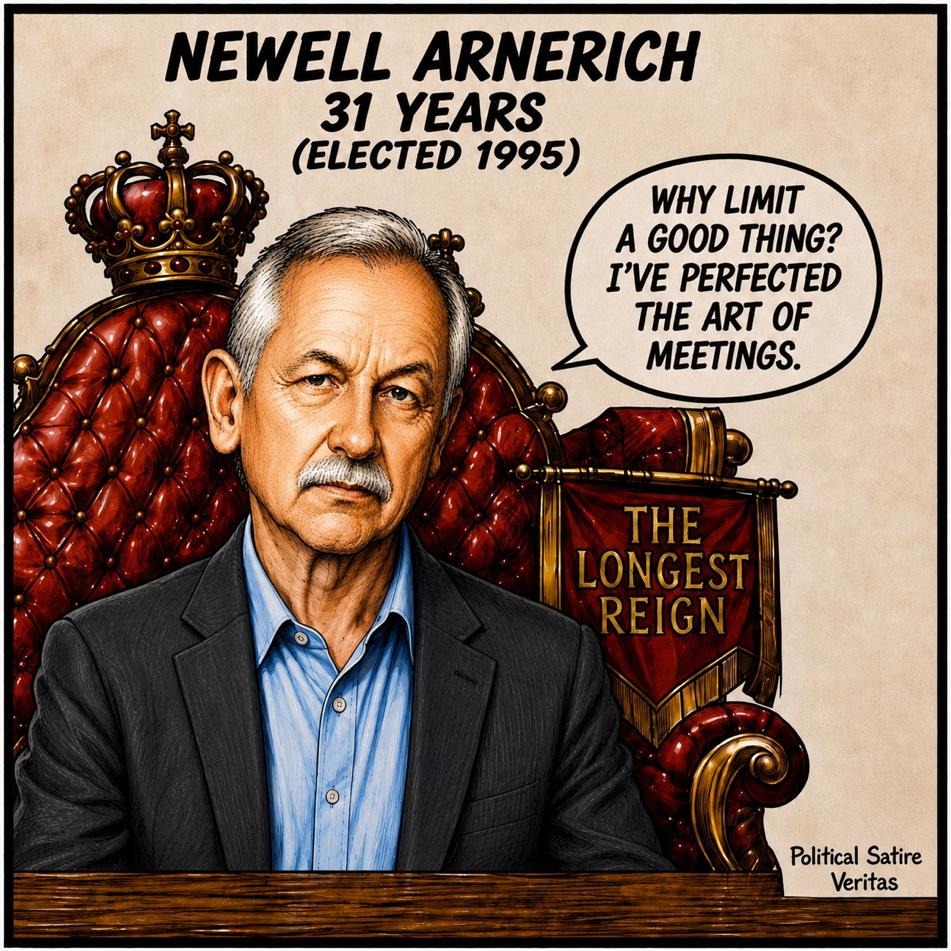
Photo Credit: Veritas
There is a difference between having institutional knowledge and becoming an institution.
That is why Danville should have a serious conversation about term limits. This should not be about attacking any particular Council member. Long-serving members can be hardworking, knowledgeable, and genuinely committed to Danville. Experience matters. But so does turnover.
Danville has only five Town Council seats. When somebody occupies one of those seats for 20 or 30 years, that is an entire generation of local government with one-fifth of the Council essentially unchanged. At some point, the question is no longer whether that person knows the job. Of course they do. The question is whether any elected office should become so closely associated with one individual that turnover begins to seem unusual.
Experience is an asset. Indispensability is a warning sign.
Term limits are not about throwing experience away. They are about making sure experience does not crowd out opportunity. With only five Council seats, Danville cannot continually develop new leaders if those seats rarely become genuinely open.
Without term limits, four years becomes eight, eight becomes twelve, twelve becomes sixteen and sixteen becomes twenty. Eventually, a Council member may have served through several Town Managers, generations of Town staff, countless development applications and enough traffic studies to wallpaper Town Hall.
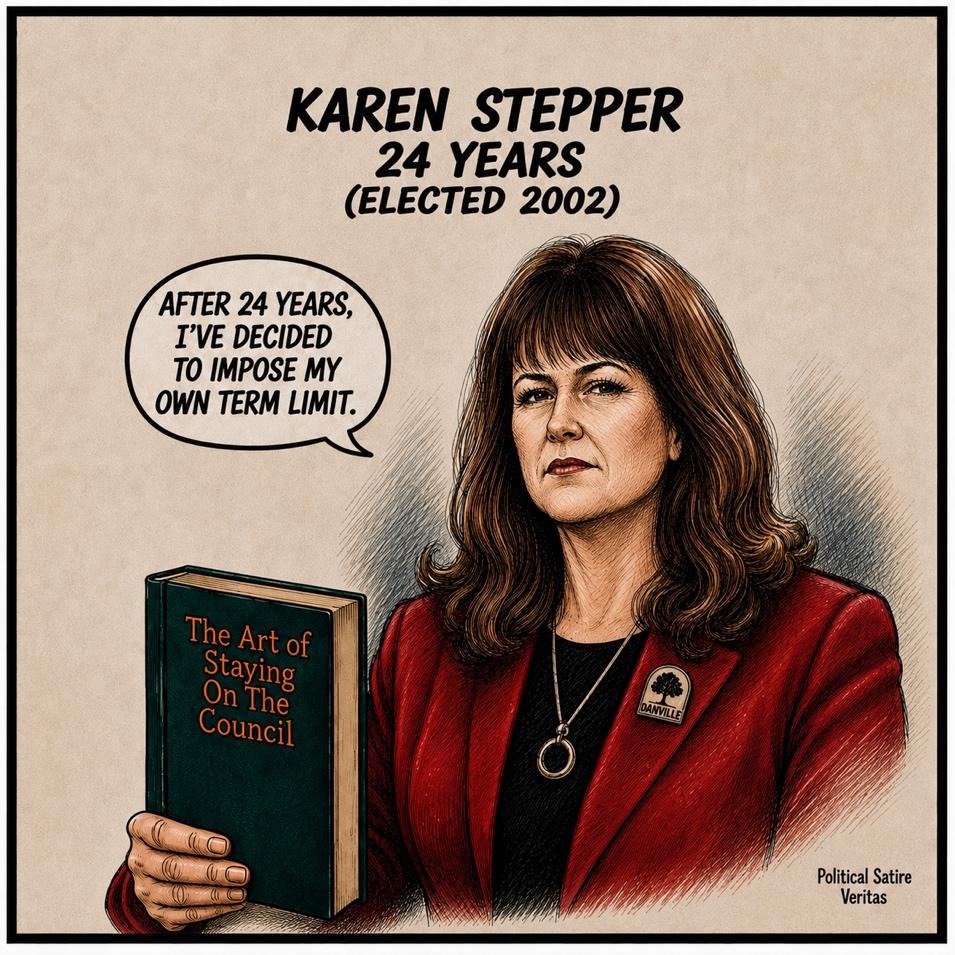
Photo Credit: Veritas / Council Member Karen Stepper, who has decided to step down after 24 years on Council
At some point, it seems fair to ask whether somebody else might like a turn.
The usual argument against term limits is experience. Another argument is even simpler: if voters want to keep re-electing someone, why stop them? Because elections involving decades-long incumbents are not the same as elections for genuinely open seats. Experienced Council members know the history, the staff, regional officials, business owners, community groups, and how Town government works. All true.
But after 20 or 30 years, those relationships can become extraordinarily powerful. Not because anyone is necessarily doing anything wrong, but because familiarity changes institutions. Eventually, “That’s how we do things” can begin replacing the more important question: “Is this still the best way to do it?”
That is where new leadership matters. Fresh Council members ask questions that may not have been asked in years: Why do we do it this way? Why wasn’t the public told sooner? Why didn’t this come before the Council? Why can’t we try something different?
Sometimes the most useful person in the room is the one willing to ask the question everyone else stopped asking years ago.
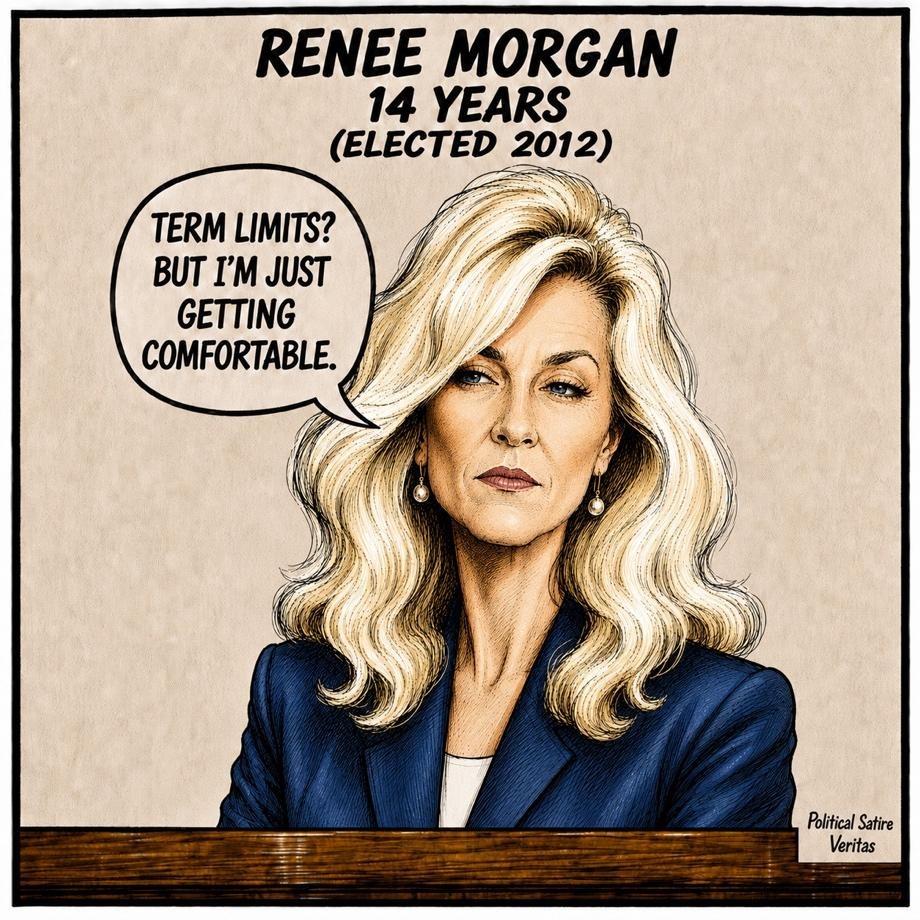
Photo Credit: Veritas / Term limits are also about making room for new leadership, new ideas and a new generation of people willing to serve.
Every generation sees Danville a little differently. Parents, younger families, longtime residents, business owners, retirees, and community volunteers all bring different experiences to Town Hall.
And when the same people occupy a handful of seats for decades, an unintended message can be sent to future community leaders: come volunteer, serve on a commission, attend the meetings — but do not expect a seat at the table anytime soon. A healthy town should continually develop its next generation of leaders, not ask them to wait 20 years for an opening.
Long tenure also makes elections harder for newcomers. A longtime incumbent has years of name recognition, relationships, endorsements, and public visibility. The incumbent has spent years attending ribbon cuttings, grand openings, and enough community events to develop professional-level handshake endurance. The challenger has spent three weeks figuring out where to order yard signs.
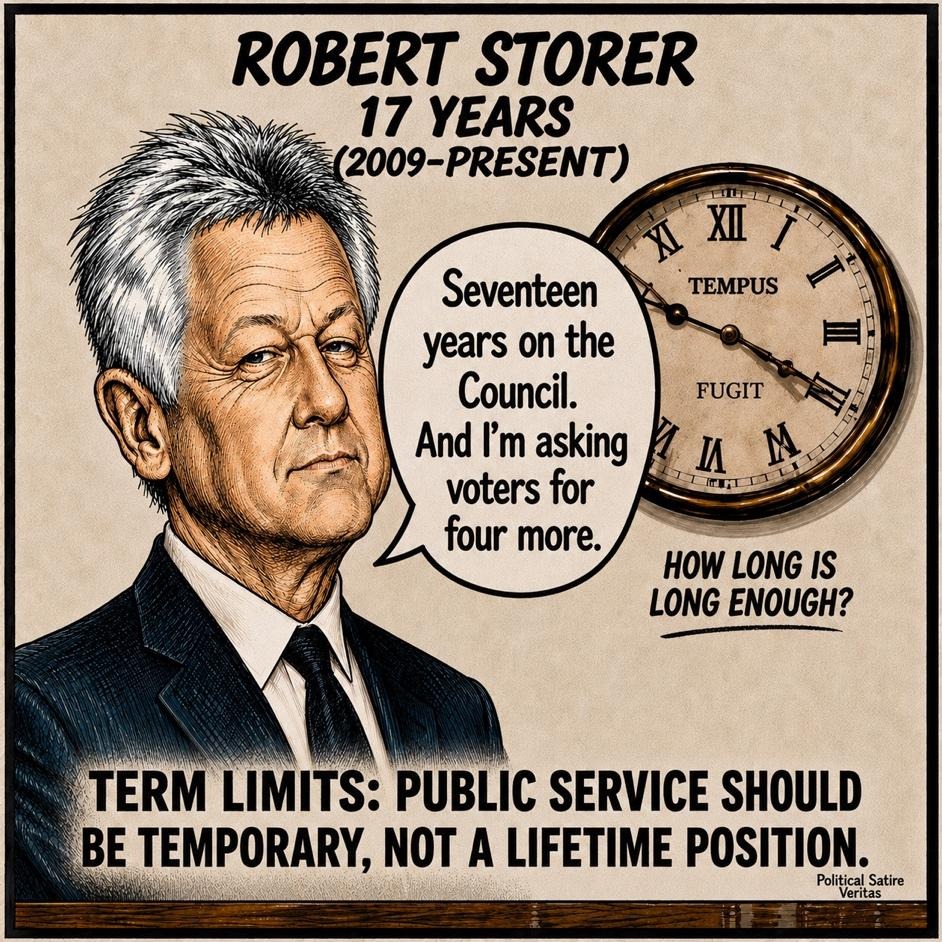
Photo Credit: Veritas / Experience provides continuity. New leadership provides renewal. Good government needs both
Term limits do not take power away from voters. They create something elections alone do not always provide: periodic open seats and realistic opportunities for new people to compete. Open seats encourage qualified residents who might never challenge a 20-year incumbent to consider running.
Town Hall should have elections, not permanent occupants.
And this is no longer just a theoretical discussion. Denton Carlson and Pratima Sonavne, candidates for Danville Town Council this November, support term limits. That makes the issue worth talking about now.

Photo Credit: Veritas
But there is an important test. If Carlson or Sonavne is elected, the exact same term limits should apply to them. No exceptions. A fair policy cannot mean, “The person I don’t like has been there too long.” It has to mean: “No one gets to stay forever — including the people I voted for.”
That is what makes this about good government instead of politics.
So, what is reasonable? Danville should consider a limit of three consecutive four-year terms — 12 years. Twelve years gives a Council member plenty of time to learn the job, pursue priorities, complete major projects, and leave a legacy. Twelve years is not exactly a summer internship.
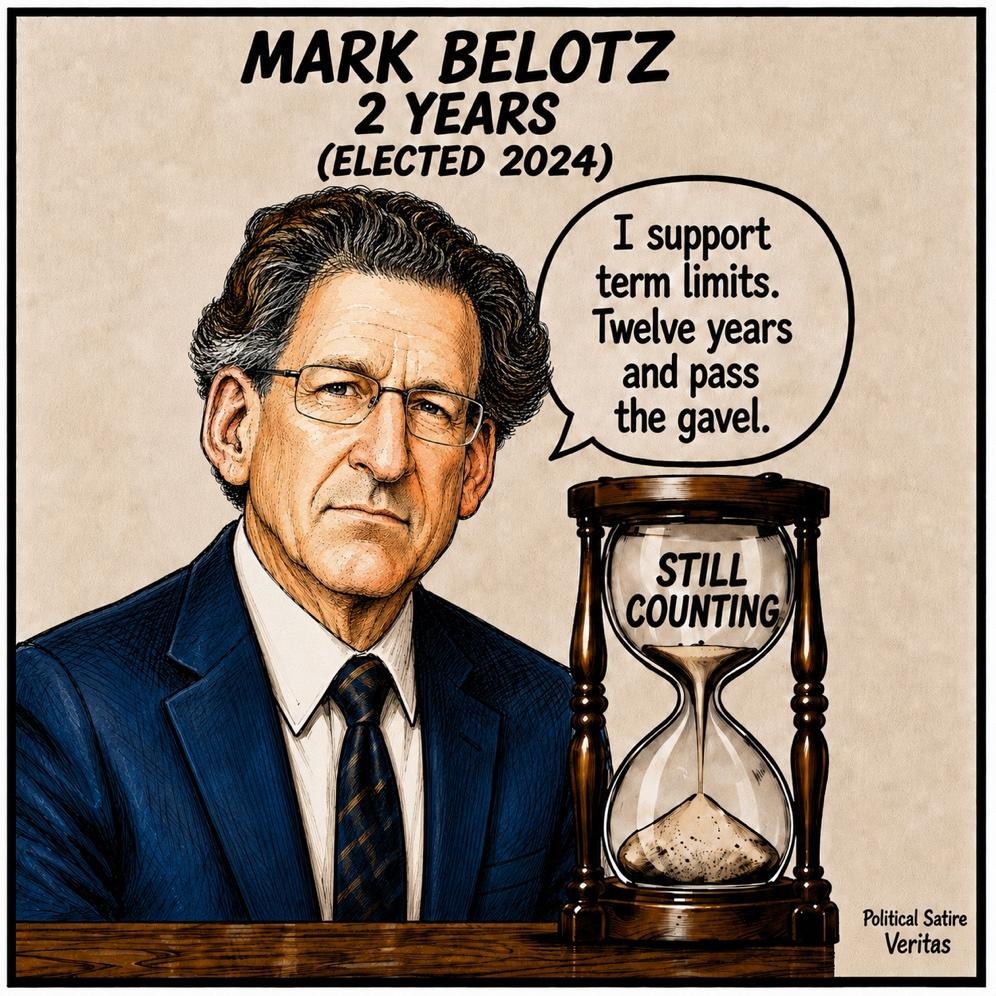
Photo Credit: Veritas
Term limits do not mean long-serving Council members have served badly. Some may have served exceptionally well. But healthy institutions should survive the departure of even their best leaders.
A successful Council member should leave behind stronger policies, stronger institutions, and people capable of carrying the work forward. Public service should produce successors, not permanent residents.
And something remarkable will probably happen. Danville will survive. The streets will remain. The schools will remain. The oak trees will remain. The Republic will survive.
The next Town Council should put a straightforward term-limits measure before Danville voters: Should Council members be limited to three consecutive four-year terms — 12 years?
The people who own those five seats should have a chance to decide.
Term limits are ultimately about more than how long one person serves. They are about whether Danville continues creating opportunities for new people to lead. A healthy Town Council should not only govern Danville today. It should make room for the people who will lead Danville tomorrow.
A Town Council seat belongs to the public, not the politician.
Serve. Lead. Make decisions. Take criticism. Cut some ribbons. Pose with the giant scissors. Then, eventually, say something every healthy democracy needs to hear:
“It’s someone else’s turn.”
Public service should be an honor, not an entitlement.
Photographs
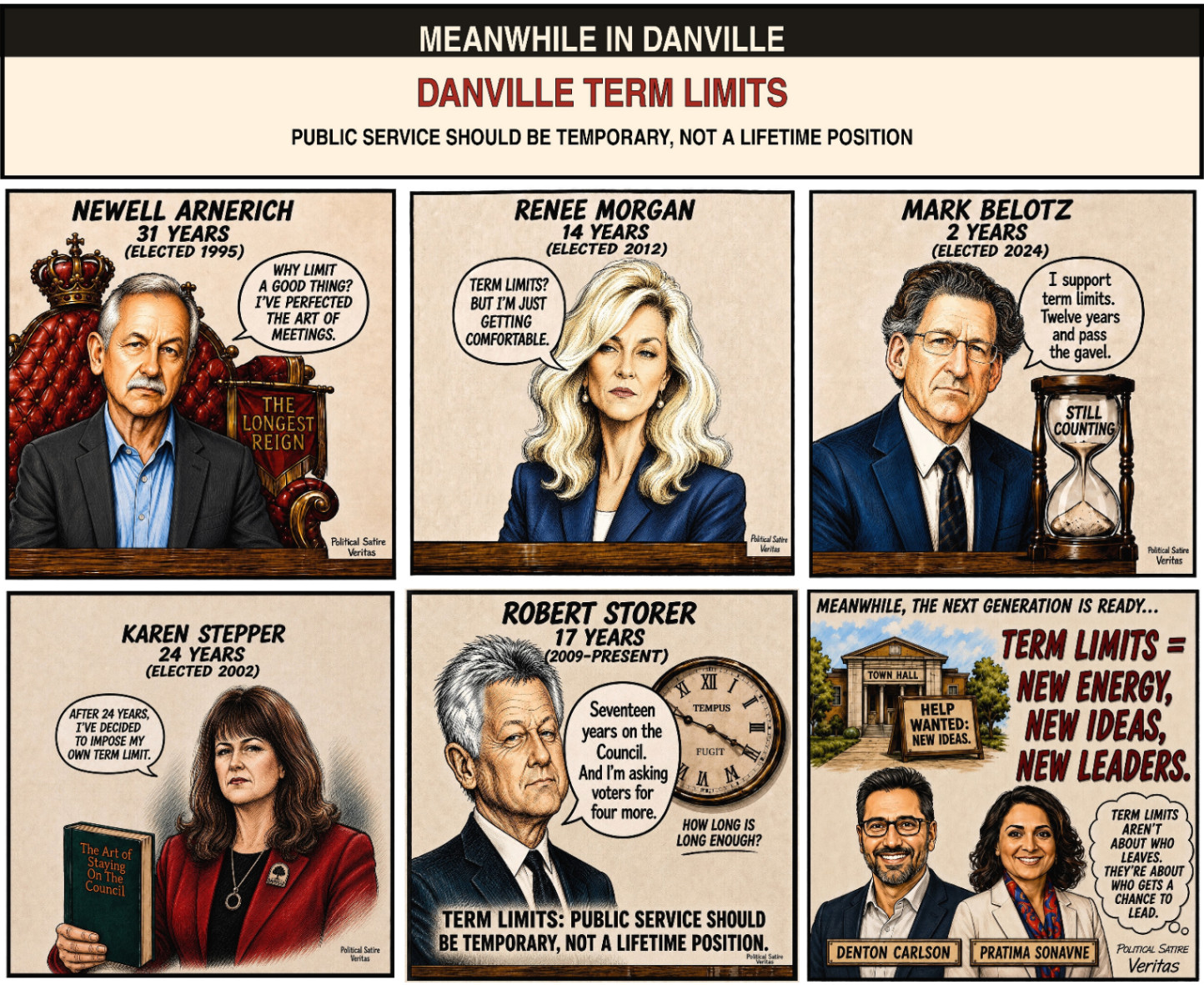
Comic Strip on Term Limits
Veritas
0
0

Comments