(SAN FRANCISCO, CA) — Overall crime numbers are down 22% during the first six months of 2026, compared with the same period last year, says San Francisco Mayor Daniel Lurie.
Car break-ins fell 42%. Car thefts declined 26%, after dropping 44% in 2025. This year, tent encampments have fallen to their lowest level on record, down 53%.
“Since we took office, April and June recorded the fewest monthly overdose deaths since the city began tracking them in 2020,” Lurie says, speaking at a San Francisco Board of Supervisors meeting.

Mayor Lurie Speaks at the San Francisco Board of Supervisors Meeting July 14, 2026.
Public perception of San Francisco is evidently improving too. San Francisco International Airport recorded its busiest Memorial Day weekend ever, and 500,000 more tourists are projected to come to the city this year than in 2025.
It is no secret that San Francisco has seen a difficult few decades with regard to crime, homelessness, and public perception thereof, but what explains the city’s recent turnaround?
While no single policy or politician deserves all the credit, evidence suggests that several factors have likely converged to produce the sharp decline.
Strengthened Law Enforcement Technology, Coordination, and Targeted Patrols
The SFPD has attributed their part in the decline to a few factors.
One of the biggest changes has been the expanded use of technology, including the controversial Automatic License Plate Readers (ALPR), which allow officers to quickly identify criminal vehicles. Another example of technological use is the deployment of drones, which can respond first to scenes, giving officers air support and visual information as they approach incidents. All this technology is integrated in the Real-Time Investigation Center, which became fully operational in December 2025.

Photo Credit: SFPD Drone, Equipped in March 2024 in San Francisco. (Video Footage of Drone Activity Can Be Viewed here.)
Another major change has been a shift toward coordinated enforcement against open-air drug markets. Building on initiatives launched under former Mayor London Breed, the Lurie administration has continued expanding joint operations involving the San Francisco Police Department, District Attorney's Office, Sheriff's Office, California Highway Patrol, California National Guard, and federal agencies.
These collaborative efforts, established under the 2023-born Drug Market Agency Coordination Center (DMACC), targeted repeat offenders, organised retail theft, and public drug dealing, particularly in the Tenderloin and South of Market.
Police also say they have increased high-visibility police patrols in commercial corridors, leading to a substantial decrease in larcenies and retail thefts. As an example, routine patrol checks have increased by 56% at 16th Street and 36% at 24th Street, two locations where crime rates were particularly high.
National Decrease in Crime Post-Pandemic
San Francisco is not unique. Most major U.S. cities have experienced significant declines in violent and property crime since 2023.
Researchers have pointed to several factors behind the increase in crime during the COVID-19 pandemic, including spikes in unemployment, school closures leaving students without supervision or structure, reduced court operations, staffing shortages within police departments, and broader social instability.
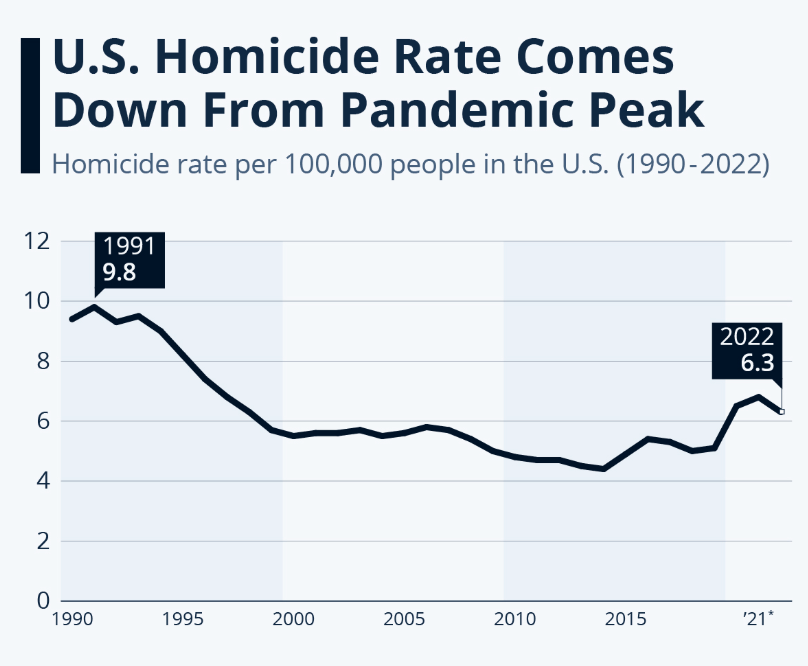
Photo Credit: Statista — U.S. homicide rate increases and then falls in relation to the COVID-19 pandemic.
Criminologists believe the unusually high crime rates have gradually returned toward historical norms as society stabilized. San Francisco's reductions have generally followed these national trends, although exceeding them in some categories.
Greater Investment in Homelessness and Behavioral Health
The city has dramatically reduced the number of large homeless encampments by 53% in 2026, while expanding shelter beds, temporary housing, behavioral health services, and treatment programs.
For example, June 30th, 2026 saw the opening of 78 Haight Street, a new 64‑unit affordable housing community in Hayes Valley that provides permanent homes and comprehensive support services for transitional‑age youth and low‑income families.
Transitional Age Youth (TAY) Health & Wellness Center opened on January 29, 2026, aimed at providing critical health services to young adults aged 18-27 experiencing homelessness.
Although controversial, many criminologists argue that reducing large encampments and increasing engagement with unhoused individuals can decrease opportunities for theft, drug markets, and other quality-of-life crimes. Furthermore, the fact that overdose deaths have fallen substantially suggests broader improvements in addiction intervention and public health.
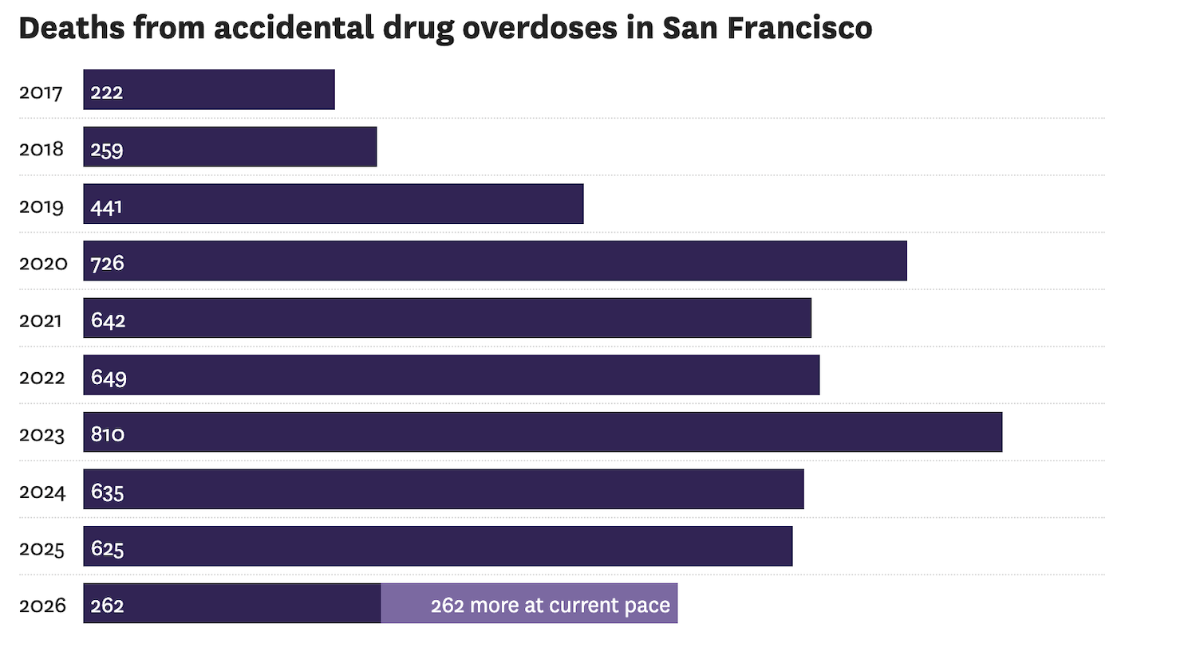
Photo Credit: Office of the Chief Medical Examiner
The story behind San Francisco's falling crime rate is not one of a single breakthrough, but of multiple trends moving in the same direction. Together, improved coordination among law enforcement, broader national crime declines, and expanded behavioral health and homelessness initiatives appear to be reshaping public safety across the city.
0
0

Comments