(SAN RAMON, CA.) - The San Ramon City Council on August 11 passed a resolution authorizing a memorandum of understanding (MOU) between the city and participating agencies for the I-680 Corridor Coordinated Adaptive Ramp Metering (CARM) Project.
Transportation Division Manager Chris Weeks said the proposed MOU was developed in collaboration with the California Department of Transportation (Caltrans), the Contra Costa Transportation Authority (CCTA), and local jurisdictions along the I-680 corridor. The agreement will document the goals, policies, and procedures related to ramp metering.
Weeks mentioned that the mayors of Danville and Walnut Creek had already approved the same MOU resolution, giving them a seat at the table for the committee discussing the ramp metering project.
Weeks then introduced CCTA Director of Projects Stephanie Hu, Innovate 680 Manager for Caltrans District 4 Sam Woldesemayat, and GHD Technical Director Darren Henderson.
Hu provided context on congestion along I-680, citing an article from the San Francisco Chronicle that listed the top 10 most congested freeways in the Bay Area. I-680 was ranked seventh on the list.
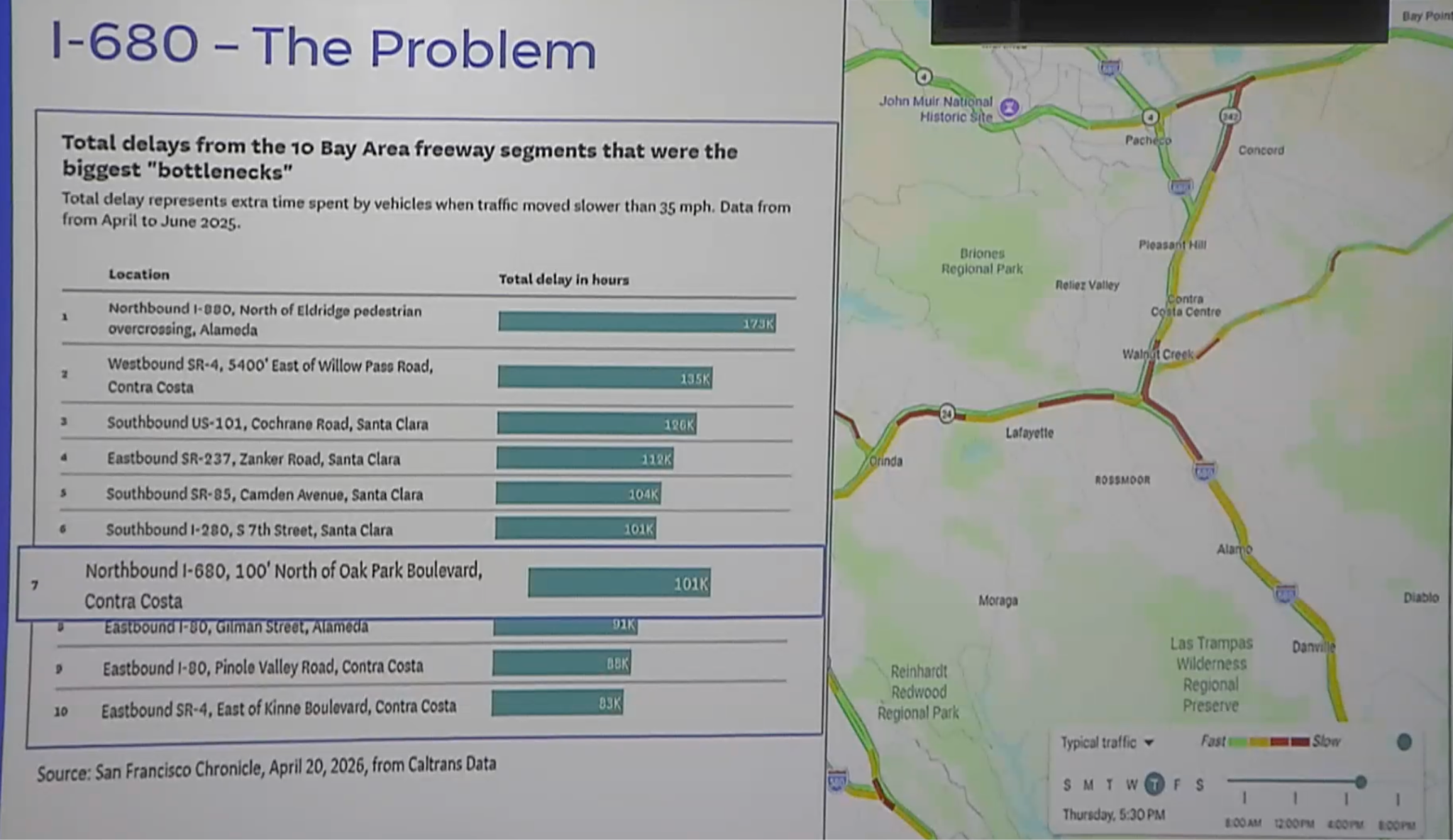
Photo Credit: YouTube / City of San Ramon
“One of the tools we’re proposing to deploy is ramp metering,” Hu said. “It regulates the flow of traffic entering the freeway.”
Hu also said the project would reduce crashes caused by traffic merging onto the freeway while creating more reliable and efficient travel. This could reduce the need for drivers to use city streets as alternate routes, which would also help reduce congestion on local roads.
Another key factor of the proposal is that it improves efficiency without widening the freeway, which aligns with the goals of Senate Bill 743 and its policy of reducing Vehicle Miles Traveled (VMT).
The I-680 ramp metering projects have been planned by Caltrans District 4 for the past few years and are funded by the State Highway Operations and Protection Program.
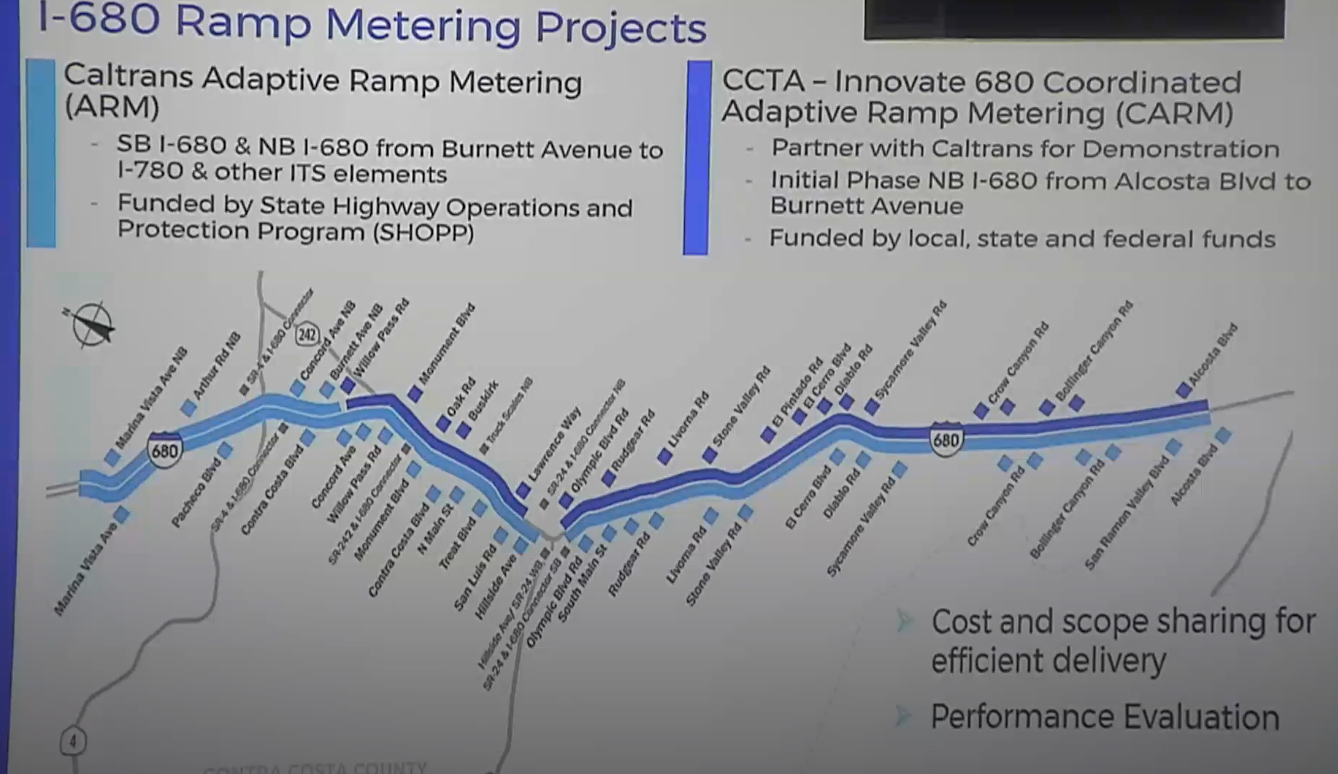
Photo Credit: YouTube // CityofSanRamon
Hu also said the CCTA had been planning the Innovate 680 Coordinated Adaptive Ramp Metering (CARM) project in parallel with the Caltrans project.
Woldesemayat continued the presentation with key details about what the project would entail.
The ramp metering will not activate based solely on time of day. Instead, it will proactively change rates based on potential traffic congestion forming on the freeway. The system will also turn on and off automatically to respond to crashes and will optimize metering rates based on mainline freeway traffic conditions.
Woldesemayat also mentioned that Caltrans has implemented Adaptive Ramp Metering (ARM) on US-101 from Gilroy to Brisbane and on I-880 from San Jose to Oakland, with studies indicating that travel times have improved significantly on those corridors.
Henderson explained the connection between ARM and Coordinated Adaptive Ramp Metering (CARM), explaining how the Caltrans partnership to implement CARM along a 20-mile portion of I-680 expands the adaptive capabilities of ARM. The system will include more real-time vehicle detection and system monitoring along the corridor, along with the ability to coordinate with adaptive traffic signal systems.
While CARM is a new approach, it has already been implemented in Riverside County on I-15 in May of this year.
“This implementation is showing positive results, so we are encouraged by that,” Henderson said.
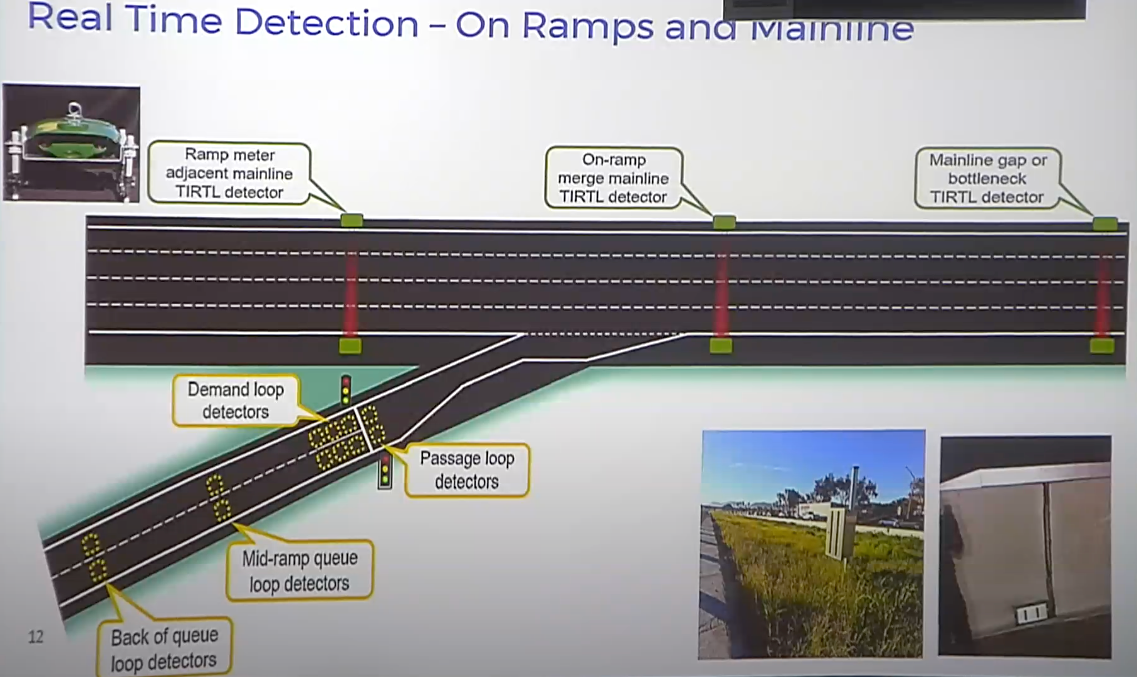
Photo Credit: YouTube / City of San Ramon
Vehicle detection will take place at all levels and will ensure that traffic is monitored consistently so that ramp metering remains accurate and appropriate for different situations and road conditions. This includes turning the system off during periods when it is unnecessary.
“There’s two locations here in San Ramon that will have more extensive improvements on the ramps themselves, although that work is being designed in a way to minimize intrusions on the traffic that needs to use these ramps on a daily basis,” Henderson said.
Those locations are Crow Canyon and Bollinger Canyon. Both have two merge points with short weaving distances for traffic, which can make driving more difficult and disruptive to mainline traffic flows during congested conditions. The project will merge those two lanes so that there will be a single merge point.
Henderson then assured the council that there would be multiple opportunities for San Ramon technical staff to be included in conversations surrounding the development of the project to ensure that city and resident needs are met.
Outlines for ramp metering operations, including incident management and maintenance responsibilities, will be developed with CCTA, Caltrans, and local agency staff. The process will include multiple review cycles, along with performance reporting and protocols for stakeholder communications.
Construction for Caltrans ARM is ongoing from November 2025 through late 2028, while Innovate 680 CARM is in its final design phase, with construction anticipated to begin in early 2027 and continue through late 2028. Both metering systems are expected to be fully operational by early 2029.
Councilmember Robert Jweinat pointed out that constituents were concerned that drivers would take streets parallel to Alcosta Boulevard to avoid I-680 in order to avoid payment. However, there are no toll fees involved with the metering system.
“I’m excited about this because I’ve been commuting I-580 for almost 30 years, and when the metering occurred on that I-580 corridor from Livermore to San Ramon, I shaved off an easy 15 minutes and stopped using side streets and started using the freeway because the metering really did affect it,” San Ramon City Manager Steven Spedowfski said.
Councilmember Sridhar Verose also questioned the difference between CARM and ARM, to which Henderson clarified that CARM is a more refined implementation of the adaptive ramp metering approach.
“The main difference is that all of the ramps in the CARM system are working together as a single unit- that way, if one ramp is backing up or is being stressed if there’s a lot more traffic at that location, for example Bollinger Canyon is a very busy location, the system can look along the entire length of the corridor and see if one portion of the road is being overloaded; it can look at Crow Canyon or Alcosta and allow more traffic to be held back at those locations so it can balance those demands,” Henderson said.
Verose questioned how information about the project is being relayed to the public.
Hu responded that work is ongoing to inform the public that ramp metering is coming, what residents can anticipate, and how they can provide comments and input if needed. Teams will provide videos and fact sheets, and Hu reminded the council that construction will not be completed until 2029, giving the city additional time to inform the public.
Vice Mayor Marisol Rubio also questioned what impact is anticipated during the transition period and implementation phase.
“We have been trying to limit impact on traffic by limiting closures only to shoulders and when necessary, we are using only nighttime closures, and we’re doing widening on the southbound direct of Bollinger Canyon and Crow Canyon along with additional lanes to provide additional storage to that traffic backup to the local arterials,” Woldesemayat said.
Additionally, whenever closures are needed, Woldesemayat mentioned that advice is provided by committees to ensure that the impact is minimal.
The main purpose of the MOU is for San Ramon to join the technical group that will monitor the project and its performance.
“This MOU is really to develop a forum or governance structure where every jurisdiction along the corridor has a seat at the table so that we can review the performance of the ramp metering implementation post operation,” Hu said.
The motion passed unanimously, with all four councilmembers voting to approve the resolution.
To add to or correct any information in this report, please email me at yashi.s@lead4earth.org or leave a comment below.
0
0

Comments