(CHARLOTTE, N.C.) — A contentious City Council zoning meeting on March 23 laid bare growing divisions over development priorities, as officials grappled with how to balance rapid growth, affordable housing needs, and neighborhood preservation.
The meeting opened with an unusual procedural dispute when council members rejected a motion to move immediately into a closed session. Instead, they opted to proceed with the public zoning agenda, signaling a commitment to transparency but also revealing underlying tensions among members.
Much of the evening focused on long-term planning efforts tied to the city’s 2040 Comprehensive Plan, including seven proposed Community Area Plans (CAPs). After extended discussion and public comment, the council voted to defer adoption of the plans and associated policy map updates until April 13, citing the need for additional review and refinement.
“As you all are well aware, since the deferral on the 24th of November and our engagement that followed that, there have been a recommendation of several new policies that have touched on neighborhood change,” said Monica Holmes, planning, design, and development director, emphasizing the evolving nature of the proposals.
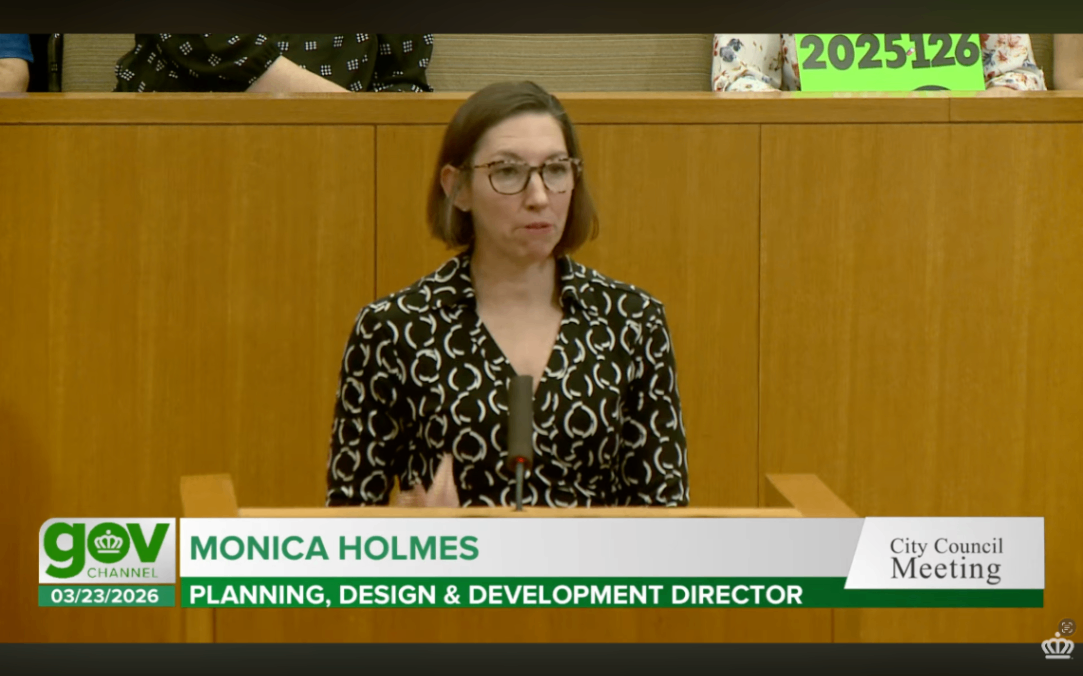
Monica Holmes, Charlotte’s Planning, Design & Development Director, explains the recent policy recommendations regarding neighborhood change and the deferral of the Community Area Plans.
(Photo Credit: City of Charlotte/YouTube)
Residents and stakeholders used the public comment period to voice differing perspectives on the plans sharply. Several speakers from established neighborhoods raised concerns about proposed land-use changes that would introduce manufacturing and logistics operations near residential areas. They warned that such shifts could erode neighborhood character, increase traffic congestion, and repeat mistakes from past zoning decisions.
“I come before you once again this evening to ask for your help in saving Steelberry Acres,” said Stephanie Loss, a representative of the neighborhood, urging council members to reconsider how zoning decisions could affect long-standing communities.
One resident described how previous industrial development had disrupted daily life in their community, emphasizing the need for enforceable policies rather than broad planning language. Others echoed calls for alternative zoning designations that would better buffer residential areas and protect long-term livability.
At the same time, advocates for increased housing supply urged the council not to scale back development opportunities. One speaker involved in shaping the 2040 plan argued that limiting density would worsen affordability challenges, pointing to data suggesting that diverse housing types can coexist with stable property values. The speaker urged council members to prioritize policies that expand access to housing across income levels.
Research supports the complexity of this debate. Studies show that zoning policies can directly influence housing supply and affordability, with restrictive regulations often limiting development and driving up costs. According to a Cato Institute analysis, stricter zoning laws can significantly constrain housing availability and worsen affordability challenges.
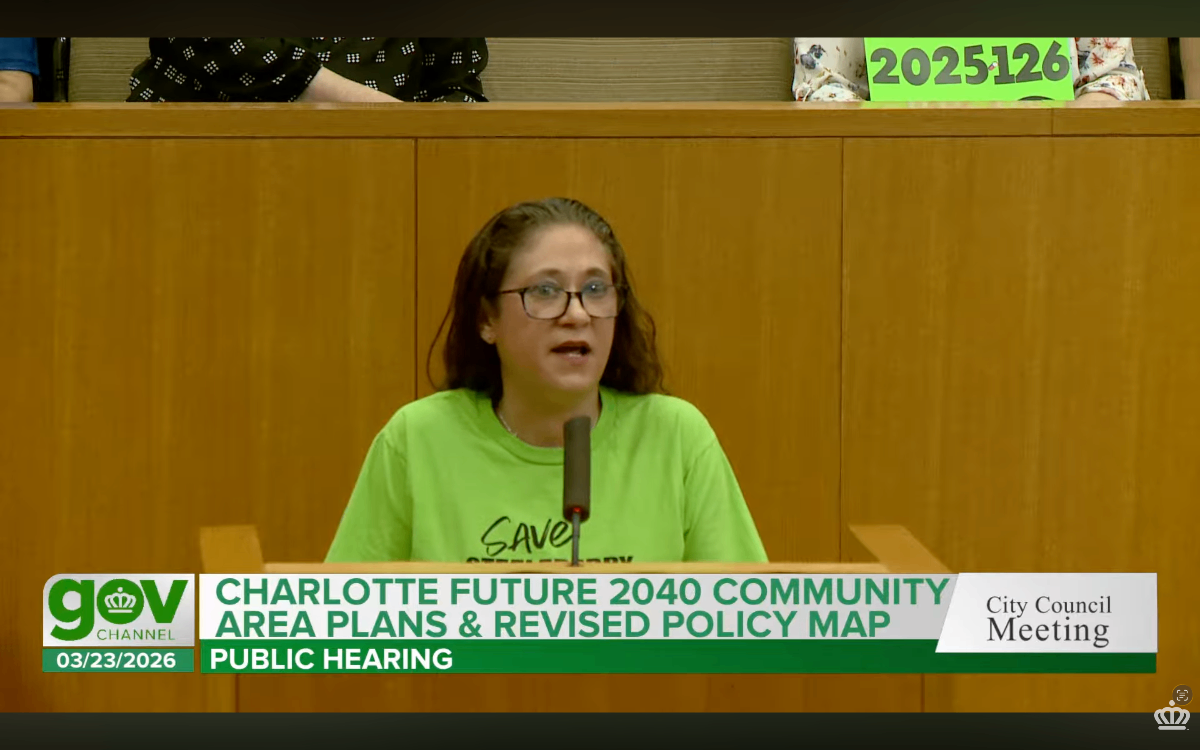
Stephanie Loss, representing the Steelberry Acres neighborhood, addresses the council during the public hearing, urging officials to protect established residential areas from encroaching industrial zoning.
(Photo Credit: City of Charlotte/YouTube)
Similar land-use tensions are playing out elsewhere. In Folsom Prepares for the Mandatory Golden-Brown Aesthetic by OpGov.news reporter Sarah Denos, officials are navigating state mandates that limit ornamental lawn watering, illustrating how environmental regulations can reshape local planning decisions and community expectations.
Those competing priorities came into sharp focus during deliberations on a major rezoning proposal known as Quasland Southeast. The project, which includes 125 affordable housing units and 11 townhomes, ultimately passed in a 6–3 vote, but only after significant debate.
Supporters of the proposal framed it as a necessary response to the city’s housing shortage, emphasizing the urgent need for affordable options. However, several council members expressed concern about concentrating additional affordable housing in one area, particularly in parts of East Charlotte that already face economic and infrastructure challenges.
Critics of the project cited traffic concerns, school capacity, and the broader question of equitable development. They argued that the city must ensure affordable housing is distributed more evenly to avoid reinforcing patterns of segregation and concentrated poverty.
Housing researchers have long warned about these patterns. A report from The Century Foundation found that zoning and land-use policies can contribute to concentrated poverty and unequal access to resources when affordable housing is clustered in limited areas.
Infrastructure concerns tied to growth are also evident in other cities. The Ordinance to Amend Downtown Redevelopment Authority (DRA) Bylaws Passes Unanimously, written by OpGov.news reporter Rory Holbrook, highlights how a mid-sized city updated its redevelopment policies to better manage growth, streamline approvals, and address community concerns about traffic and density, illustrating how zoning and infrastructure decisions intersect with broader urban planning goals.
Despite those divisions, the council demonstrated unity on several other items. Members unanimously approved up to $25 million in capital improvements for the BLEX entertainment complex, funded through tourism tax revenue. The vote underscored broad support for investments aimed at boosting economic development and attracting visitors.
The council also approved multiple rezoning petitions without opposition, including a therapeutic park project associated with the local hospital authority and a proposal for a church seeking a permanent location. In addition, a text amendment updating the city’s Unified Development Ordinance to better align with the 2040 plan passed unanimously.
Several other rezoning cases, including proposals from developers and institutional stakeholders, were either deferred, withdrawn, or left undecided following public hearings. These included projects involving mixed-use development, logistics operations, and institutional expansion, each drawing varying degrees of public interest and scrutiny.
Throughout the meeting, recurring themes emerged: the strain of infrastructure under continued growth, the challenge of maintaining neighborhood identity, and the urgency of addressing housing affordability. Public comments frequently reflected frustration with past decisions and skepticism about whether new plans would adequately address community concerns.
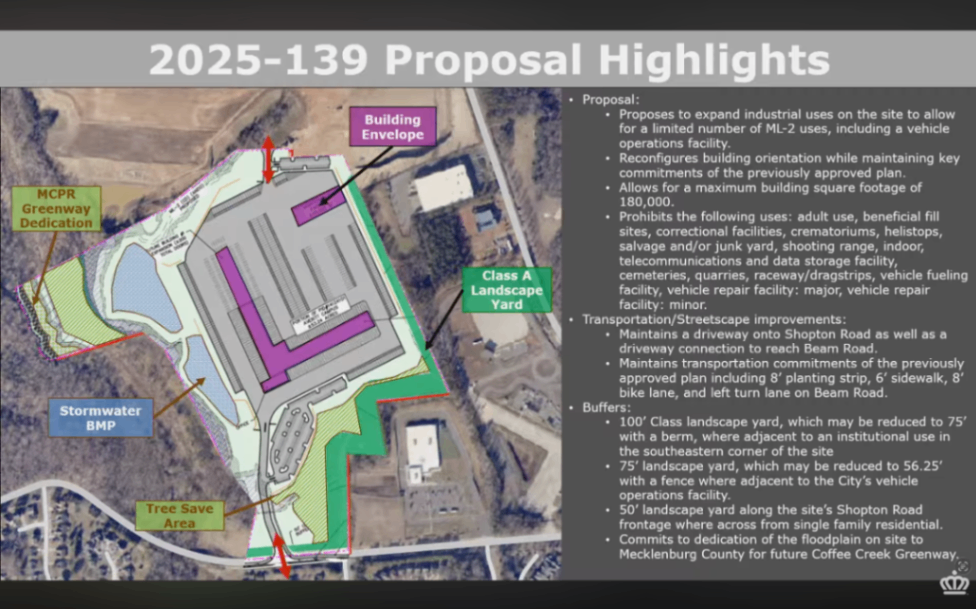
A detailed look at the 2025-139 Proposal Highlights, which includes a building envelope of up to 180,000 square feet and specific land-use restrictions to buffer industrial operations from the surrounding community.
(Photo Credit: City of Charlotte/YouTube)
At the same time, council members acknowledged the complexity of their role in shaping the city’s future. Balancing economic development with equitable growth and community preservation remains an ongoing challenge, particularly as population growth and demand for housing continue to accelerate.
The decision to delay action on the Community Area Plans suggests that further debate is likely in the coming weeks. As council members prepare to revisit the plans in April, the outcome will play a critical role in determining how the city manages growth and development in the years ahead.
For now, the meeting highlighted both the progress being made and the difficult trade-offs that remain, as leaders seek to chart a path forward that reflects the needs of a rapidly changing community.
The full council meeting agenda and materials are available on OpGov.news at Charlotte City Council Meeting.
Make sure to comment below what you think of what the Charlotte City Council has approved this week.
You can reach Victoria Osborne at victoria.o@lead4earth.org.
(Thumbnail Photo Credit: City of Charlotte/YouTube)
0
0

Comments