(PLEASANTON, Calif.) - Pleasanton voters are facing a familiar question this November with a very different answer. After rejecting a half-cent local sales tax increase in late 2024, the City Council has unanimously (5-0) placed a new tax proposal on the November 3 ballot (Thurber). This time, unlike the 2024 sales tax proposal, the new measure would increase the tax paid by guests at hotels and other qualifying short-term lodging.
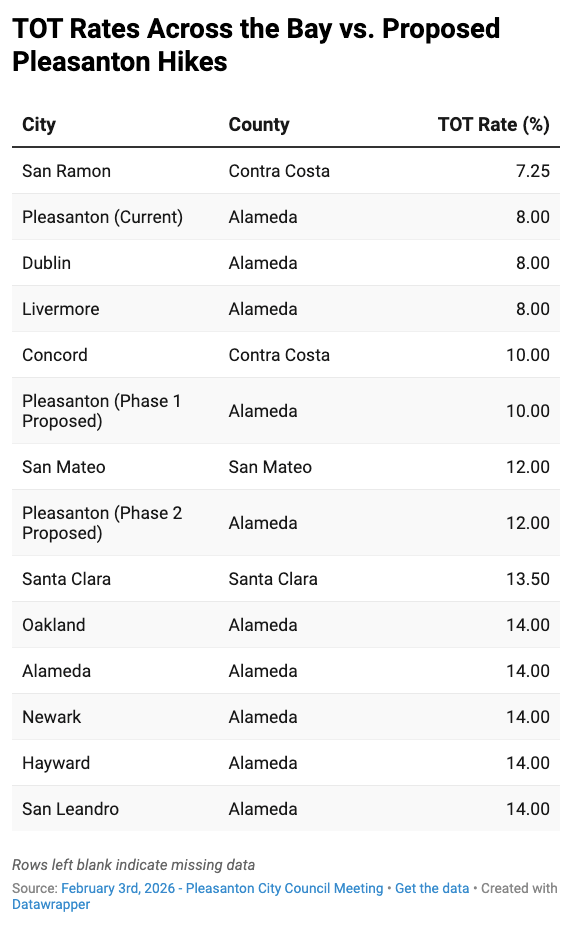
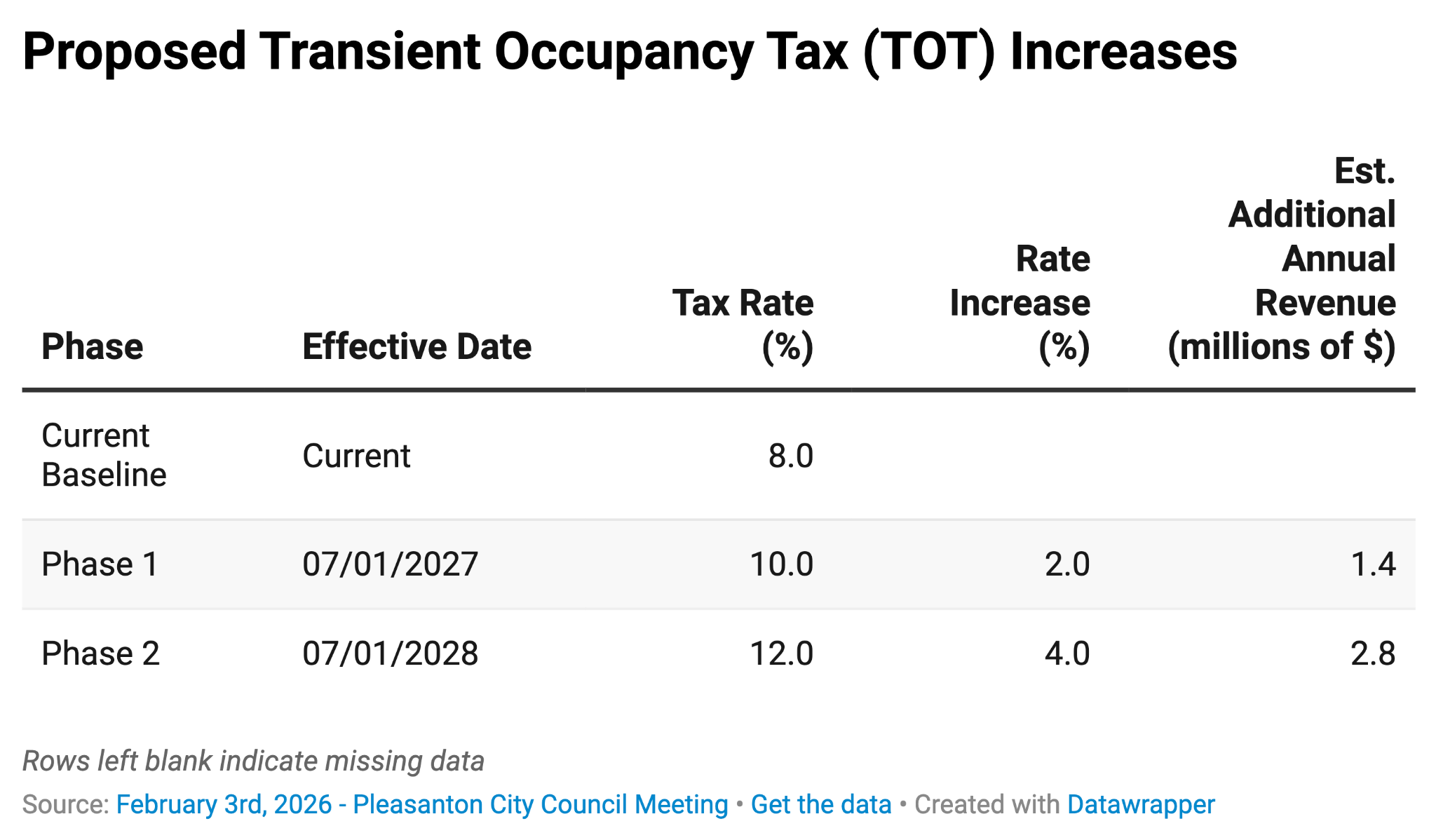
The proposed Transient Occupancy Tax would raise the lodging rate from 8 %, a level that has not changed since 1983. The increase would happen in two steps. First, the rate would rise to 10 percent on July 1, 2027, bringing in an immediate $1.4 million annually. Then, it would move to 12% on July 1, 2028, increasing total new revenue to $2.8 million each year (City of Pleasanton). This phased approach matches the 12 % rate used throughout most of Alameda County and helps the hospitality industry adjust without a sudden price shock.
For residents, the benefit is clear: local taxpayers do not pay this tax unless they stay in a local hotel. Visitors use city roads, rely on police and fire protection, and enjoy local parks during their stay. By passing this measure, Pleasanton can shift some of its financial burden to non-residents, bringing in millions to protect essential services. This revenue is coming at a critical moment. Pleasanton is facing a yearly budget deficit between $7 million and $8 million (Pleasanton Voters). Without new funding, the city may have to cut police staffing, close fire stations, or reduce hours at the Dolores Bengtson Aquatic Center. A $2.8 million annual boost would help keep public pools open and emergency services responsive.
(Photo Credit: Google Image)
However, focusing strictly on raising the tax rate ignores a second, crucial factor for financial growth: driving down hotel vacancy rates. Currently, Pleasanton’s 8 % tax generates roughly $5.6 million annually, implying that local hotels collect approximately $70 million in gross room revenue each year at an estimated 65 % average occupancy rate. While the proposed TOT rate increase to 12 % secures $2.8 million in new city revenue at current occupancy levels, pairing that rate hike with higher hotel occupancy creates a compounding economic benefit for both public coffers and private hospitality businesses. To lower vacancy rates, Pleasanton doesn’t have to reset its tourism strategy; it just needs to capitalize on regional demand drivers. First, city leaders and local hotels can partner closely with regional destination marketing organization Visit Tri-Valley to aggressively market Pleasanton as the premier stay-and-play hub for youth sports tournaments at Bernal Community Park and major events at the Alameda County Fairgrounds. Second, hotels can capture high-margin weekend leisure travelers by offering package deals bundled with wine tours, downtown dining vouchers, and golf access. Third, catering to modern remote workers through tailored work-related packages can convert low-occupancy nights into productive corporate stays.
The math behind this method demonstrates why filling vacant rooms is vital for everyone. If regional marketing initiatives boost hotel occupancy by 5 % points, moving average occupancy from 65 % to 70 %, room sales across Pleasanton hotels would expand by up to $5.4 million annually. At the new 12 % TOT rate, that 5 % reduction in vacancy would deliver an extra $648,000 to the City’s General Fund on top of the projected $2.8 million, bringing total new municipal tax revenue to nearly $3.45 million per year. Simultaneously, local hotels would keep over $4.7 million in revenue after taxes, while benefiting from secondary visitor spending at nearby restaurants, retail shops, and gas stations.
Looking at the issue objectively, the arguments in favor are straightforward and compelling. Proponents argue that an 8 % rate is an outdated relic from four decades ago that fails to cover modern service costs. Neighboring cities like Dublin are pursuing the exact same 12 % rate on the same ballot, meaning Pleasanton will not lose out on room bookings to its closest neighbors. According to the City of Pleasanton’s official FlashVote poll, recent polling shows close to 67 % of local residents already support the idea, recognizing it as a fair way to fund neighborhood services.
On the other hand, a thoughtful look at the issue reveals fair concerns from critics. Skeptics point out that a hotel tax only fixes about 35 to 40 % of the overall budget deficit. Money generated goes straight into the unrestricted General Fund, meaning there is no legally binding guarantee that every dollar goes directly to road repairs or the aquatic center. Some business observers also worry that higher room costs could push cost-conscious travelers or youth sports teams toward lower-tax areas outside the region, potentially hurting local restaurants and shops if hotel stays dip (Thurber).
Others argue that city leaders should focus strictly on cutting internal and labor costs before raising taxes of any kind. They argue that relying on tax increases can distract from solving the root causes of city overspending. Ultimately, voters must choose between these competing views. Is a phased hotel tax an ideal, low-pain solution that protects public services like police response and the local pool at the expense of out-of-town guests? Or is it a partial solution that purely delays deeper financial responsibilities? In November, Pleasanton voters will make the call.
1
3

Comments