(CHARLOTTE, NC) – Charlotte is experiencing increased pressure from proposals to build and expand data centers as artificial intelligence and cloud computing continue to reshape the national economy.
Charlotte Faces a New Wave of Digital Infrastructure Growth
Local officials are now weighing how these large-scale facilities fit into the city’s long-term growth strategy, particularly as utility demand and land use conflicts become more visible in planning discussions.
Data centers are specialized facilities that house computer servers responsible for processing, storing, and distributing digital information.

City officials use a scale ranging from small server rooms to massive hyperscale facilities to illustrate the varying energy and infrastructure demands of different data center types.
(Photo Credit: City of Charlotte/YouTube)
They power services such as online banking, streaming platforms, cloud storage, and generative AI systems. As demand for these services increases, companies including Amazon, Microsoft, Google, and Meta have expanded investment in digital infrastructure across the United States.
In Charlotte, recent proposals and council discussions have focused on whether current zoning and infrastructure systems are sufficient to support continued growth in this sector.
Rising Electricity Demand Becomes a Central Concern
One of the most significant issues tied to data center expansion is electricity demand. The rapid growth of AI-driven computing has accelerated the need for high-capacity facilities that operate continuously and require substantial energy input for both processing and cooling.
A 2024 analysis from the Electric Power Research Institute (EPRI) estimated that data centers could account for up to 9% of total U.S. electricity consumption by 2030 under high-growth AI scenarios. The study highlights how AI workloads are increasing energy intensity beyond traditional cloud computing models.
The U.S. Department of Energy similarly notes that data centers are among the most energy-intensive building types due to constant server operation and cooling requirements, which must run 24 hours a day to prevent overheating. U.S. Department of Energy
In North Carolina, Duke Energy has identified large-scale data centers as a key driver of future electricity demand growth, raising broader questions about grid capacity, long-term infrastructure investment, and potential impacts on ratepayers.
Water Use and Environmental Pressures
Alongside electricity consumption, water use has become a growing concern in discussions about data center development in Charlotte and surrounding counties. Many facilities rely on evaporative or hybrid cooling systems that require significant water input to regulate server temperatures.
While exact usage varies widely depending on design, scale, and efficiency, cooling systems remain a major operational requirement in most data center models. The Department of Energy has noted that water and energy consumption are closely linked in these systems, though new technologies are gradually reducing usage intensity in some modern facilities.
These concerns have become more prominent as Charlotte continues to grow rapidly and faces competing demands on water infrastructure from residential, commercial, and industrial users.
Economic Benefits vs. Long-Term Tradeoffs
Supporters of data center development often point to job creation during construction, expanded tax bases, and increased private investment in local infrastructure. These projects can generate significant short-term economic activity and contribute to land development in underutilized areas.
However, long-term employment levels are typically lower once facilities become operational, with staffing often limited to highly specialized technical roles.
Broader research from the Brookings Institution similarly notes that while data centers can drive local investment, they also present challenges related to energy demand, land use, and public cost distribution that are often underrepresented in early economic forecasts.
Charlotte City Council Weighs Moratorium and Policy Changes
Recent Charlotte City Council debates have reflected growing scrutiny of how data centers fit into the city’s development framework, specifically during recent city council meetings like this week’s meeting on Monday.
During these conversations, council members debated whether the city should temporarily pause new approvals to allow for deeper review of energy usage, water impacts, and proximity to residential areas.
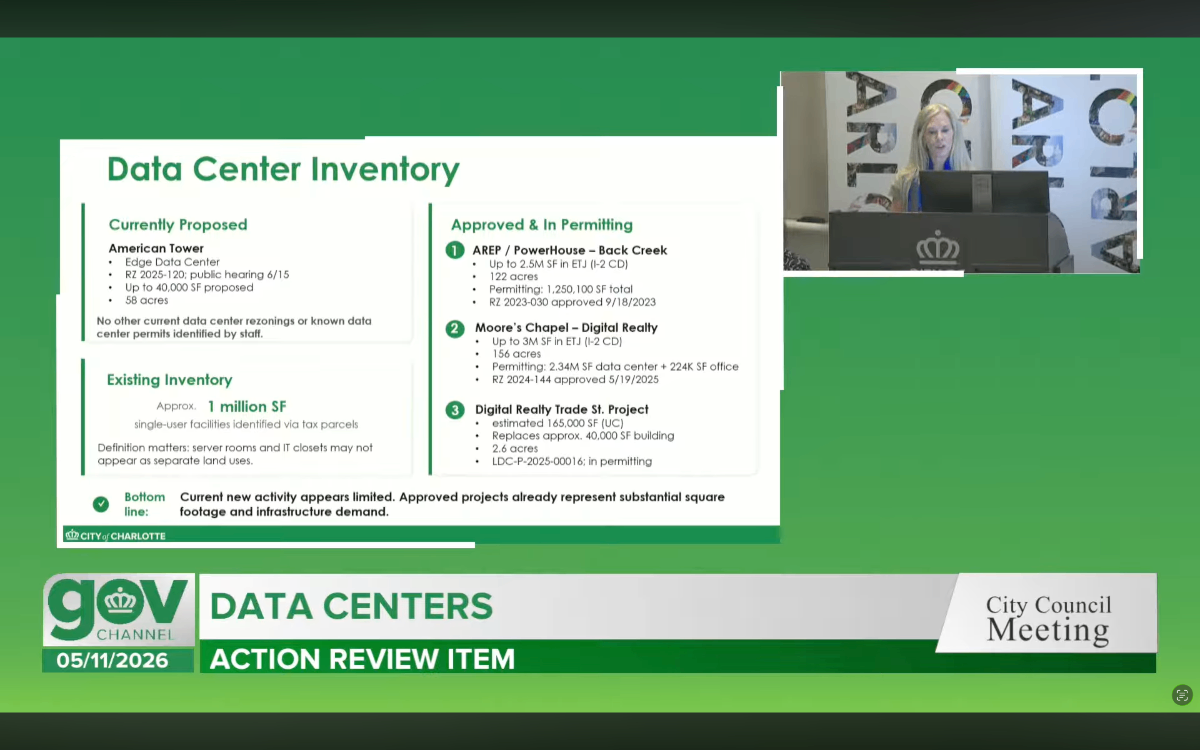
The City of Charlotte's current inventory shows over one million square feet of existing data centers, with millions more currently in the permitting and proposal stages.
(Photo Credit: City of Charlotte/YouTube)
City Council discussions also included early-stage policy ideas aimed at shaping how future data center development is regulated. Council Member Dantè Anderson noted the need to proactively build safeguards into local rules, saying, “But as we do that, I’d like for us, this advisory group, to think about the types of guardrails we can bake into our policy, like the behind-the-meter strategies.”
Community Response and Rising Public Opposition
City staff have also emphasized that public feedback is actively shaping the review process.
Deputy City Manager Alyson Craig said community input has been a key factor in evaluating potential changes, noting, “I think the community has been very vocal, and some concerns that they have, and they would like to see things introduced into our process that provide them assurances that we would like to research to see if we could actually incorporate.”
Public reaction in Charlotte has been increasingly visible across community meetings, neighborhood discussions, and online forums.
A community petition opposing a proposed east Charlotte data center near Reedy Creek Nature Preserve has gathered 5,526 signatures as of May 2026, according to organizers.
Residents have raised concerns about electricity costs, water usage, noise, and environmental disruption. In neighborhood-based discussions, including Nextdoor posts and comments, some residents described fears about long-term utility impacts and quality-of-life changes.

Local residents attended the May 11 City Council meeting in large numbers, holding signs calling for a moratorium to better understand the long-term impacts of rapid data center expansion.
(Photo Credit: City of Charlotte/YouTube)
One resident wrote that “the bills are already high. I don't want to pay them now, much less adding more. The bills will increase, no doubt about it,” reflecting concerns about potential increases in utility costs.
Another resident described environmental risks, stating, “No data centers, period!! They're so harmful to the environment. The amount of water they use will drain Mt Island Lake in no time. The noise pollution is dreadful and bad for the animals.”
Other comments focused on location and land-use concerns, including one resident who said, “We just want the data right? Streaming TV, social media, all that stuff — but don't put it in my back yard?”
Another noted operational impacts, saying, “Horrible noise from all the cooling fans, spike in energy costs and drop in water pressure is what people living next to data centers complain about.”
A separate commenter added simply, “No more data centers!!!!”
Council Meeting Highlights Broader Policy Tensions
Council members and residents discussed a range of issues tied to growth, including housing shortages, transportation planning, and city service capacity.
On data centers specifically, council members moved forward with a public hearing for a potential 150-day moratorium, signaling interest in temporarily pausing approvals while further analysis is conducted. The decision followed extended debate over potential economic consequences and legal considerations.
Housing affordability was another major focus, with multiple speakers urging expanded investment in the Housing Trust Fund and stronger protections against displacement.
Advocates cited rising eviction rates and a shortage of affordable units relative to population growth.
Transportation also remained a key issue, particularly regarding the I-77 South Corridor project.
The council approved an independent re-evaluation and alternatives analysis, though efforts to fully rescind prior approvals were unsuccessful, highlighting internal disagreement over the extent of policy reversal.
Public comments throughout the meeting also emphasized concerns about employee compensation. City workers and first responders raised issues related to pay equity, recruitment, and workload increases tied to Charlotte’s rapid growth.
Broader Infrastructure Debate Continues
As Charlotte continues to grow, data center development has become part of a broader debate over how the city should manage infrastructure demands tied to the digital economy. While the industry offers economic investment and supports modern digital services, it also introduces challenges related to electricity consumption, water use, land planning, and long-term public cost distribution.
A 2024 report from Lawrence Berkeley National Laboratory, commissioned by the U.S. Department of Energy, estimates that data centers account for about 4% of total U.S. electricity use and could see significant growth through 2028 under high-demand artificial intelligence scenarios. At the same time, local concerns in Charlotte reflect broader questions about how those costs and impacts are distributed among residents.
Charlotte’s Next Steps
Charlotte officials are expected to continue reviewing data center regulations as part of ongoing planning discussions. The outcome of the proposed moratorium hearing and subsequent policy recommendations will help determine how the city balances economic development with infrastructure capacity and community concerns.
As AI-driven growth continues to reshape national demand for digital infrastructure, Charlotte’s decisions may serve as a case study for how mid-sized metropolitan areas manage the intersection of technology expansion, utility systems, and community impact.
The full meeting agenda and materials are available through OpGov.news at the City of Charlotte Meeting.
To add to or correct any information in this report, please contact me at victoriao@lead4earth.org.
(Thumbnail Photo Credit: City of Charlotte/YouTube)
0
0

Comments