(CHARLOTTE, N.C.) – Charlotte’s rapid growth has transformed the city into one of the country’s fastest-growing metropolitan areas, but for many residents, that growth no longer feels synonymous with opportunity.
Rising Costs Leave Residents Feeling Financially Trapped
Instead, residents across Charlotte say rising rent, soaring home prices, increasing fees, and stagnant wages are making financial stability increasingly difficult to maintain.
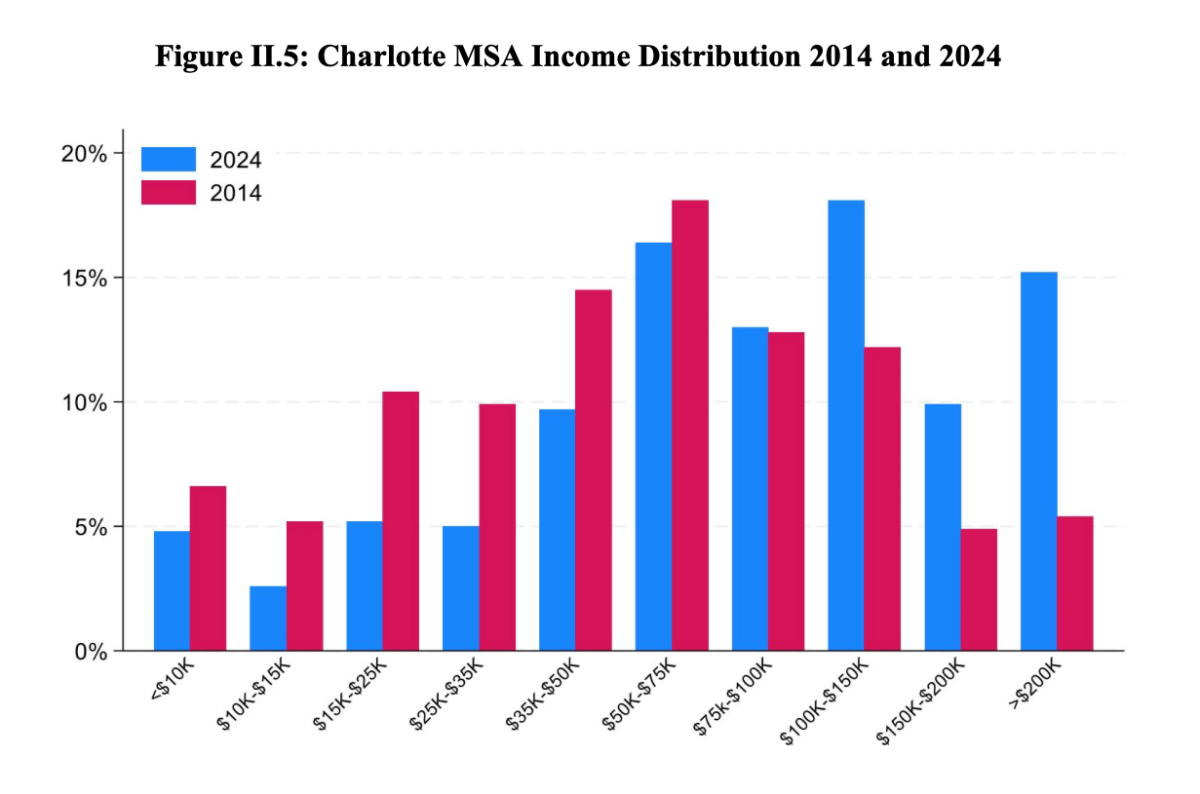
Income distribution in the Charlotte MSA has shifted significantly toward higher earners since 2014, leaving middle- and low-income residents competing for a dwindling supply of affordable options.
(Photo Credit: The University of North Carolina at Charlotte–Belk College of Business and the Childress Klein Center for Real Estate/State of Housing in Charlotte Report 2025)
“Rent is so insanely high that it’s impossible to save up for a down payment to purchase a home,” resident Shelby Proctor wrote in response to a public call for residents’ experiences with housing affordability in Charlotte.
Dozens of residents echoed similar frustrations, describing a housing market that many say has become increasingly inaccessible not only for low-income residents but also for middle-income workers, retirees, and people living on disability income.
“I work hard just to survive,” resident Angie Beers wrote, pointing to rising rent, insurance costs, mandatory apartment fees, and the broader cost-of-living pressures affecting Charlotte residents.
The responses reflected a growing sense of instability among residents who say even full-time employment no longer guarantees financial security in Charlotte’s housing market.
That frustration aligns with findings from researchers behind the 2025 State of Housing in Charlotte report, which found that the median home price in the Charlotte region has climbed to roughly $443,000. Researchers estimated households would need an annual income of approximately $146,000 to comfortably afford a median-priced home in the region.
The report also found that only a small portion of homes sold in the Charlotte area were priced below $300,000, further limiting options for first-time homebuyers.
For many residents, that affordability gap has created a feeling of being financially trapped between rising rents and unattainable homeownership.
“House prices are so insane that you need more than a year’s salary for a down payment,” Proctor wrote.
Rent Relief Remains Limited Despite New Development
Others described how quickly financial stability can unravel under rising housing costs and unexpected expenses.
Tamika Lair said she had previously felt financially stable while earning approximately $62,000 annually and living in an older apartment with rent around $950 per month.
But after her parked car was totaled, she took on a new monthly car payment while also facing rising rent costs. She later lost her position, further straining her finances.
“Now I’m at the bottom of the totem pole again,” Lair wrote, “but with these higher expenses.”
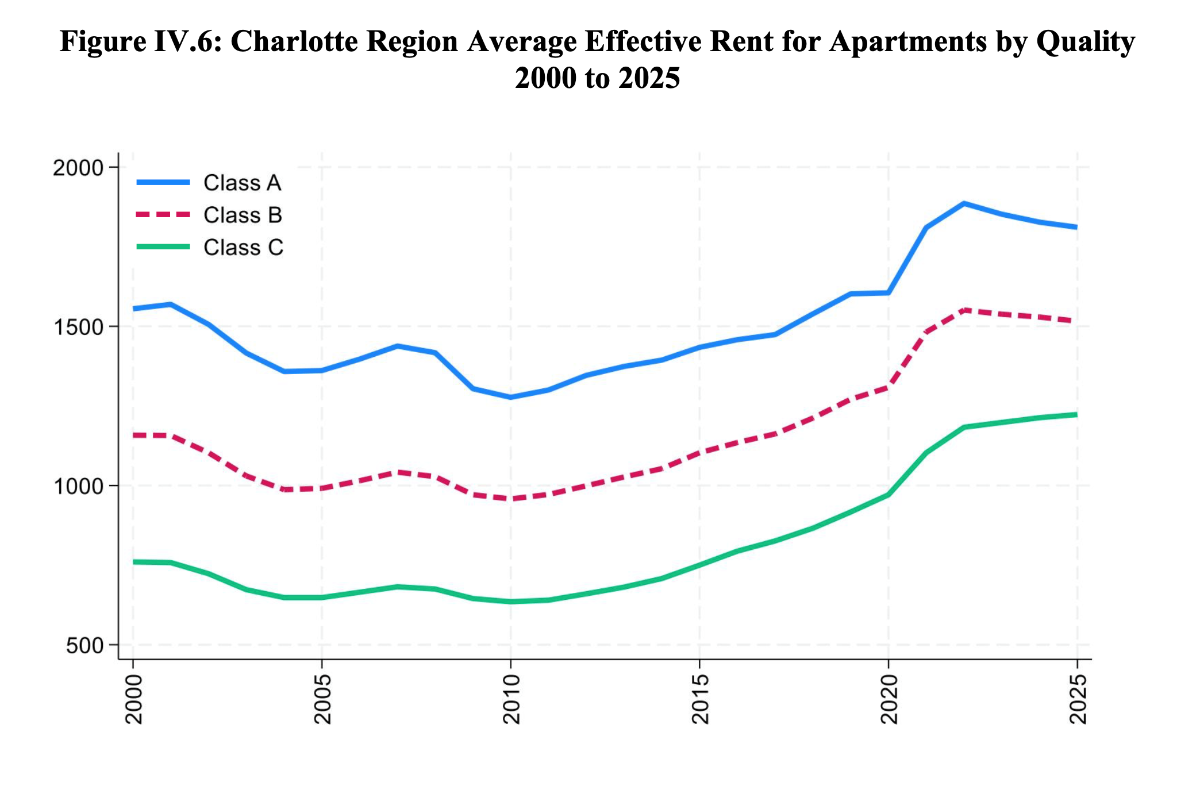
Despite an increase in new construction, average effective rents for all apartment classes remain near historic highs, with Class A units leading the market's price surge.
(Photo Credit: The University of North Carolina at Charlotte–Belk College of Business and the Childress Klein Center for Real Estate/State of Housing in Charlotte Report 2025)
Residents repeatedly described how housing affordability pressures are compounded by broader financial realities, including transportation costs, insurance increases, medical expenses, and mandatory apartment fees.
Several residents also pointed to frustration over apartment application fees and additional charges attached to rental housing.
Joanna Jones criticized the number of application fees renters often pay while searching for housing, while Beers said hidden costs attached to apartment living leave little room for savings or emergencies.
Even as thousands of new apartments continue to rise across Charlotte, many renters say affordability has not meaningfully improved.
Residents Raise Concerns About Housing Quality and Accountability
For some residents, the issue extends beyond affordability itself and into the quality and accountability of available housing.
Maria Morales said she and her family moved out of an apartment complex near Optimist Park after what began as a positive experience deteriorated over time.
“For the amount of money in rent we paid, we felt that was going to be the standard,” Morales wrote. “It was not.”
Morales said the complex, initially marketed as luxury housing, eventually became somewhere her family no longer felt comfortable calling home. She criticized management responsiveness and broader quality concerns while also describing difficulty finding single-family housing options within their budget.
Her family ultimately purchased a newly built townhome, though Morales noted it was not their ideal long-term housing solution.
The issue of accountability in Charlotte’s rental market was echoed by housing advocate Aryanna Baldwin, who said many renters struggle not only with high costs but also with unresolved disputes and maintenance concerns.
“As someone who works directly with Charlotte renters navigating housing disputes, what I see daily goes beyond affordability,” Baldwin wrote. “Renters are dealing with unresolved maintenance, illegal fees, wrongful deposit withholding, and retaliation when they speak up.”
“Affordability gets people in the door,” Baldwin added. “Tenant protections determine whether they can stay.”
Baldwin’s comments reflected a broader divide within the discussion as some residents debated the balance between tenant protections and landlord rights.
While some commenters argued that stronger tenant protections are needed, others expressed concerns about property damage, rising taxes, and the financial pressures landlords themselves face.
Rapid Growth Adds Pressure to Charlotte’s Housing Market
At the same time, residents repeatedly connected Charlotte’s housing pressures to the city’s rapid growth.
According to researchers involved in UNC Charlotte’s housing analysis, the Charlotte metropolitan area added roughly 78,000 residents in a single year, equivalent to approximately 214 new residents per day. The figures were highlighted in a UNC Charlotte housing research advisory discussing regional housing pressures.
Residents frequently referenced Charlotte’s growth directly in their responses, particularly the increasing construction of apartment and townhome developments.
Housing advocates and researchers have also documented a shrinking supply of low-cost housing across the region. According to a Charlotte Post housing insecurity report, roughly 77% of Charlotte’s low-cost housing stock that existed in 2015 had disappeared by 2024, reflecting broader affordability pressures tied to redevelopment and rising housing costs.
“Enough of the townhouses,” one resident wrote, criticizing what they viewed as a declining availability of single-family homes.
Others expressed concerns that Charlotte’s growth is increasingly prioritizing high-density housing while leaving longtime residents uncertain about whether they can remain in the city long-term.
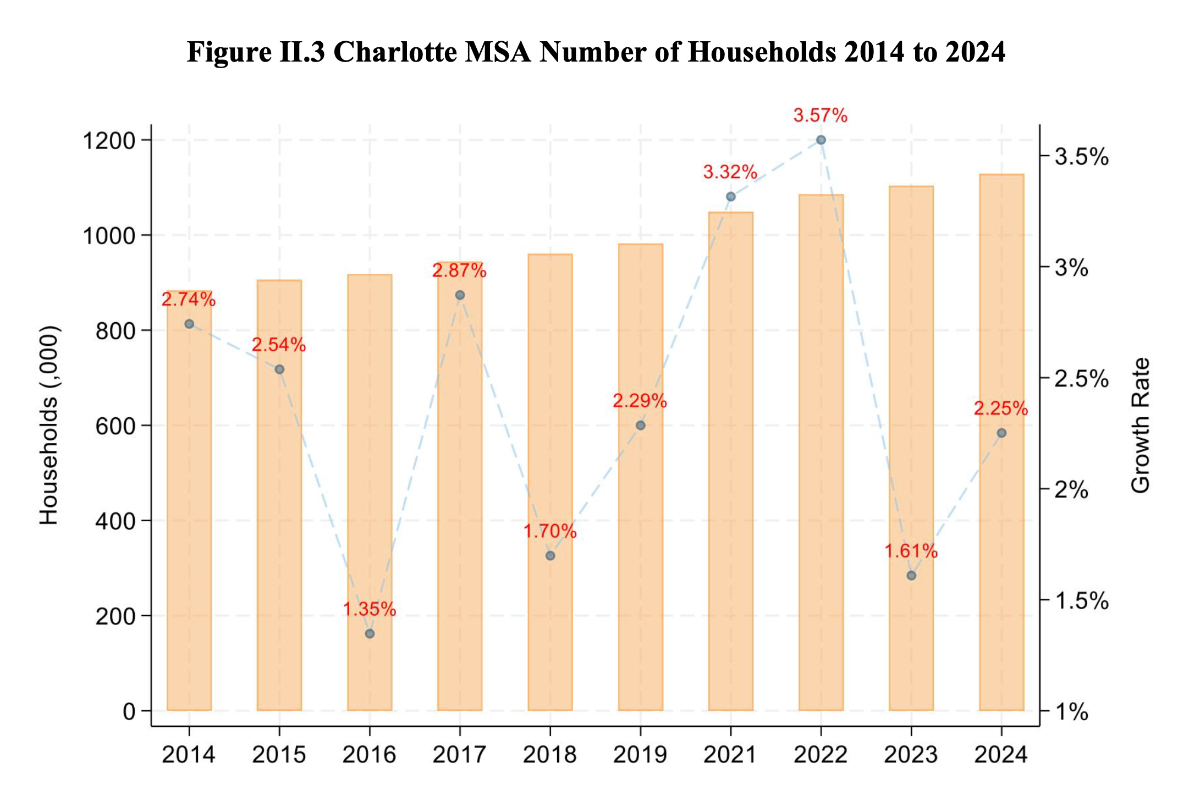
The Charlotte metropolitan area continues to see rapid expansion, adding tens of thousands of new households annually and driving intense demand for limited housing stock.
(Photo Credit: The University of North Carolina at Charlotte–Belk College of Business and the Childress Klein Center for Real Estate/State of Housing in Charlotte Report 2025)
Fixed-Income and Disabled Residents Face Additional Challenges
Retirees and residents on fixed incomes described especially severe financial strain.
Donna Hunt said she has seen townhomes and condominiums within affordable purchase price ranges for retirees, but argued that high homeowners association fees effectively place those properties out of reach.
“So many more people and first-time buyers would be able to be a homeowner if it wasn’t for the outrageous HOAs,” Hunt wrote.
Other residents said rising property taxes have also intensified anxiety among longtime homeowners approaching retirement age.
Francine Black said she ultimately decided to leave Charlotte because she no longer believed remaining in the city during retirement would be financially sustainable.
Meanwhile, residents living on disability income described even fewer housing options.
Anissa Taylor said she has been on a housing waitlist through Inlivian, Charlotte’s public housing authority, since 2014. After becoming disabled in 2017, Taylor said she repeatedly updated the agency while struggling to maintain stable housing.
Inlivian’s Housing Choice Voucher Program notes that housing assistance programs remain limited and are primarily available to low- and extremely low-income households.
Taylor said she eventually moved in with family members because she could no longer afford housing on disability income alone.
Her experience reflects one of the strongest themes repeated throughout the discussion: that Charlotte’s affordability challenges increasingly affect residents across income levels and life stages, from working professionals to retirees and disabled residents.
Residents Share Different Explanations, but Similar Concerns
While residents disagreed sharply on the causes of the city’s housing pressures, pointing variously to government policy, investor-owned housing, corporate property management companies, wages, taxes, and rapid population growth, many shared the same underlying concern: that financial stability in Charlotte feels increasingly difficult to maintain.
The housing data, combined with residents’ experiences, paints a picture of a city where growth has continued at a rapid pace while affordability struggles persist for many who live and work there.
For some residents, the question is no longer simply whether Charlotte is affordable.
Instead, many are asking whether ordinary residents will still be able to build stable futures in the city at all.
You can reach Victoria Osborne at victoriao@lead4earth.org.
(Thumbnail Photo Credit: The University of North Carolina at Charlotte–Belk College of Business and the Childress Klein Center for Real Estate/State of Housing in Charlotte Report 2025)
0
0

Comments