(CHARLOTTE, NC.) – The Charlotte City Council’s Public Safety Committee unanimously recommended changes to the city’s Youth Protection Ordinance during a special meeting on July 14, advancing a proposal that would establish a 9 p.m. daily curfew for anyone younger than 18 following concerns from officials about large youth gatherings, juvenile-related incidents, and public safety.
The proposed ordinance would replace Charlotte’s current age-based curfew schedule with one standard curfew for all minors younger than 18. Existing exceptions for youth traveling to or from work, school-sponsored activities, religious events, or situations involving a parent or guardian would remain unchanged.
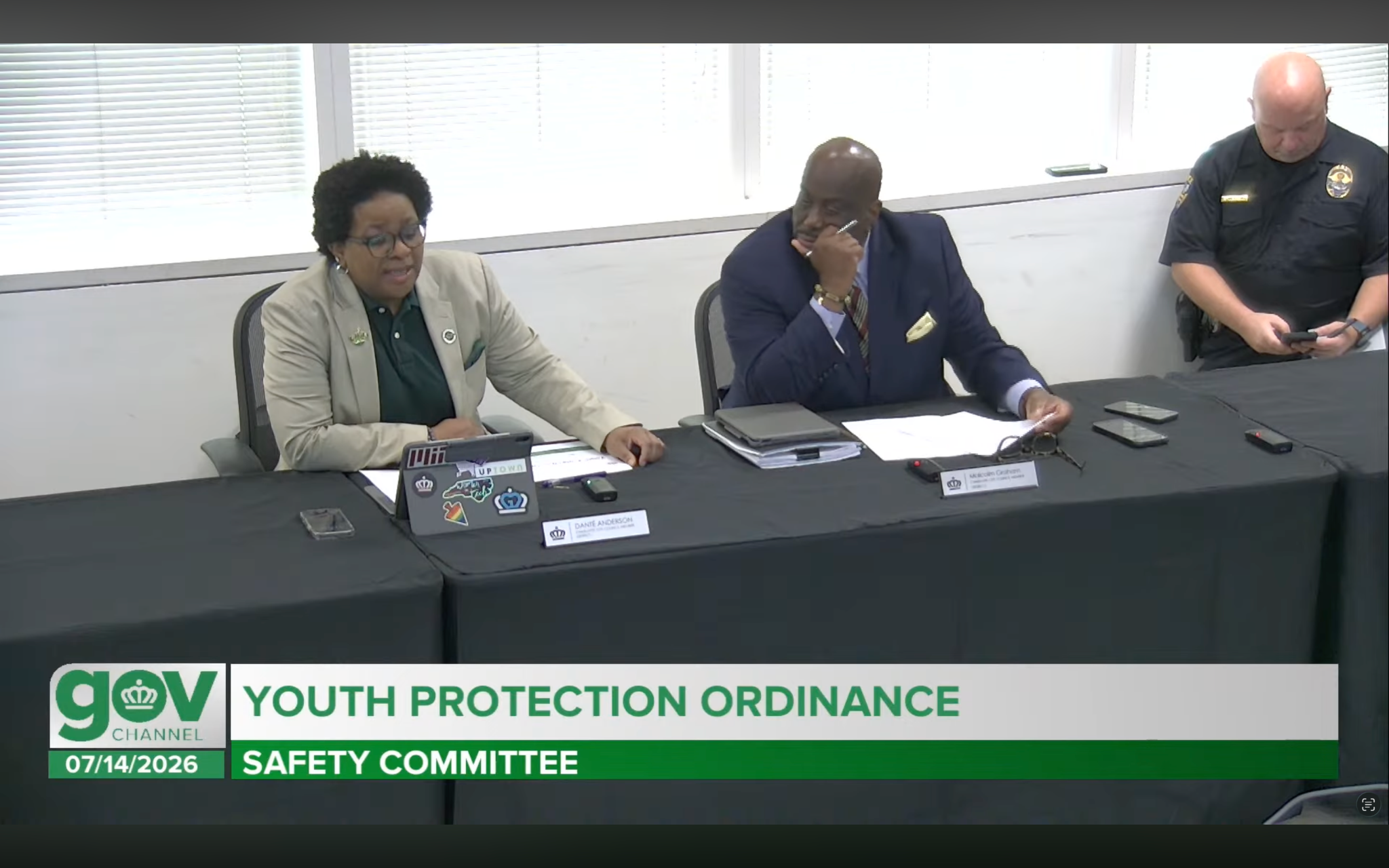
City Council members review proposals to streamline curfew hours for minors across Charlotte.
Photo Credit: City of Charlotte/YouTube
Charlotte-Mecklenburg Police Department officials told council members that simplifying the ordinance would help officers enforce the curfew more consistently by removing the need to determine different age requirements during interactions.
CMPD presented data showing officers have responded to 1,532 incidents involving juveniles since January 2026, including 456 incidents occurring after 8 p.m.
Officials also highlighted several recent incidents, including a June shooting involving teenagers and large July 4 gatherings in University City that resulted in disorderly conduct reports and the recovery of multiple firearms.
Police officials said responding to large youth gatherings requires significant staffing and resources, creating challenges for the department as it manages current personnel and budget limitations.
The department said the current curfew violation numbers remain low because officers often address more serious offenses first or use diversion programs when appropriate. CMPD reported 33 curfew violation charges so far this year.
During the discussion, City Council Member Ed Driggs questioned whether sufficient data showed that similar youth curfews in other cities had reduced crime.
CMPD officials said they reviewed curfew policies in cities including Winston-Salem, Fayetteville, Raleigh, Nashville, Chicago, Indianapolis, Baltimore, and Minneapolis.
Officials presented comparisons of those ordinances but acknowledged that available data measuring long-term effectiveness varied among municipalities.
City Council Member LaWana Mayfield Azmeier requested that staff provide follow-up information within 60 to 80 days if the ordinance moves forward. She said the city should continue focusing on education, prevention, and fair enforcement while evaluating the impact of any changes.
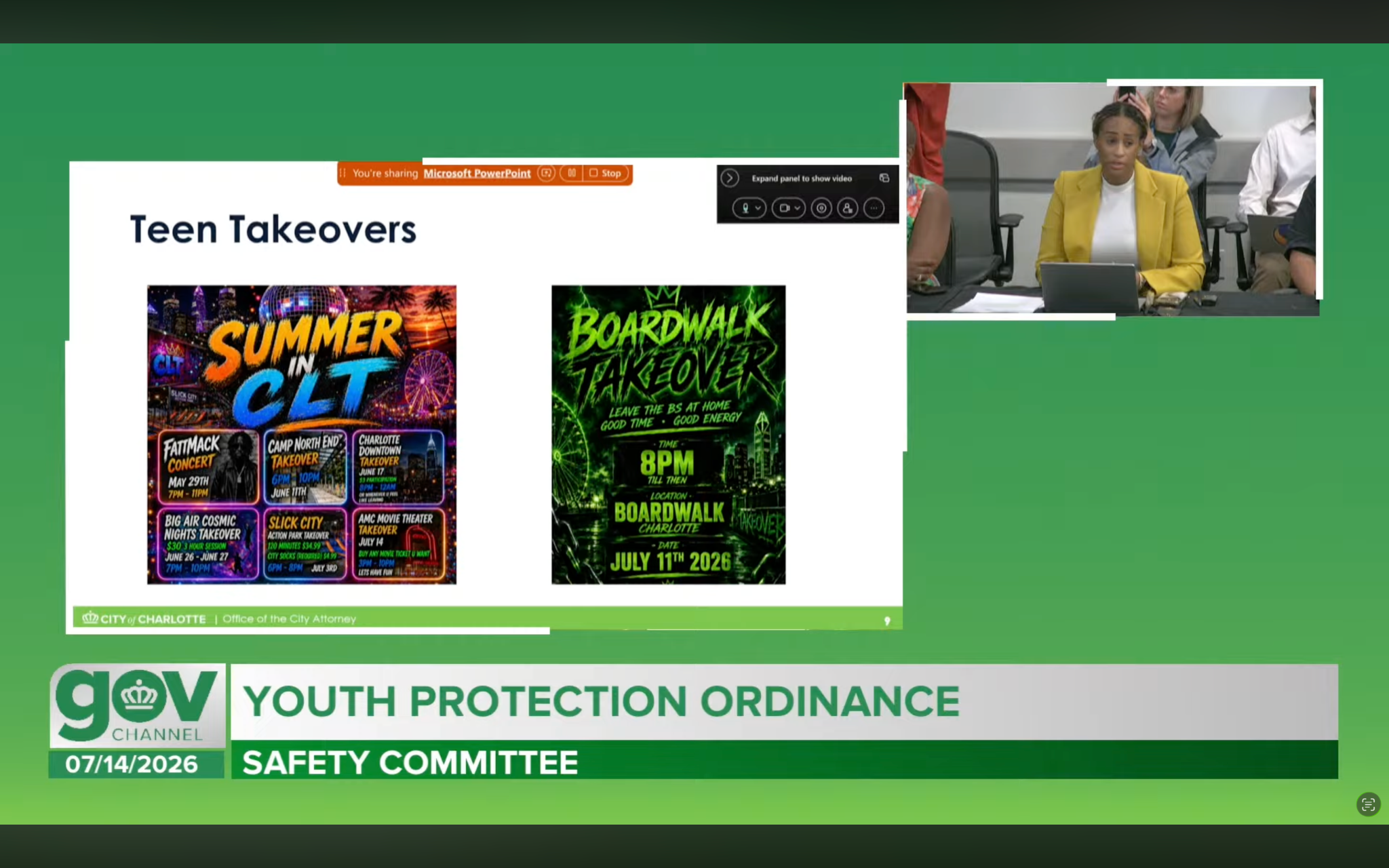
A presentation slide highlights promotional flyers for organized "Teen Takeover" events in Charlotte.
Photo Credit: City of Charlotte/YouTube
Several residents and community representatives spoke during public comment, including representatives from faith-based organizations, Charlotte Center City Partners, and neighborhood groups. Speakers discussed concerns about public safety while also emphasizing the need for additional youth programs, mentorship opportunities, and safe spaces.
CMPD highlighted existing youth engagement efforts, including the Police Athletic League, the REACH program, and community events such as Summer Jam and Pool Jam. Officials said those programs provide structured activities for young people, but acknowledged that additional opportunities are needed.
This push for broader youth engagement and mentorship aligns with national efforts to give young people constructive alternatives and guidance outside of school hours.
As detailed in the San Ramon, California report "No Race Goes Unopposed: Leader Mentorship One-Day Crash Course," written by Chirag Kathrani, local organizations are increasingly turning to intensive training and active mentorship models to empower youth and young adults.
Proponents of these initiatives argue that equipping young people with leadership skills and direct guidance addresses the root causes of youth unrest far more effectively than restrictive municipal policies.
At the same time, institutions are continually re-evaluating daily structural rules to manage youth behavior and engagement environments.
A parallel shift in youth management is unfolding within public education systems as school districts rethink daily boundaries.
As reported in Union City, California, in "New Cell Phone Policy Coming To James Logan High School," written by Madison Vinas, administrators are introducing stricter rules surrounding student devices in an effort to reduce distractions, curb conflict, and foster a safer, more focused environment during peak daytime hours.
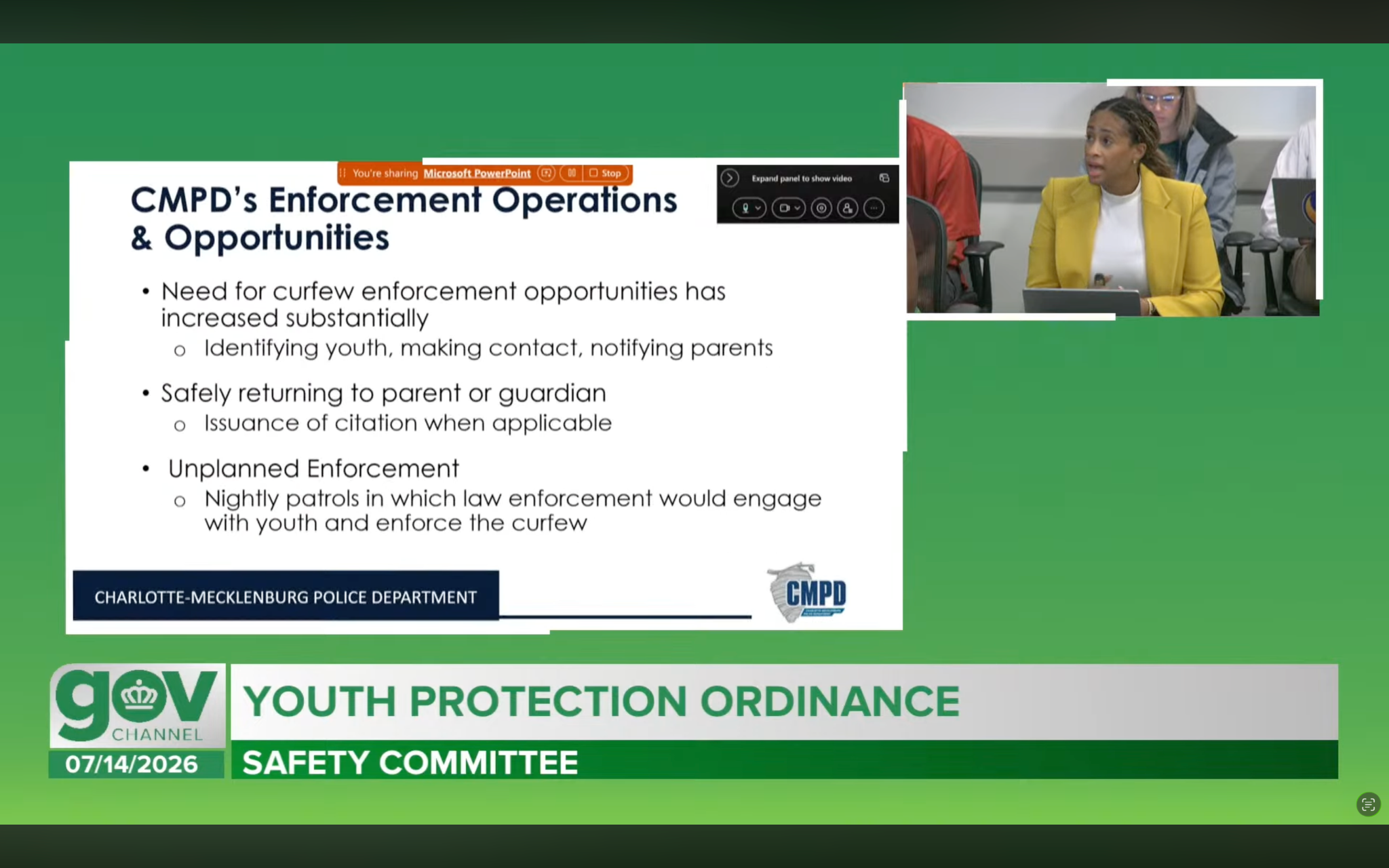
Officials review police operational strategies and engagement opportunities during the presentation.
Photo Credit: City of Charlotte/YouTube
Following the council meeting, viewers continued discussing the proposal in the comments on the city’s YouTube livestream.
One commenter, identified as lajasonlovett3780, wrote, “Give teens a place to go and things to do, and don't automatically see how you can arrest and charge them.”
Another commenter, MissWest86, wrote, “They need discipline and support not just criminalization and permanent records,” while also calling for additional leadership development opportunities for young people.
A third commenter, rashaanpeek9256, questioned how the city plans to address those organizing the gatherings, asking, “How can we get to the source, the flyer designers, the influencers, etc. Will they be charged as well?”
The committee voted unanimously to advance the recommendation to the full Charlotte City Council for consideration.
To add to or correct any information in this report, please contact me at victoria.o@lead4earth.org.
Thumbnail Photo Credit: City of Charlotte/YouTube
0
0

Comments