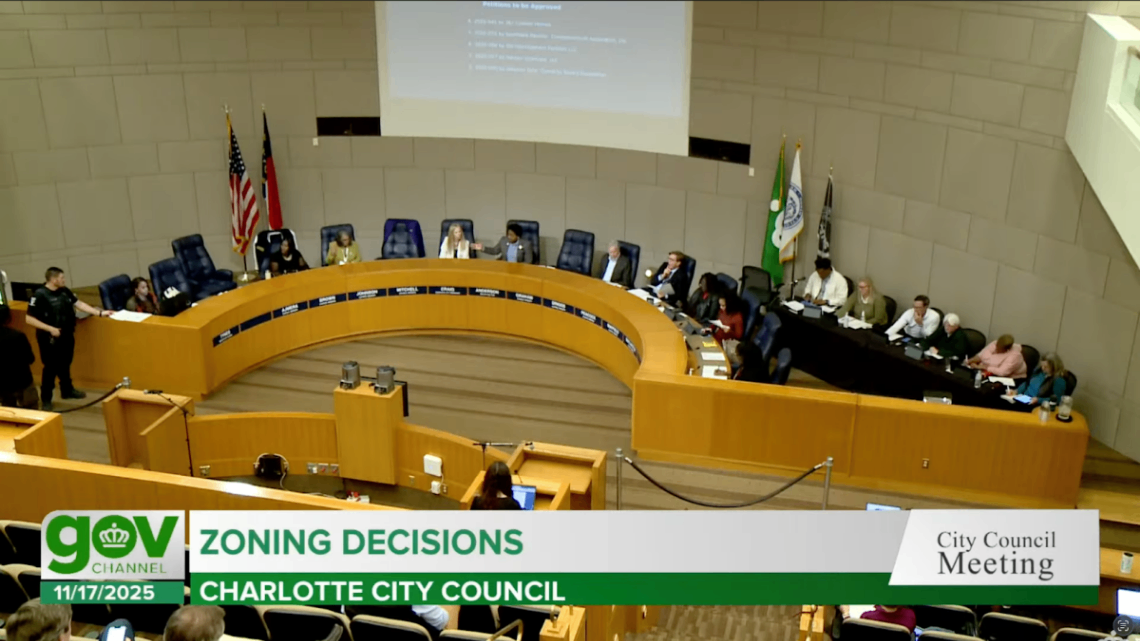
Charlotte City Council meets on Nov. 17, 2025, to review and vote on a slate of zoning petitions that sparked debate over development, neighborhood impacts and economic growth.
(CHARLOTTE) – Charlotte City Council moved a wide mix of rezoning petitions forward last Monday night while weighing neighborhood concerns, economic pressures and long-standing land use rules.
The Nov. 17 meeting, led by Mayor Pro Tem Danté Anderson, followed earlier debate on transit board appointments and questions about transparency. What followed was a long zoning agenda that showed how the city’s 2040 Policy Map works when residents, developers and staff collide in the same room.
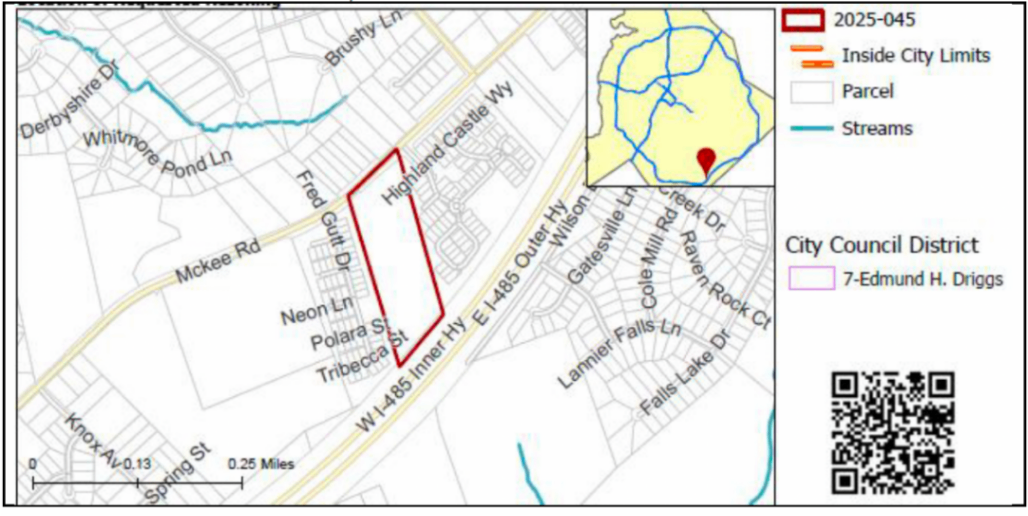
The proposed rezoning would shift 9.09 acres south of McKee Road, east of Fred Gutt Drive and west of Glenmore Garden Drive from Neighborhood 1-A to Neighborhood 1-D.
(PHOTO: CITY OF CHARLOTTE)
A request to rezone a small parcel off Motorsports Lane drew some of the night's strongest reactions. Planning staff said the change from Neighborhood 1B to General Commercial was not consistent with policy, but noted the corridor already functions like a commercial and logistics area.
Residents disagreed.
“I bought that property in 1988,” resident Carolyn Westbrook said. “I’m seeing snakes and rats coming from that vacant lot… I do not want to jeopardize my property for somebody else’s benefit.”
Another neighbor, Mr. Dunn, said he tolerated parked cars but not the repair activity happening behind his home.
“There’s compressors, noise and fumes at all hours,” he said.
Council Member LaWana Mayfield encouraged residents to report the issues.
“Call 311 and use the CLT+ app,” Mayfield said.
Council Member Dimple Ajmera also asked staff whether stronger buffers or a Class A screen could help. The petitioner and staff discussed whether a conditional rezoning could better address concerns.
One of the most complicated items involved Brookhill Village, a historically Black neighborhood near Remount Road. The proposal creates a special overlay to allow temporary uses such as markets, sports courts, and food truck events on part of a 42-acre site under a 99-year ground lease that ends in 2049.
Planning staff called the case “one of the most unique projects” they have worked on and recommended not approving it “in its current form,” citing unresolved issues with sidewalks, streets, and utilities.
Attorney Colin Brown, representing the petitioner, said the goal is to activate land that has sat mostly vacant. “We’re asking, could we do farmers' markets? Could we have a food truck rally? None of that is allowed today,” Brown said.
He added that full street upgrades would cost roughly $7 million and cannot be supported by temporary uses.
“If the city wants that, we’ll need cooperation,” he said.
Council Member Ed Driggs warned about setting a precedent without a clear benefit to the public.
“When you start making concessions on zoning requirements, we need to know what the quid pro quo is,” Driggs said.
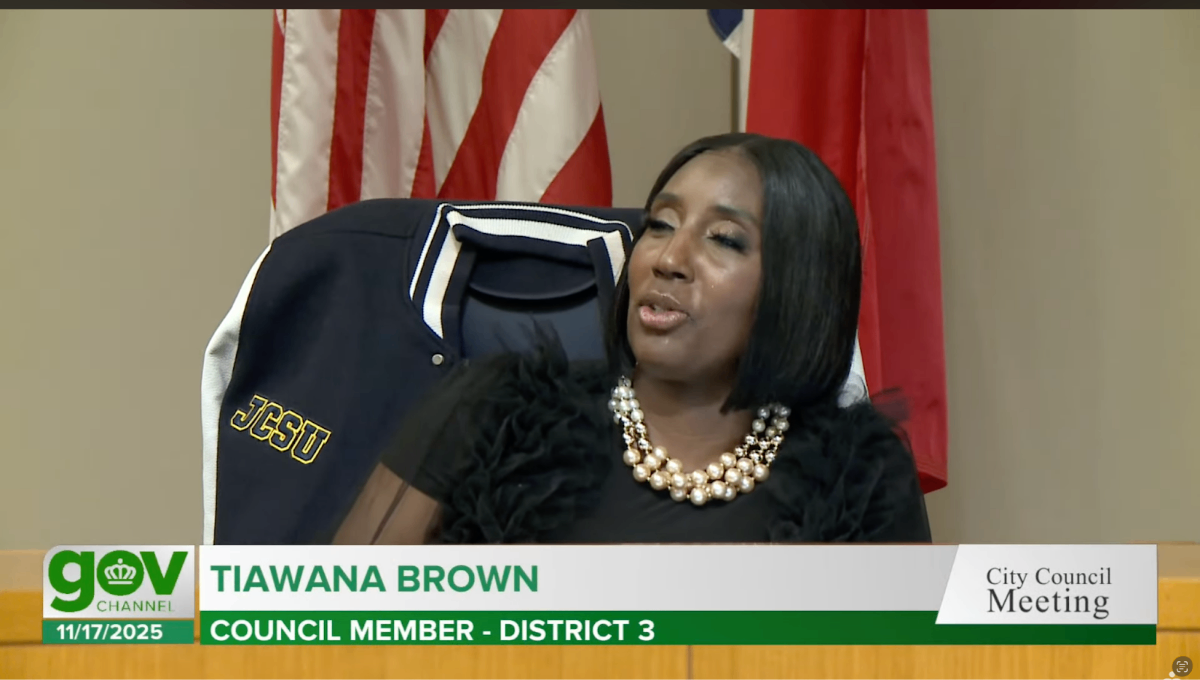
District 3 Council Member Tiawana Brown speaks during the Nov. 17, Charlotte City Council meeting, where she urged more investment and attention for long-neglected neighborhoods.
(PHOTO: CITY OF CHARLOTTE)
District 3 Council Member Tiawana Brown said residents deserve more.
“I don’t like riding by and just seeing what I see,” Brown said. “We need to put the same love into this area as any other part of the city.”
Council also heard a proposal for 397 homes along IBM Drive and Neil Road, including apartments and attainable townhomes aimed at teachers, first responders, and other essential workers.
Developer James Scruggs described the project as intentionally mixed-income.
“Our attainable homes might sell for $450,000 on the open market,” Scruggs said. “These mortgages are structured so 80% AMI households can own for under $300,000.”
Environmental advocate Marjorie Marinescu told council the city must take tree loss more seriously.
“We request a site-specific tree save plan showing how many trees will be removed versus preserved,” she said.
District 4 Council Member Renee Johnson said she hopes the developer and staff can continue negotiations. “I hope we can get to a better balance,” Johnson said.
A different debate unfolded in Hidden Valley, where residents supported a Dutch Bros Coffee drive-thru near the Tom Hunter Blue Line station. Staff opposed the plan because it conflicts with transit-oriented development goals, but neighborhood leaders said they want visible private investment.
“From Sugar Creek to Tom Hunter, there has been little to no economic development,” Hidden Valley Community Association President Marjorie Parker said. “We need businesses, jobs, and amenities.”
Anderson, who represents the district, said she supported the request.
“This economic opportunity doesn’t come along every term,” Anderson said.
The Council also advanced several other rezonings with little pushback, including a Living Spaces furniture showroom on Tyvola Road, a group of transit-oriented development rezonings near the Blue Line, a 24-unit townhome project near Shopton Road, a Toll Brothers plan for 113 townhomes near Old Statesville Road, and a Carmel Commons project with 380 apartments and ground-floor retail.
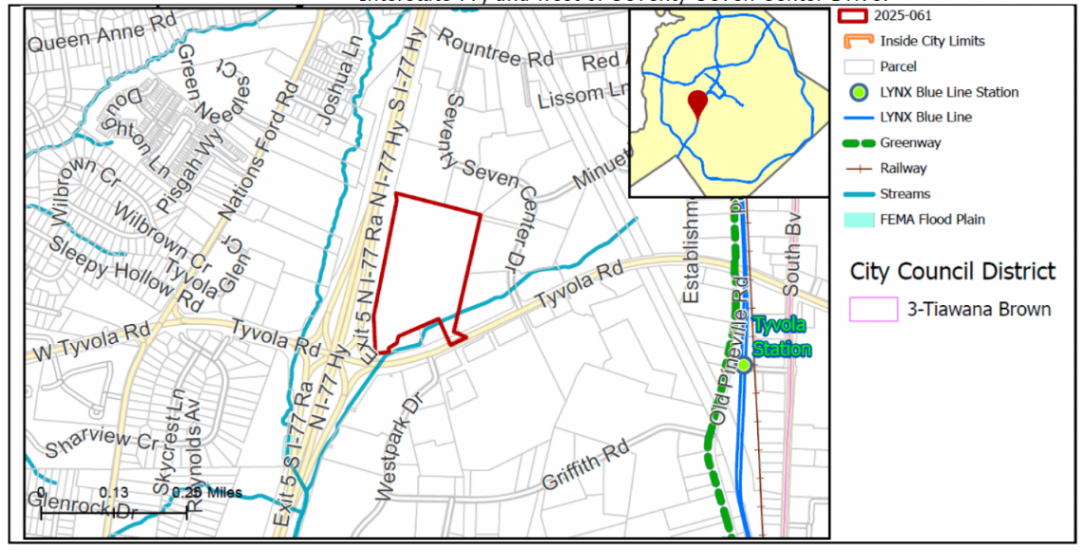
The 20.95-acre site north of Tyvola Road and east of Interstate 77 is proposed to shift from Manufacturing & Logistics 2 to Manufacturing & Logistics 1 under rezoning petition 2025-061 in District 3, represented by Council Member Tiawana Brown.
(PHOTO: CITY OF CHARLOTTE)
Not everything passed quietly.
A rezoning at Valleydale Road and Fred D. Alexander Boulevard drew objections from resident Quentin Mann, who said the wooded area shields nearby homes.
“I bought it because I was told it would stay a wooded area,” Mann said. “Now traffic’s up, accidents are up, trash is up.”
Johnson again questioned why some cases come in as conventional rezoning without a site plan.
“Residents deserve to know what’s going to be built there,” she said.
The night closed with a cleanup rezoning for Zealous Empowering Nurturer, aligning a long-standing community garden with current rules. Anderson adjourned the meeting after hours of debate that showed how even small rezonings can force Charlotte to balance growth, neighborhood stability, and environmental concerns.
If you have questions or tips, contact me at victoria.o@lead4earth.org.
0
0

Comments