(CHARLOTTE) — Charlotte City Council approved a slate of uncontested rezoning petitions and deferred several others during a zoning meeting Monday evening at the Charlotte-Mecklenburg Government Center.
The meeting, which began shortly after 5 p.m., included more than 30 rezoning cases affecting neighborhoods across the city, along with approval of the city’s 2026 regular and budget meeting schedule.
Council members voted early in the meeting to approve the proposed 2026 calendar, which adds midyear performance check-ins for council-appointed positions and moves annual performance reviews closer to the end of the fiscal year.
City Clerk’s Office staff said the schedule complies with state law requiring the city to adopt and publicly post its regular meeting calendar each year.
Most zoning cases were approved through the consent agenda, which allows council members to vote on multiple petitions in a single motion. The approvals come as Charlotte continues to face housing demand and affordability pressures, according to the 2025 State of Housing in Charlotte report from UNC Charlotte’s Belk College of Business. No items were pulled from consent during the meeting.
All consent agenda items met the required criteria, including no public opposition at earlier hearings, unanimous recommendations from the Zoning Committee, and approval recommendations from city planning staff.
The rezonings come as Charlotte leaders continue to address growth pressures tied to housing supply and infrastructure, issues the council discussed earlier this month. Several petitions changed industrial or low-density zoning classifications to neighborhood-scale residential uses, reflecting ongoing growth and redevelopment across Charlotte.
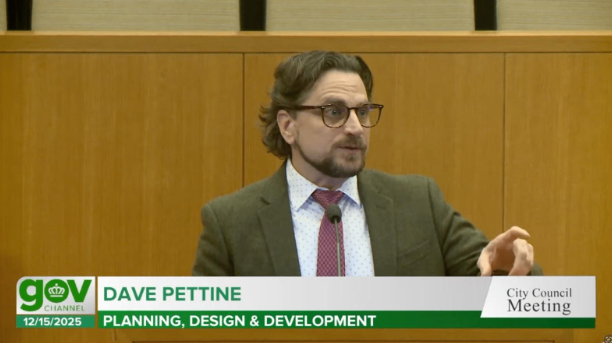
Dave Pettine, with the city's Planning, Design, and Development Department, presents rezoning proposals to the City Council on Dec. 15, 2025. (PHOTO: CITY OF CHARLOTTE)
City officials have said updates under Charlotte’s Unified Development Ordinance are intended to encourage a broader mix of housing types and densities across the city.
One approved item involved a rezoning request from the Charlotte-Mecklenburg Hospital Authority to allow general office use on a site in south Charlotte. Another consent item modified zoning for a logistics property near Interstate 77, shifting it to a lower-intensity manufacturing and logistics classification.
Council members also granted multiple deferral requests from petitioners seeking additional time before final consideration. Several rezonings were deferred to the Jan. 20, 2026, zoning meeting, including proposals in east, south, and southwest Charlotte.
Council acknowledged the deferral requests without objection. Deferred cases include rezonings for neighborhood centers and residential developments where petitioners said they need more time to address transportation concerns, site design issues or coordination with surrounding property owners.
Holly Cramer with the Planning, Design, and Development Department during a Charlotte City Council zoning meeting. (PHOTO: CITY OF CHARLOTTE)
Several rezoning cases returned to the council for decisions following earlier public hearings. Among them was a west Charlotte proposal involving more than 42 acres along South Tryon Street that previously received a divided recommendation from the Zoning Committee. City planning staff reiterated during the meeting that they do not recommend approval of the petition in its current form, citing unresolved issues outlined in the final staff analysis.
Another rezoning petition discussed during the meeting involved an 8.65-acre site along Mt. Holly-Huntersville Road in northwest Charlotte. The request from Tryon Advisors, LLC seeks to rezone the property from neighborhood 1-A to neighborhood 2-B conditional zoning to allow increased residential density.
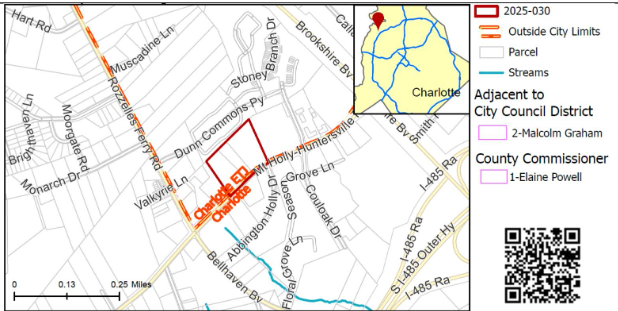
A city planning map outlines Rezoning Petition 2025-030, which proposes a multi-family townhome development and childcare center on an 8.65-acre site (PHOTO: CITY OF CHARLOTTE)
The site is located on the north side of Mt. Holly-Huntersville Road, east of Rozzelles Ferry Road and south of Dunn Commons Parkway in Council District 2. City planning staff said they recommend approval of the petition once outstanding issues related to transportation, site, and building design are resolved.
During discussion of a separate rezoning tied to long-term planning considerations, a land use consultant said revisions were made after feedback from nearby residents concerned about access and traffic flow. Land Use Consultant Bridget Grant with Moore & Van Allen said residents requested a change to improve circulation through the area.
“One of their last suggestions was for us to provide an access driveway behind Cooks Presbyterian through the existing church campus over to Cool Oak,” Grant said.
Another rezoning discussed during the meeting was Petition 2025-109 by Ravin Partners, which seeks to amend the site plan for a 1.46-acre property in east Charlotte. The site is located east of East Independence Boulevard, north of Hayden Way and west of Lakeview Circle in Council District 5.
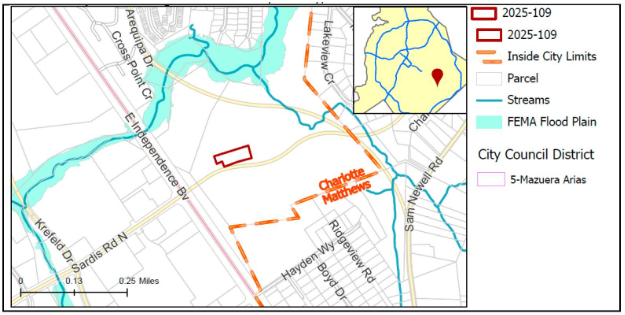
Site plan amendment for a 1.46-acre property near East Independence Boulevard in east Charlotte to allow neighborhood-scale residential uses. (PHOTO: CITY OF CHARLOTTE)
The request would change the zoning from general commercial conditional to neighborhood 2-B conditional with a site plan amendment. City planning staff said they recommend approval of the petition once an outstanding issue related to site and building design is resolved. Floodplain considerations have increasingly factored into development reviews nationwide, including in Charlotte.
Colin Brown, speaking on behalf of the petitioner, Ravin Partners, referenced earlier community engagement connected to the broader area.
“And so when we did this 80-acre rezoning a few years ago, there was great interest from the community," Brown said. "We had a large engagement; we had a pretty big crowd here.”
Other decision items involved rezonings across north and northeast Charlotte that would allow increased residential density under neighborhood 2-A and 2-B zoning classifications. Many of those petitions received unanimous recommendations from the Zoning Committee and were approved by the council without discussion.
The agenda also included multiple rezoning hearings for projects that will return to the council for future votes. Several of those petitions involve large-scale residential or mixed-use developments and require additional work related to transportation planning, environmental considerations, or site and building design.
City planning staff indicated during the meeting that several hearing items could move forward once outstanding technical issues are resolved, including traffic impacts, access points and site layout revisions.
Deferred and hearing items are expected to return to the council in January.
You can reach Victoria Osborne at victoria.o@lead4earth.org.
0
0

Comments