(CHARLOTTE, N.C.) – Charlotte City Council approved a slate of rezoning petitions Tuesday night amid public opposition, internal confusion over new zoning analysis, and mounting frustration from residents who say the city’s growth is outpacing infrastructure, environmental protections, and neighborhood safety.
The full Charlotte City Council Zoning Meeting referenced in this report is available on the OpGov.ai platform here: January 20th Charlotte City Council Zoning Meeting.
The Jan. 20 zoning meeting featured dozens of rezonings across nearly every council district, many of which passed unanimously. But extended debate, multiple deferrals, and emotional testimony revealed growing tension between Charlotte’s long-term development goals under the 2040 Comprehensive Plan and residents’ quality-of-life concerns.
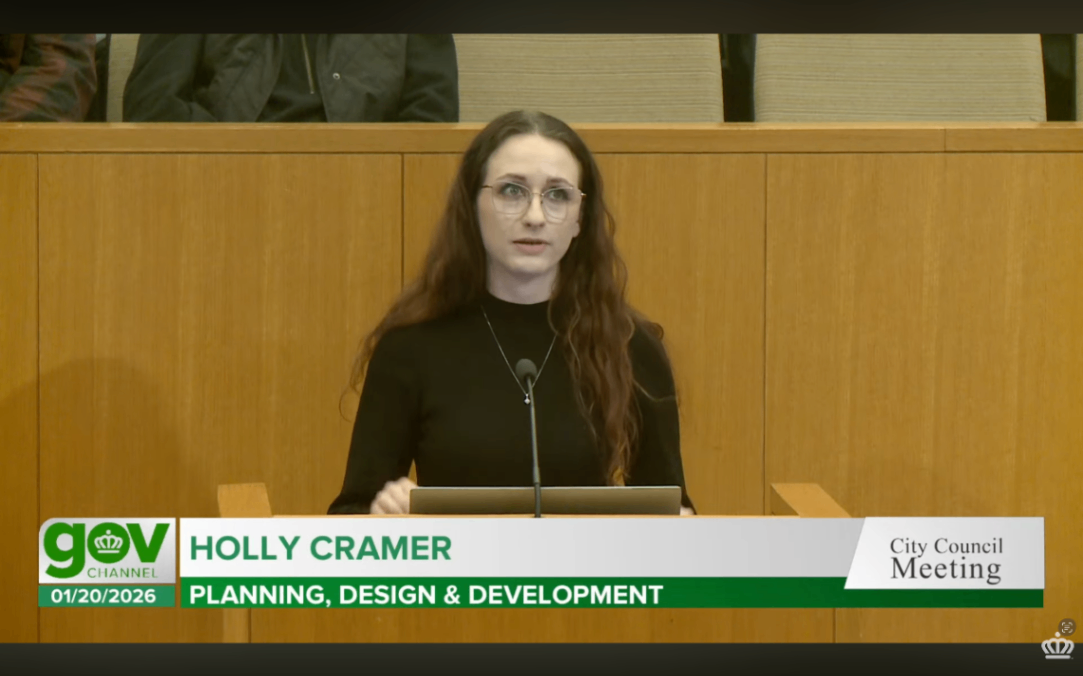
Holly Cramer of the Planning, Design & Development department presents to the Charlotte City Council during the Jan. 20 meeting.
(Photo Credit: YouTube/City of Charlotte)
OpGov.ai’s AI review of the full zoning agenda, staff reports, and meeting transcript flagged repeated concerns related to traffic congestion, stormwater runoff, and neighborhood compatibility across multiple petitions. Follow-up reporting by OpGov.ai confirmed these themes were echoed by residents during public comment and by council members during deliberations.
Council members questioned how newly implemented staff analysis tools align with the 2040 Policy Map and adopted community area plans, with some expressing uncertainty over how consistency determinations are being made and whether the information is easily accessible to the public.
That confusion spilled into the online livestream, where viewers voiced frustration in real time.
“That's just what East Charlotte needs, more affordable housing while North and South Charlotte get new rail and road upgrades,” wrote YouTube user @LeoLeft.
OpGov.ai reviewed the agenda, staff reports, public testimony, and livestream comments and published a comprehensive breakdown of the meeting, including rezoning outcomes, deferrals, and vote tallies.
Eight rezoning petitions were deferred to the Feb. 16 meeting, including requests from Crosland Southeast, Atapco Properties, and American Asset Corporation, as developers and staff continue working through unresolved transportation, environmental, and site design concerns.
Several rezonings advanced without opposition. Council unanimously approved Morris Holdings’ 9.72-acre rezoning along Mallard Creek Road, with Council Member Renee Johnson citing its location and support from community associations. A 1.46-acre petition by Ravin Partners near East Independence Boulevard also passed unanimously despite traffic concerns, after the Charlotte Department of Transportation noted reduced trip counts and existing commitments.
One of the most significant approvals involved Charter Properties’ 65-acre rezoning near West Mallard Creek Church Road and Galloway Road. The project includes 100 affordable senior housing units restricted at 80% of the area median income for more than 20 years, contingent on Housing Trust Fund support, and a $10,000 contribution toward traffic calming. Council members also highlighted preservation efforts tied to a historic African American slave cemetery located on the site.
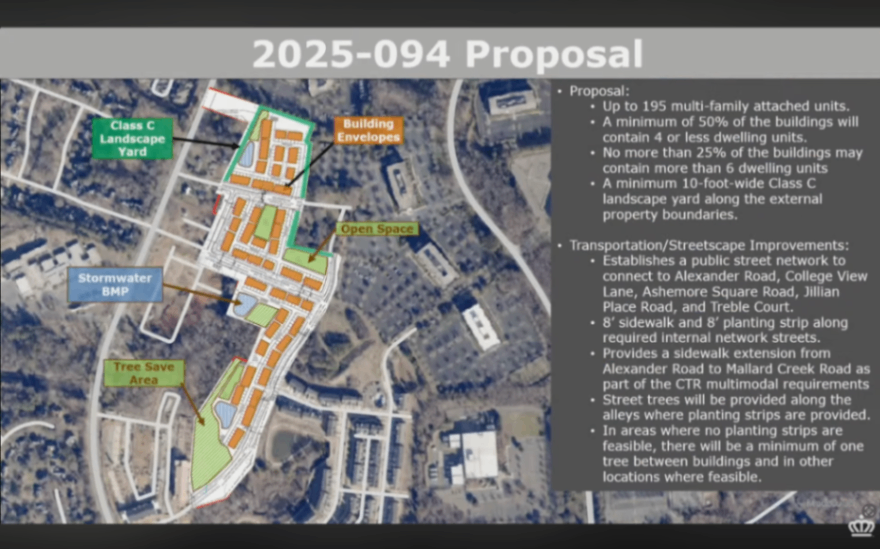
A site plan details Atapco Properties for up to 195 townhomes east of Mallard Creek Road.
(Photo Credit: YouTube/City of Charlotte)
Other petitions drew sharp opposition.
Residents criticized Crosland Southeast’s proposal for 164 units near Wilora Lake Road, including 144 affordable senior housing units, arguing that four-story buildings were incompatible with surrounding single-family neighborhoods and would worsen safety along high-injury roadways.
“This proposal pushes four-story buildings deep into single-family neighborhoods and creates serious public safety risks on roads that are already dangerous,” public commenter Mory Mahood said.
Opposition intensified around Atapco Properties’ proposal for 195 townhomes east of Mallard Creek Road. Residents cited congestion near Mallard Creek Elementary School, forced connectivity through existing neighborhoods, and cumulative impacts of development without infrastructure upgrades. Council Member Johnson voted against the petition, citing traffic and school capacity concerns.
Environmental impacts were also central to opposition against Northway Homes’ request to downzone property near Kentberry Drive. Residents described severe stormwater runoff, stream erosion, and flooding risks that they said would worsen with additional impervious surfaces.
Throughout the meeting, developers pointed to affordable housing commitments as a public benefit. Residents and some council members, however, questioned whether age-restricted rental housing meets the city’s broader need for workforce homeownership.
Frustration with the zoning process itself was evident among livestream viewers.
“I'm going to have to watch these more often because this is a circus,” wrote YouTube user @DevonteLove-b4h.
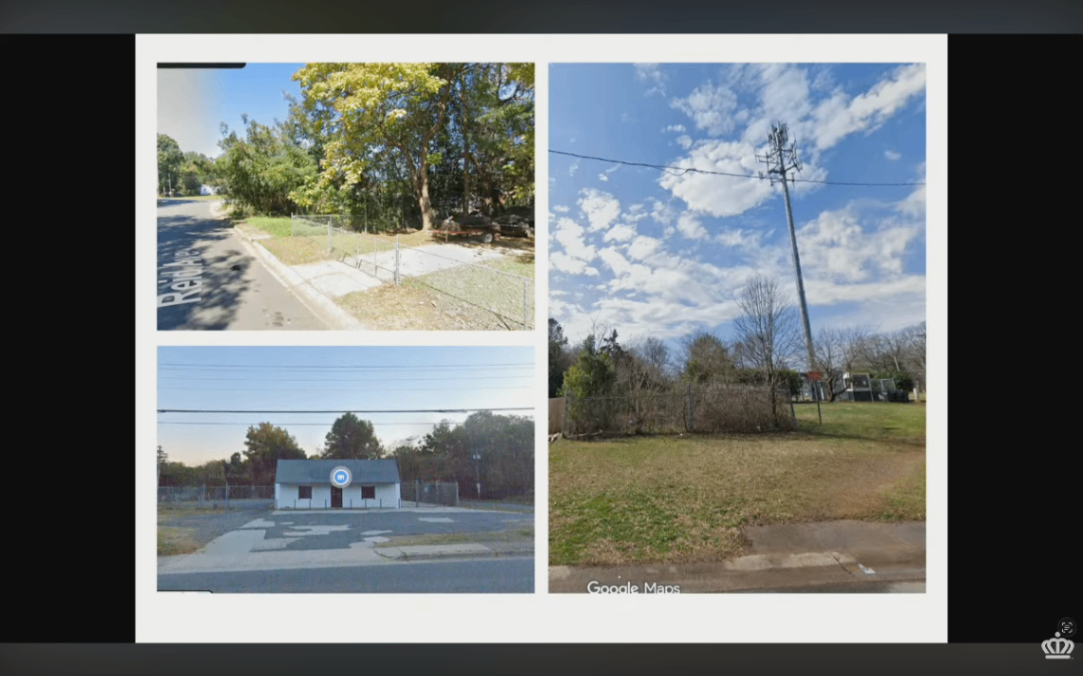
Street-level views presented during the meeting show the current conditions of properties up for rezoning.
(Photo Credit: YouTube/City of Charlotte)
Similar tensions are playing out nationwide. According to the American Planning Association, zoning reforms intended to increase housing supply frequently face resistance when infrastructure investment and community engagement lag behind development approvals. A 2024 Urban Institute analysis found that traffic congestion, flooding concerns, and neighborhood compatibility are the most common drivers of public opposition to higher-density housing across U.S. cities.
OpGov.ai reporting shows this pattern extending beyond Charlotte. In Gilbert, Arizona, residents recently raised quality-of-life concerns during a town council meeting focused on high-density housing. In Pensacola, Florida, members of the Urban Core Redevelopment Board faced pushback as officials promoted affordable housing downtown while residents questioned scale, location, and long-term neighborhood impacts.
Planning Director Monica Holmes announced upcoming community area plan workshops and urged council members to encourage public participation. The meeting opened with an invocation emphasizing the separation of church and state, quoting Martin Luther King Jr., and included a moment of silence for Lance Sautello.
As Charlotte continues to grow, Tuesday’s meeting underscored that zoning decisions are no longer routine land-use matters but flashpoints in a broader debate over equity, safety, and the future shape of the city.
Make sure to comment and let us know your thoughts!
You can reach Victoria Osborne at victoria.o@lead4earth.org
Thumbnail Photo Credit: YouTube/City of Charlotte
0
0

Comments