(CHARLOTTE) — Charlotte City Council moves forward with a regional wastewater partnership, new affordable housing investments and major infrastructure contracts during its final business meeting of 2025, even as residents sound alarms over transit violence, advisory board restrictions and the city’s shrinking tree canopy.
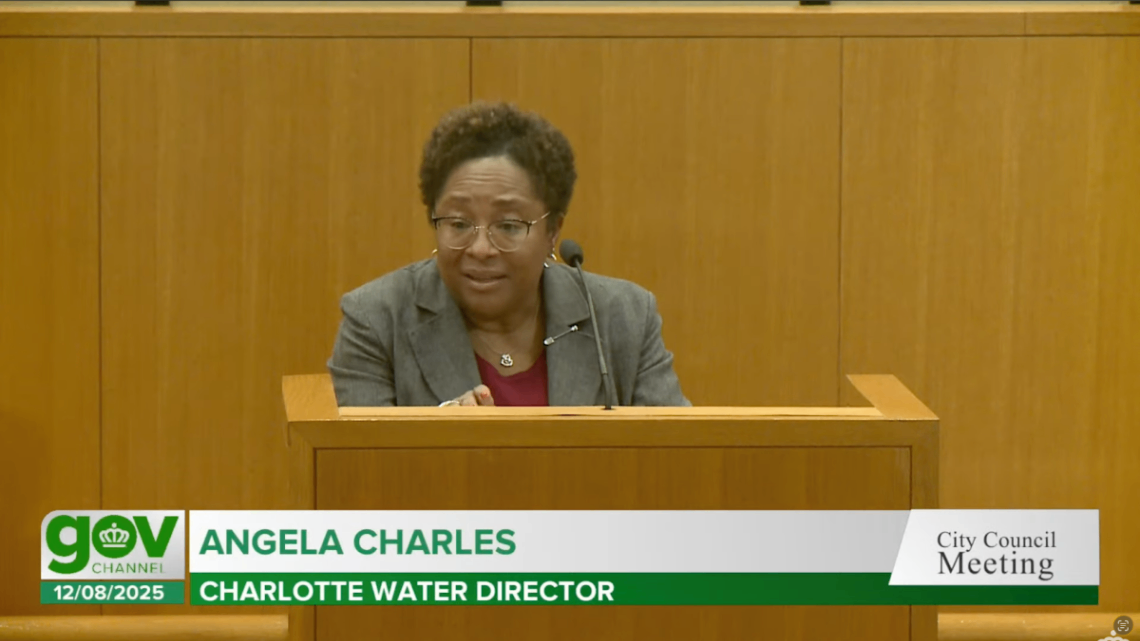
Charlotte Water Director Angela Charles discusses the regional partnership with Mount Holly and Belmont. (PHOTO: CITY OF CHARLOTTE)
Council members approved the measures after a meeting that began with celebration, recognizing Johnson C. Smith University’s football team for its 2025 CIAA championship win and praising the victory as a point of pride for the city. But the tone shifted sharply during the public forum, where several speakers criticized the city’s response to recurring violence on the Lynx Blue Line and urged leaders to address deeper systemic failures rather than relying solely on increased police presence.
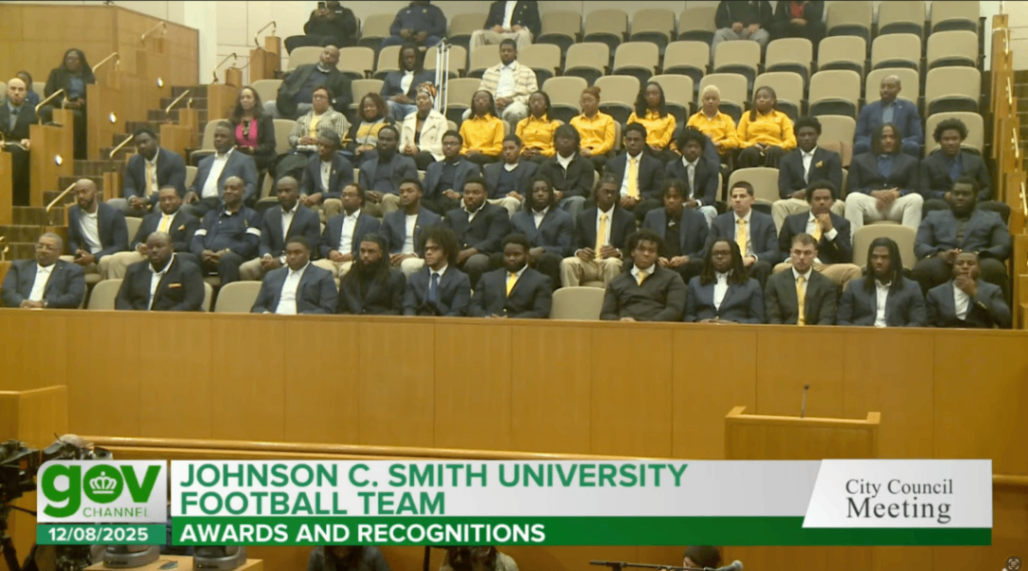
Charlotte City Council kicked off their meeting with cheers, honoring Johnson C. Smith University’s 2025 CIAA championship (PHOTO: CITY OF CHARLOTTE)
Residents also questioned the city’s ethics policy for advisory boards. Speakers argued that language restricting members from “advocating” against council policy contradicts free-speech rights and discourages civic participation during the meeting.
Charlotte Water Director Angela Charles briefed council on a regional partnership involving Mount Holly and Belmont that will allow those towns to rely on Charlotte for wastewater treatment.
“We need partnerships with Mount Holly and Belmont to accommodate the growth on the Mecklenburg County side. . . At the end of the day we will have a cleaner and better Catawba River for our region… ,” Charles said.
Nationally, the U.S. Environmental Protection Agency has urged similar regional collaborations as aging local plants struggle to meet capacity demands and pollution rules.
District 5 Council Member Marjorie Molina pressed the utility to help residents understand what services they pay for depending on where they live.
“It would be really helpful to leverage our Government Channel to educate residents on how your organization is truly a regional utility… Folks really don’t know what they’re paying for with their taxes and what they’re not receiving,” Molina said.
The council also approved a $465,000 purchase of three single-family homes on Catherine Simmons Avenue for long-term affordable housing, part of a joint city-county effort targeting persistent homelessness, substance-abuse concerns and nuisance properties in the Beatties Ford Road corridor. Nationally, cities from Denver to Minneapolis are increasingly purchasing older homes to preserve naturally affordable housing and reduce displacement.
Real Estate & Building Industry Coalition (REBIC) Executive Director Rob Nanfelt addresses Charlotte City Council.
(PHOTO: CITY OF CHARLOTTE)
Public safety dominated much of the meeting. Residents described fear and frustration after two recent stabbings on the light rail, calling current security insufficient. A UNC Charlotte student pushed council to partner with academic experts on bystander-intervention training, saying policing alone cannot solve underlying issues of mental health and housing instability.
Charlotte residents have raised similar concerns about safety and community trust in a previous meeting, including a November session where speakers demanded stronger protections for immigrant families and vulnerable communities.
At-Large Council Member Dimple Ajmera echoed those concerns in her remarks to city staff.
“We need to do everything that we can to restore confidence in our system… students and workers depend on public transit and people do not feel safe right now,” Ajmera said.
Cities nationwide are facing similar concerns, with the National League of Cities reporting rising pressure on transit safety systems, mental-health response gaps and the inability of local governments alone to manage growing public safety demands.
Other speakers highlighted workforce challenges tied to child care shortages, the growing affordability gap identified in a UNC Charlotte housing study and the need to protect Charlotte’s diminishing tree canopy. A South Charlotte resident described watching eight mature trees near her home be demolished despite the city’s stated canopy goals.
Concerns about Charlotte’s shrinking tree canopy have been recurring throughout the fall, with council previously debating how to balance development pressures with environmental protection.
Council members later raised several policy issues of their own. They deferred approval of the 2026 meeting calendar after disputes over how to schedule employee evaluations and whether the city should conduct a mid-year review of its appointed officials. Several members raised concerns about repeating past delays.
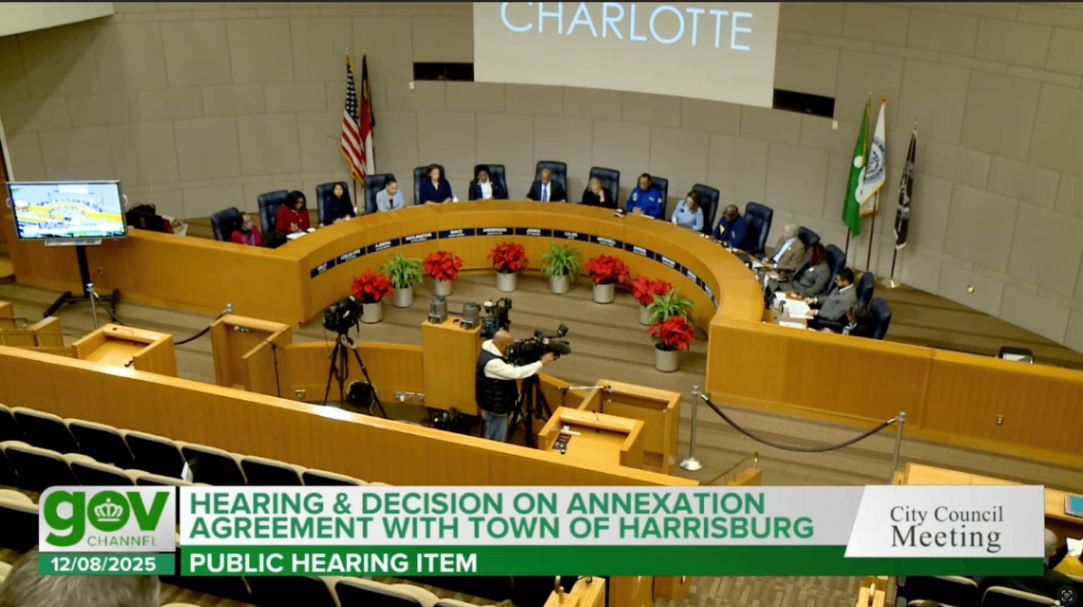
Charlotte City Council greenlights a 10-year annexation agreement with Harrisburg and approves key upgrades to the airport, CATS, and wastewater systems. (PHOTO: CITY OF CHARLOTTE)
The council also adopted a 10-year annexation agreement with the Town of Harrisburg, preventing either jurisdiction from annexing across the county line, and approved upgrades across airport, CATS, and wastewater systems.
Discussions throughout the night reflected broader national challenges. Cities across the country are facing similar tensions between managing rapid growth and maintaining public safety, investing in aging infrastructure and addressing mental-health needs without adequate state support.
Council members closed the meeting by reiterating their commitment to public safety, environmental stewardship and intergovernmental partnerships. But several also acknowledged that the year ahead will require more aggressive, coordinated action if Charlotte is to meet the expectations residents expressed during the forum.
You can reach Victoria Osborne at victoria.o@lead4earth.org.
0
0

Comments