(CHARLOTTE, N.C.) — The Charlotte City Council approved a series of rezonings last Monday night, deferred seven cases to March, and debated industrial expansion and updates to the city’s development rules.
At the Charlotte-Mecklenburg Government Center, council members balanced routine land-use approvals with broader discussions about affordability, accessibility, and neighborhood impacts, reflecting a tension seen nationwide as cities weigh housing expansion against local protections.
Research from the Brookings Institution highlights the role of accessory dwelling units in boosting housing supply, while the Urban Institute has documented how municipal land-use policies shape affordable housing availability.
Items on the consent agenda were approved unanimously after meeting criteria that included no public opposition, zoning committee approval, and no post-committee changes. Several rezonings were deferred at the petitioners’ requests until March 23.
Among the approved cases was petition 2025-025 by Angelo Tillman, covering 4.75 acres off Moss Road in District 3. Minor conditional-note changes did not return to the zoning committee, but the plan passed with support from District 3 Council Member Joi Mayo, who praised the developer’s engagement with residents. “Excited to continue to hear about potential jobs that will come to our area if this is passed. And loved our conversation as well, talking about a potential bus stop at this location,” Mayo said.
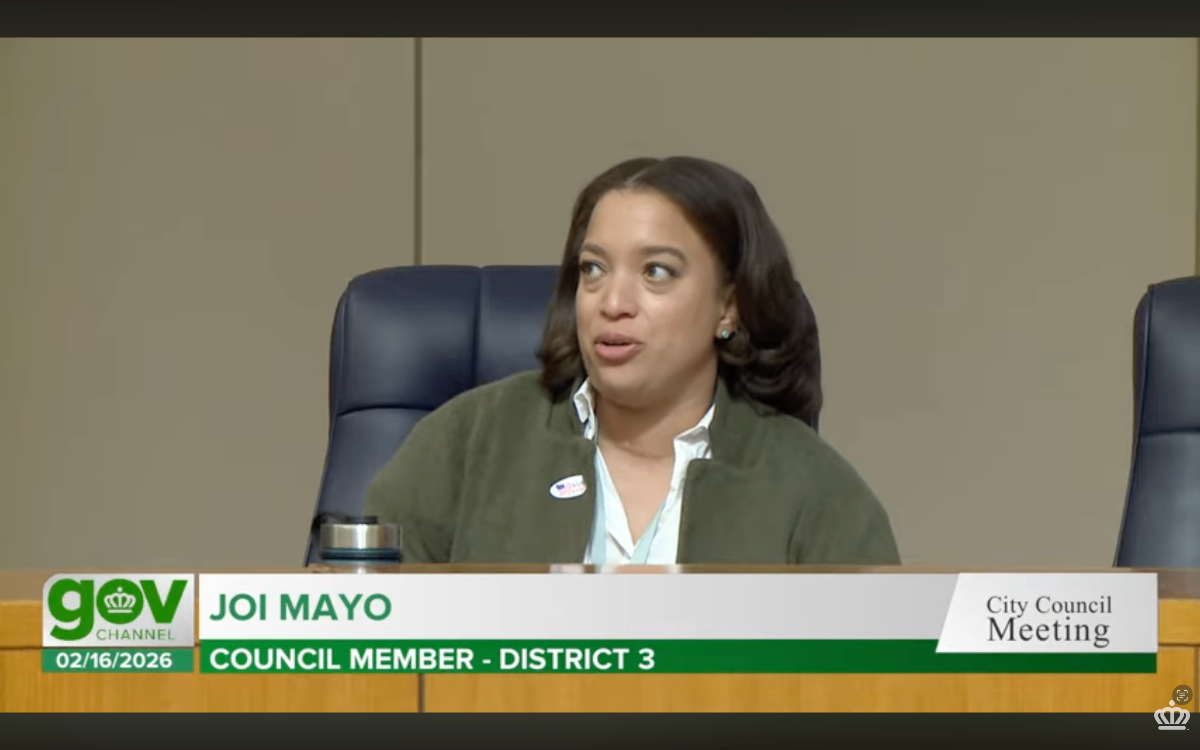
Charlotte City Council Member Joi Mayo addresses colleagues during a zoning hearing, expressing support for projects tied to job creation and transit access while urging additional community engagement.
(Photo Credit: City of Charlotte/YouTube)
Council also approved petition 2025-076 by Kevin Nguyen LLC to rezone 2.58 acres on Shopton Road. The developer agreed to additional sidewalks, a crosswalk, converted visitor parking, and sound mitigation following neighborhood feedback. Mayo credited collaboration with the Still Creek Residents Association for shaping those commitments.
Northway Homes’ petition 2025-088, involving 3.51 acres south of Kentberry Drive in District 2, also won approval. The plan prohibits vinyl siding, a change prompted by community input. Council Member LaWana Mayfield raised questions about driveway commitments but said developer concessions and neighborhood support justified her vote.
Council devoted significant time to petition 2025-118, a sweeping text amendment updating 25 of 39 articles in the city’s Unified Development Ordinance to align with the Charlotte Future 2040 Comprehensive Plan. Changes include expanded flexibility for ADUs, broader allowances for outdoor and farmers markets, revised solid waste standards, and updated wireless telecommunications setbacks.
Council Member Dimple Ajmera pressed staff on the timeline for city-provided ADU design templates, saying they could lower costs and speed approvals for homeowners. “At some point, we were also looking at design templates to incentivize ADU developments to help us tackle the affordable housing crisis,” Ajmera said.
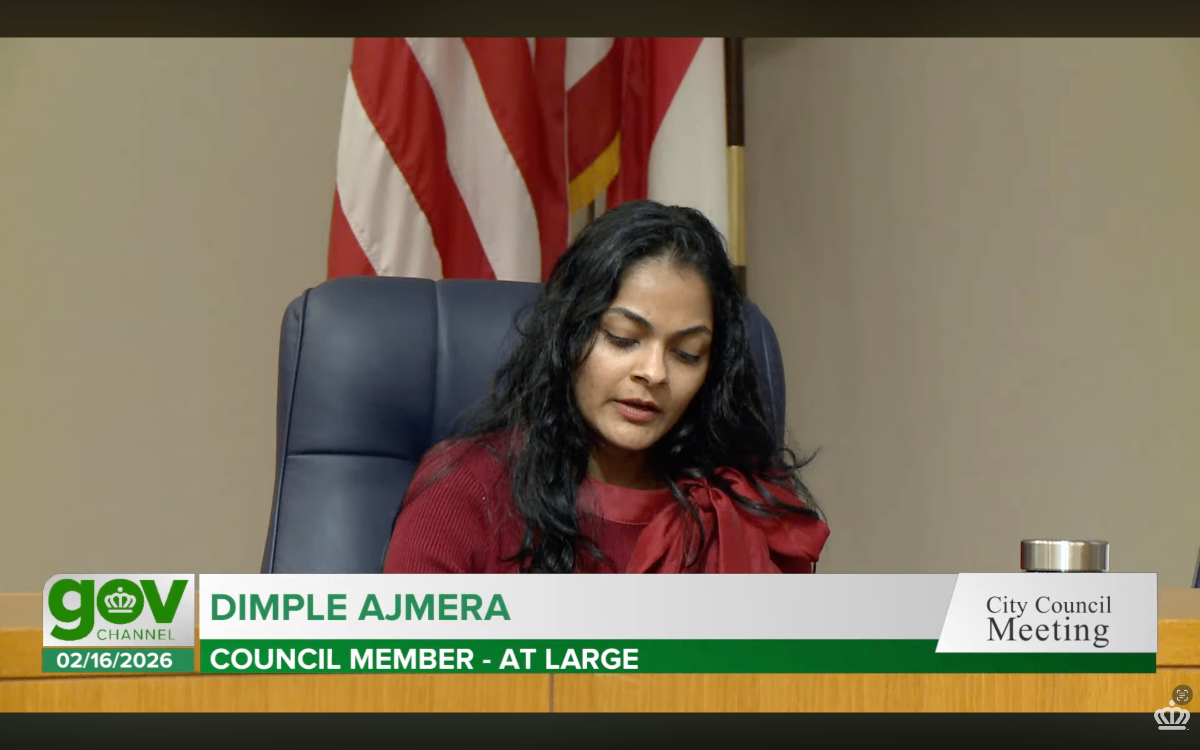
Charlotte City Council Member At-Large Dimple Ajmera speaks during a zoning hearing at the Charlotte-Mecklenburg Government Center, where she raised questions about accessory dwelling unit design templates as part of updates to the Unified Development Ordinance.
(Photo Credit: City of Charlotte/YouTube)
Kimberly Owens and Mayfield emphasized that templates should include ADA-compliant features, such as wider doorways and accessible bathrooms. Mayo praised allowing outdoor markets in more zones, noting it could improve food access in underserved neighborhoods.
The discussion reflects tensions in other communities. In Maui County, a recent OpGov.Ai article reported frustration over slow rebuilding and limited affordable housing after wildfires. Sacramento recently approved a six-story mixed-use development amid neighborhood opposition, citing state housing accountability laws that restrict when cities can deny residential projects.
Council Member Malcolm Graham described the ordinance as a “living document,” saying updates are essential as Charlotte grows.
The most contentious debate involved petition 2025-086 by Pence Road Development LLC, seeking to rezone 31.17 acres to ML-2 conditional for a rail freight terminal. Planning staff recommended denial over concerns about industrial uses near residential neighborhoods and recreational areas.
Petitioner representative Colin Brown argued that portions of the property are railroad-owned and federal law could preempt local zoning if the railroad built an internal facility. He said the conditional ML-2 request offered stronger public protections, including buffers and operational limits, than a by-right project.
Several council members questioned the claim.
JD Mazuera Arias asked about federal preemption and whether noise, vibration, and environmental studies were conducted. Ajmera cautioned against heavy industrial zoning near single-family neighborhoods and requested a clearer list of prohibited uses and a quality-of-life impact study. Owens pressed for details, comparing proposed buffers with federally preempted requirements. Mayo called for more community outreach, noting limited attendance and evolving project details.
Council did not take final action last Monday.
Other approvals included petition 2025-114 by Charlotte-Mecklenburg Hospital Authority to rezone 0.56 acres on Lombardy Circle for a passive therapy park with seating, gardens, and a 25-foot landscape buffer. Council confirmed the privately owned park would remain accessible to the surrounding neighborhood.
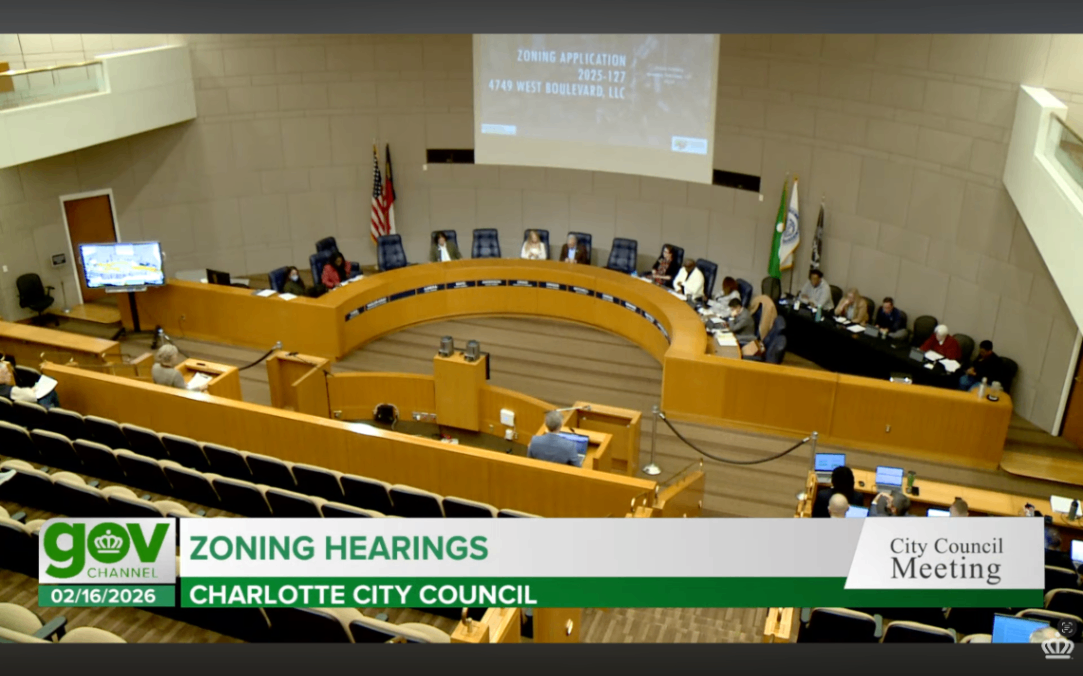
The Charlotte City Council meets for zoning hearings at the Charlotte-Mecklenburg Government Center on Feb. 16, 2026, advancing housing-related amendments and debating a proposed rail freight terminal on Pence Road.
(Photo Credit: City of Charlotte/YouTube)
Council also approved a site plan amendment for The Huntington National Bank in Ballantyne, church expansions, corporate headquarters development on West Boulevard, and a 65-unit affordable townhome project near West Sugar Creek Road. Proposed by True Homes and University City United Methodist Church, the homes would remain reserved for households earning at or below 80% of the area median income for at least 100 years without city funding.
As Charlotte faces continued growth pressures, last Monday’s meeting reflected the council’s effort to advance housing and economic development initiatives while scrutinizing projects with potential environmental and neighborhood impacts. Like communities nationwide, Charlotte continues to grapple with using policy tools, from ADUs to zoning reform, to expand housing while preserving quality of life.
The full council meeting transcript and materials are available on OpGov.ai at Charlotte City Council Meeting.
Make sure to comment on your opinions on how Charlotte is handling rezoning!
You can reach Victoria Osborne at victoria.o@lead4earth.org
(Thumbnail Photo Credit: City of Charlotte/YouTube)
0
0

Comments