(CHANDLER, Ariz.) – Chandler voters will not decide any contested mayor or City Council races on the November 3 general election ballot after those seats were filled in the July 21 primary. Residents will still vote on Proposition 430 (Home Rule), an Arizona Public Service franchise question, and four proposed City Charter amendments.
The July 21 primary decided the mayor’s race and three at-large City Council seats. Matt Orlando was elected mayor after incumbent Kevin Hartke reached the term limit. Jane Poston, Angel Encinas, and Cicely Rocha-Miller were elected to the three council seats. Under Chandler rules, candidates who receive a majority of votes in the primary are elected outright and do not appear on the general election ballot. The general election was therefore canceled for those races.
Photo Credit: City of Chandler
The highest-impact item on the November 3 ballot is Proposition 430, which continues the city’s local alternative expenditure limitation, known as Home Rule. Approval allows the City Council to set its own spending limit for the next four years after at least one public hearing instead of following the state formula.
According to the city’s analysis, a no vote would require Chandler to follow the state’s expenditure limitation and would reduce the annual budget by approximately $232 million, affecting public safety, parks, libraries, and other services. A yes vote continues Home Rule for fiscal years 2027-28 through 2030-31. A no vote places the city under the state formula. Chandler voters have approved Home Rule eleven consecutive times since 1982. Full details are on the city’s Home Rule page.
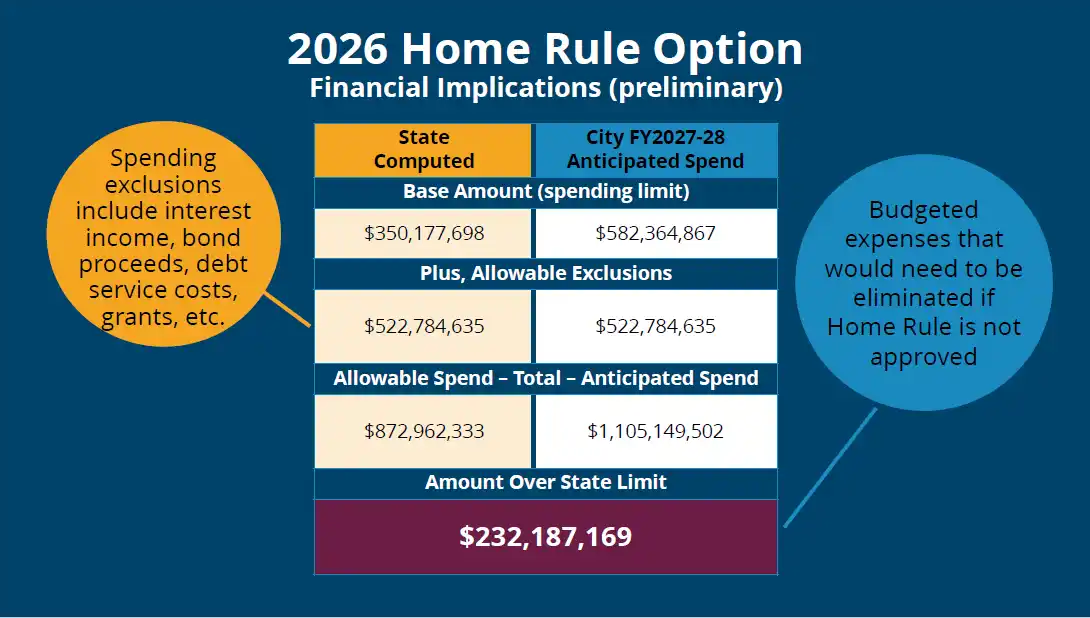
Photo Credit: City of Chandler
Question 1 asks voters whether to grant Arizona Public Service a 25-year franchise, from January 1, 2027, through December 31, 2051, to construct, maintain, and operate its electric system in city rights-of-way. A yes vote grants the franchise under Ordinance No. 5160. A no vote rejects it. The city has stated that approval does not increase electricity rates. The full ballot language appears on the city’s General Election page.
Four charter amendments recommended by the Charter Amendment Resident Advisory Committee and referred by the City Council are also on the ballot. Each is a technical or procedural change rather than a spending or rate issue:
Proposition 431 clarifies that the vice mayor is selected at the first regular City Council meeting in January each year. A yes vote adopts the clearer timeline. A no vote keeps the existing language.
Proposition 432 aligns the charter’s resign-to-run rule with state law so that a councilmember who files nomination papers to run for mayor is treated as having resigned upon filing. A yes vote matches state law and current practice. A no vote retains the current wording.
Proposition 433 removes the requirement that ordinances be introduced at one meeting and adopted at a second meeting. A yes vote allows single-meeting adoption. A no vote keeps the two-meeting process.
Proposition 434 updates residency rules: the city manager and other Council-appointed positions (city attorney, city clerk, and city magistrate) must establish residency in Chandler within 12 months instead of six months; most other department heads no longer face a residency requirement; and all employees must live within a reasonable distance of the city. A yes vote adopts the updated rules. A no vote keeps the current language.
The city’s information pamphlet and sample ballot, including official titles and arguments for and against each measure, are posted on the General Election page. The Charter Amendment Voter Information Guide is available here.
No contested city offices appear on the November 3 ballot. Residents interested in running for mayor or council in a future cycle can contact the City Clerk’s Office for candidate information.
To add to or correct any information in this report, please contact me at george.y@lead4earth.org. Comment below what you think about the measures on Chandler’s November ballot.
0
0

Comments