
(OPGOV GLOBAL) – Any migraine sufferer can hand over a list of their migraine triggers on-demand. Try as they might, though, some triggers simply can’t be avoided – or, rather, they’re trickier to avoid as a part of everyday life.
For some, that trigger can be critical thinking.
It may sound bizarre, but yes, using your brain for high-level thinking or processing complex information for long periods of time can absolutely bring on a migraine, hence why long study sessions, an intense workflow, or problem-solving can land a migraine sufferer in a flare, even if all other migraine triggers are avoided. This is especially true for high-level brain activity that’s stressful.
Psychological migraine triggers are making waves in recent research, directing attention to the pressures that make it difficult for people who suffer from migraine disorder to cope with stress.
Migraine disorder comes with a menu of multiple varieties. Most common is migraine without aura, which accounts for up to 75% of migraine cases, but many also experience migraines with aura, which is accompanied by visual disturbances that can alert to an incoming attack. Other migraines are unaccompanied by pain, while still others can arrive with a multitude of other symptoms in tow.
For those affected, however, any migraine can mean hunkering down for treatment, sometimes for days at a time.
Since stress is a major factor being measured for this discussion, a quick breakdown of migraine versus tension headaches is in order: a tension headache is the most common headache type, characterized by a dull ache or pressure around the head; migraine, on the other hand, is associated with several mild to severe symptoms ranging from nausea and head pain to photophobia and phonophobia sensitivity (sensitivity to light and sound, respectively).
A 2020 study published in the Caspian Journal of Neurological Sciences analyzed the differences in patients with migraine and tension headaches. The study found that patients with migraine have a higher rate of RNT “(repetitiveness, intrusiveness, difficulties with disengagement)” than patients with tension headaches alone.
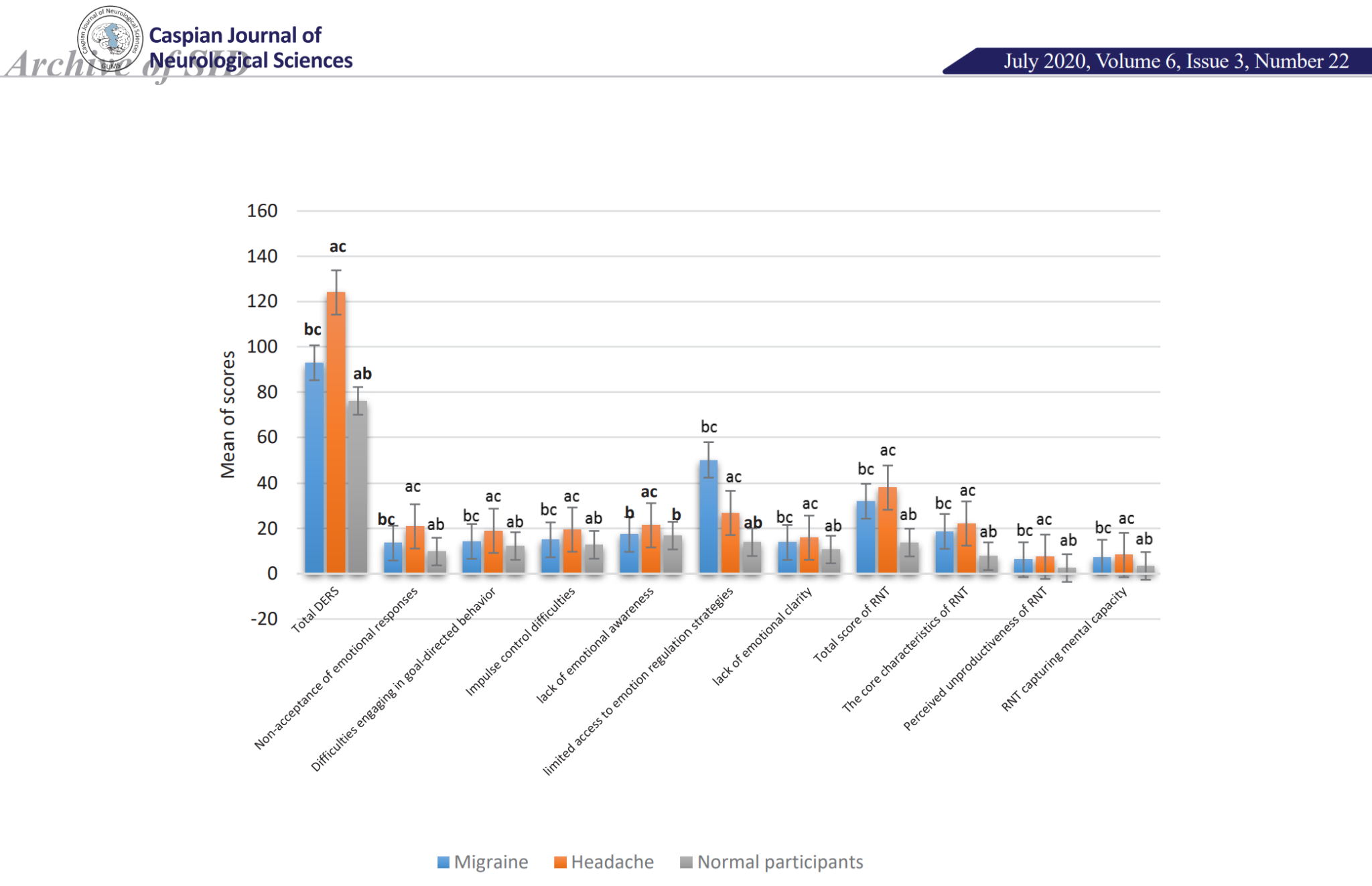
Photo Credit: Caspian Journal of Neurological Sciences / Volume 6, Issue 3
It’s not a far leap from stress to migraine; numerous studies support this theory, and yet, a 2016 study published in Psychology & Health (NCBI) suggests that it’s not just the stress that triggers migraine in chronic sufferers; it’s also rumination or repetitive thought.
Several comorbidities, including numerous anxiety and depression disorders which are often linked to migraine on their own, are accompanied by mechanisms that are thought to drive migraine directly: depressive rumination and psychological distress.
The study states, “...rumination in migraine may be a consequence of chronic illness. However, it is also possible that people who are susceptible to, and develop migraine might have higher premorbid trait rumination.”
So, the age-old question remains: which came first, the ruminative tendencies, or the migraine?
It’s possible that a synergistic negative effect occurs when migraine and other chronic illness overlaps, but frankly, we need more data to verify a direct link.
A paper published in January of this year in Personality and Individual Differences outlines a possible approach to this conundrum.
In a bid to test mind over matter, researchers tested 91 adults with clinically-diagnosed migraine disorder with a variety of questionnaires to determine a baseline for their migraine symptoms and frequency; one of these tests was the Zimbardo Time Perspective Inventory, which is an advanced psychological assessment designed to identify how an individual measures time perspective from within the human experience.
Interestingly, the study identified that balanced time perspective (BTP, for the sake of this study) was correlated with an improvement of pain symptoms in migraine sufferers.
Since stress is often correlated with time as chronic time pressure (chronic awareness of time shortage), it’s not surprising that balancing one’s perspective of time can help ease the stress and associated anxieties that can bring on migraine.
In today’s society, we’re all short on time – all of the time.
A 2025 study from BMC Psychology (BioMed Central) suggests that “Chronic time pressure is associated with reduced wellbeing. Feeling chronically harried is associated with increased experiences of the symptoms of depression, anxiety and stress. The results emphasize the need for governments, employers and healthcare providers to prioritise reducing time pressure as a mechanism of improving wellbeing.”
With depression, anxiety, and stress all being linked to migraine, it stands to reason that a more balanced time perspective really can be a key for migraine sufferers to maintain more control over their symptoms.
“Through promoting adaptive coping, psychological flexibility and reducing anxiety, BTP may help regulate stress responses and mitigate the biological burden associated with prolonged stress activation, potentially reducing allostatic load, and consequently the burden of migraines and the associated disability,” researchers state.
While the mechanism of treatment may look different for everyone, additional avenues such as talk therapy or support groups should make their way into conventional treatment funnels for migraine – especially since migraine treatment has made so few strides in past years.
Migraine isn’t simply a recurring headache; there are more contributing factors than we have the ability to realize, and there’s so much more to be discovered about why the body insists on such unbearable symptoms when stress is at its peak.
To add to or correct any information in this report, please contact me at tracy.t@lead4earth.org.
3
0

Comments