(CONTRA COSTA COUNTY, CA) - When Chirag Kathrani launched Open Governance Initiative, abbreviated as OpGov.News, he had a focused objective: strengthen civic engagement by bringing local government closer to the communities it serves.
Kathrani's commitment to civic participation eventually extended beyond journalism. After a campaign for mayor of San Ramon in 2024, he ran for California State Assembly, motivated by what he describes as repeated frustrations with government responsiveness and concerns about election transparency.
In an interview with Sarah Denos, a prolific reporter from OpGov.News, Kathrani reflected on his campaigns, his efforts to recruit new candidates, and why he is pursuing an election recount despite the high financial cost.
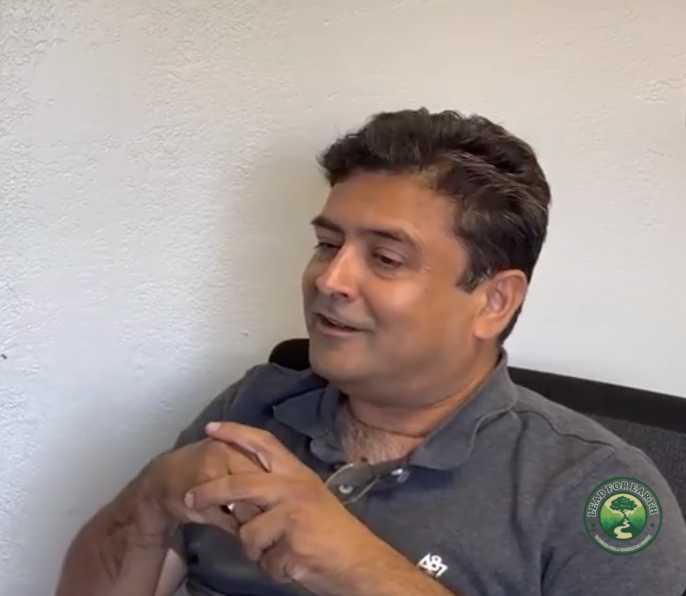
Photo Credit: Sarah Denos interviews Chirag Kathrani.
From Local Journalism to Public Office
Kathrani entered electoral politics after witnessing what he believed was a lack of responsiveness from elected officials regarding issues affecting San Ramon.
Following his mayoral campaign, where he received approximately 31% of the vote after entering the race only two months before Election Day, he sought a larger platform through a State Assembly campaign.
According to Kathrani, repeated attempts to contact state legislators and members of Congress often resulted in delayed or unsatisfactory responses.
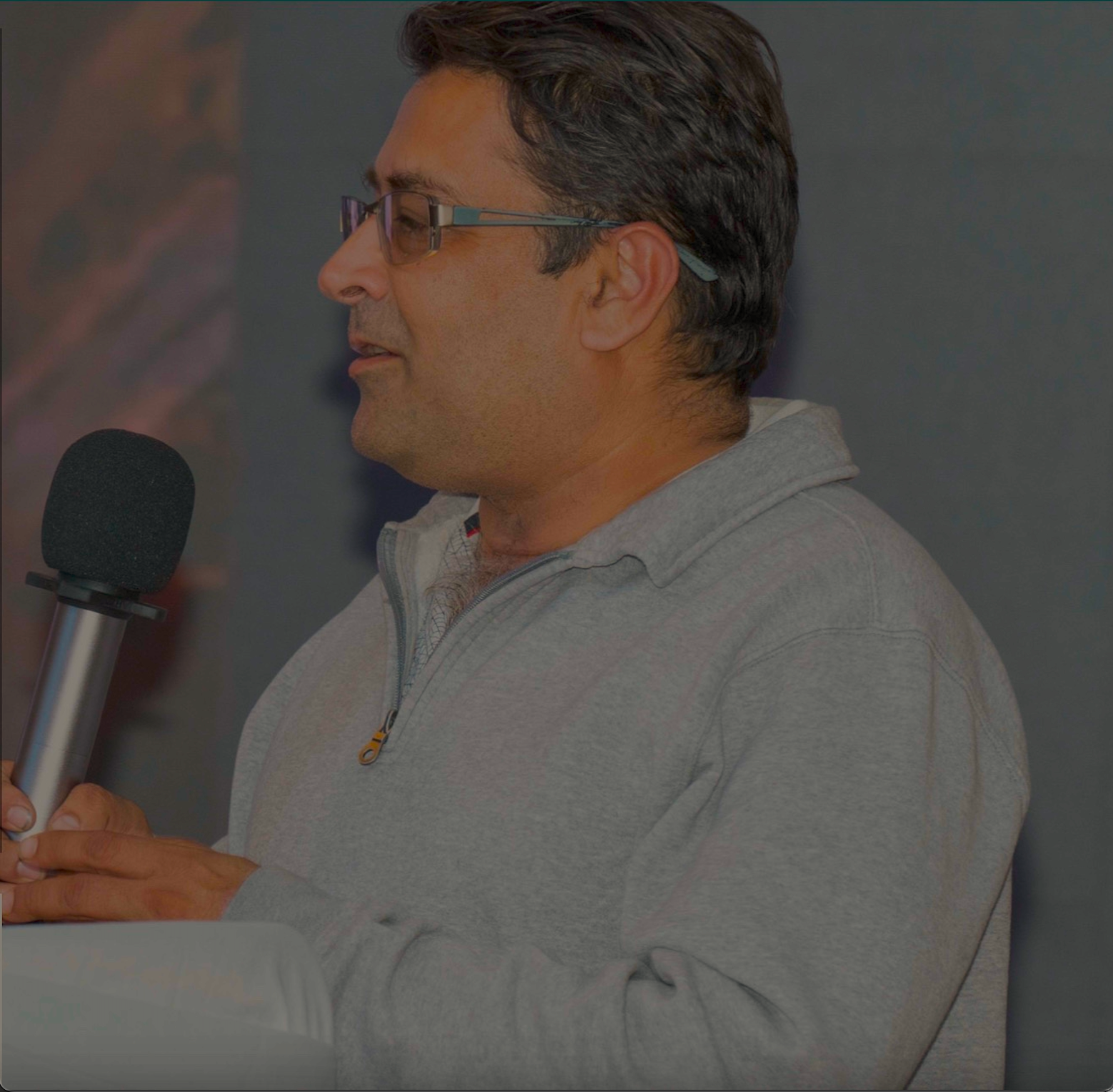
Photo Credit: Chirag For Mayor
"I thought if I couldn't get answers through emails or meetings, maybe I could ask those questions on the debate stage," said Kathrani.
Running for office inevitably became a vital avenue to elevate concerns he believed deserved greater public attention.
Encouraging Citizens to Run
One of the strongest themes throughout Kathrani's campaign was increasing civic participation. His focus was not only on voter turnout but also on candidate participation.
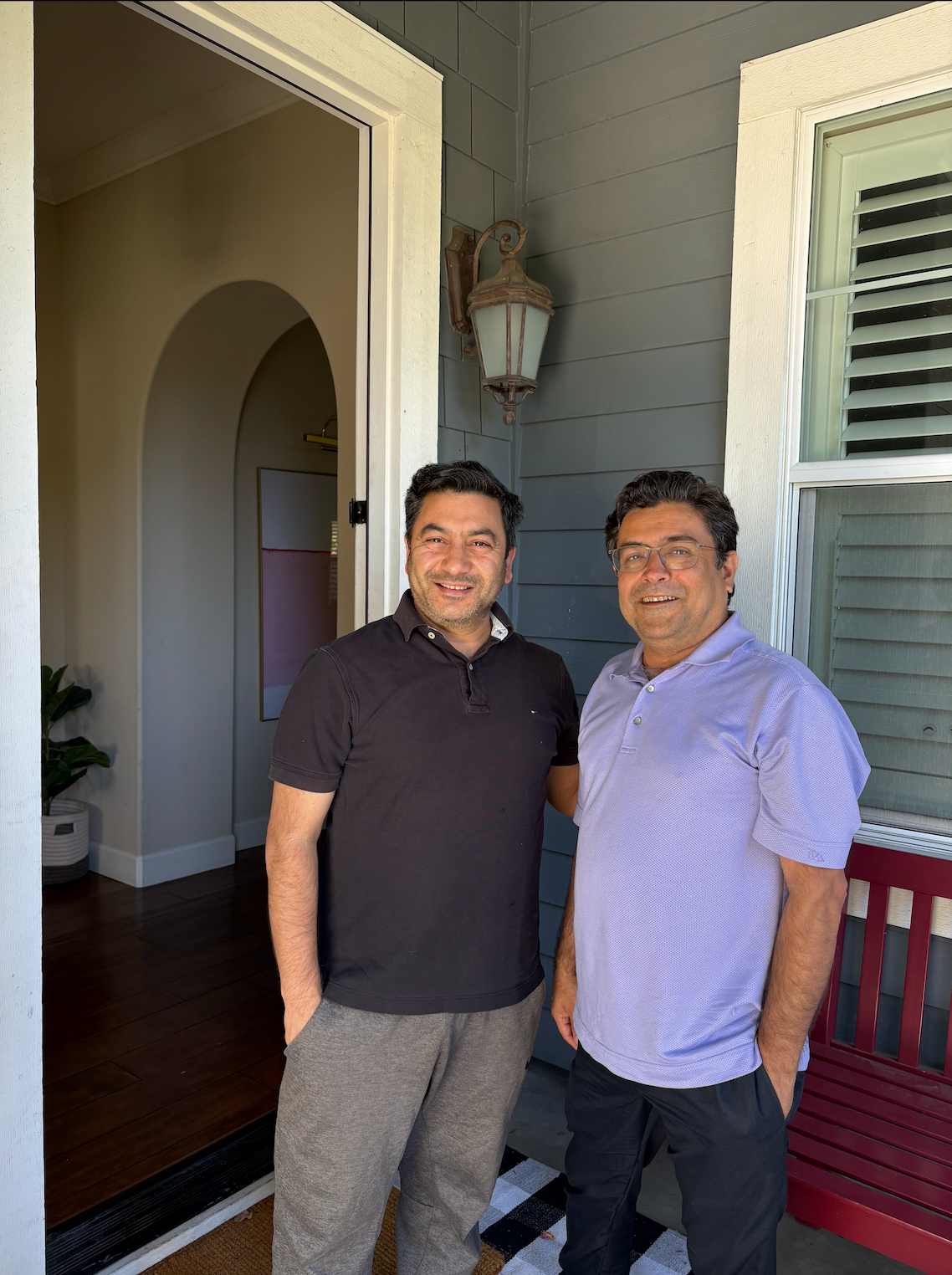
Photo Credit: Kathrani shown during outreach with a San Ramon citizen.
He pointed to a large number of uncontested local races in Contra Costa County as evidence that many government positions receive little public scrutiny.
To address this, Kathrani launched a mass outreach campaign encouraging residents who had even minimal interest in public service to consider running for office.
His message was this – "If you have one percent interest, I'll add the zeros."
The campaign generated significant engagement. Approximately 140 individuals joined Zoom meetings, as Kathrani personally spoke with many prospective candidates.
Ultimately, six individuals decided to run for public office after those conversations, including one candidate for Contra Costa County Clerk, which he highlights as an important position within the interview.
Building a Network of First-Time Candidates
Rather than focusing solely on his own campaign, Kathrani organized an aptly named "Fighters" WhatsApp group, bringing together candidates running for various local offices.
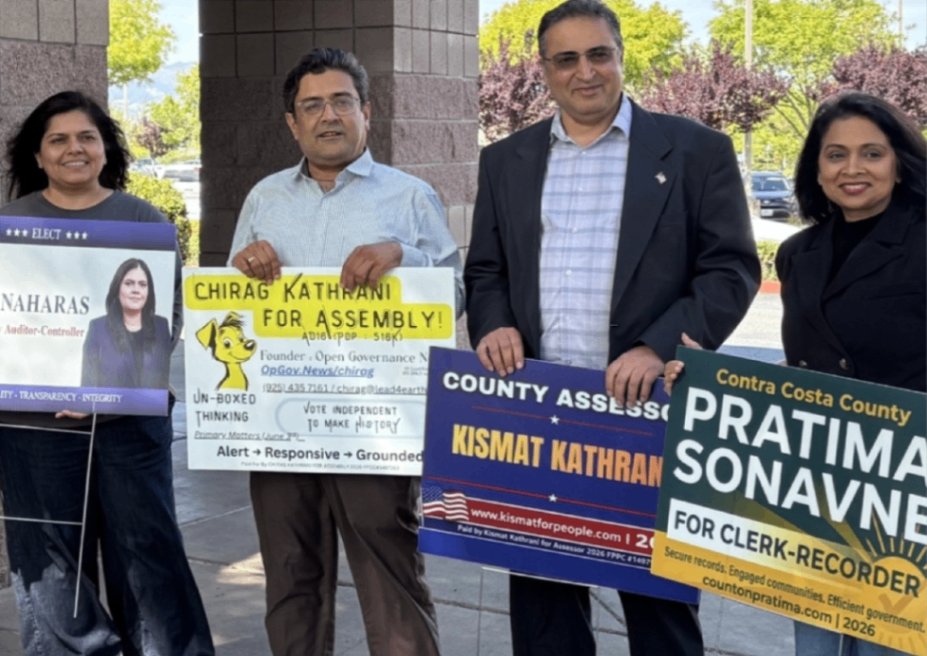
Photo Credit: Chirag for State Assembly
The group shared campaign strategies, resources, and encouragement throughout the election cycle.
Kathrani also expanded his outreach by attending meetings hosted by realtor associations, taxpayer organizations, churches, community groups, and, notably, youth organisations.
He said one of his primary educational messages centered on the value of voting.
By dividing government budgets by constituent populations, Kathrani created an illustration suggesting that each individual vote influences substantial public spending, using the calculation showing that each California vote is worth approximately $19,000 to encourage greater civic participation.
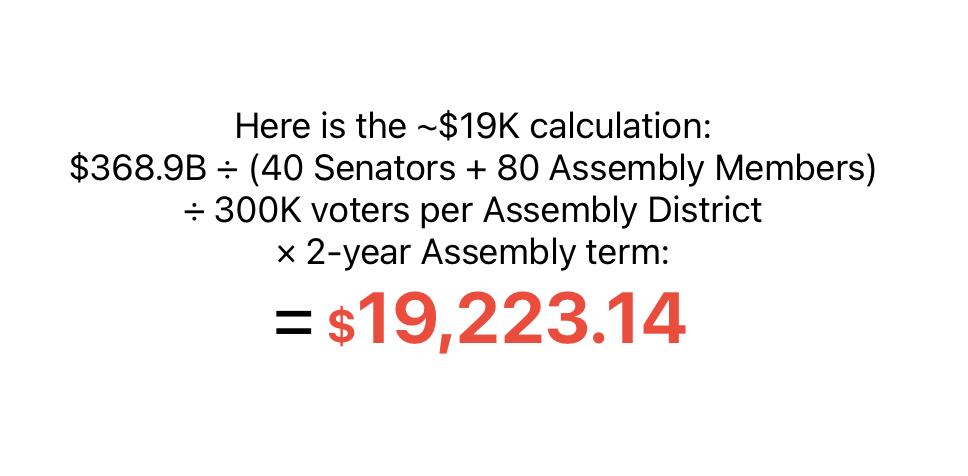
Photo Credit: OpGov.News
A Turnout Increase Raises New Questions
Kathrani believes community engagement efforts helped increase voter participation.
He pointed to county turnout figures that he says increased by approximately 7.5% compared to the previous comparable election, despite noting that the earlier election coincided with a presidential race, which typically produces higher turnout.
Although increased turnout aligned with one of his campaign goals, Kathrani said several election results surprised him.
Most notably, he questioned his own vote totals in San Ramon.
After receiving roughly 11,000 votes during his mayoral campaign and remaining active in the community for another year and a half, Kathrani said he received approximately 1,500 votes in the Assembly race within the city.
He also noted that his brother, appearing elsewhere on the ballot with the same last name, reportedly received substantially more votes in the same area.
Kathrani emphasized that these observations prompted questions rather than conclusions:
"I chose some of those precincts just to see if I could validate what happened," he said.
Examining Election Transparency
Kathrani's concerns eventually shifted from campaign outcomes to election procedures.
Before requesting a recount, he visited ballot-counting facilities to observe the process firsthand.
He described election observers being positioned behind glass in designated observation areas where they could watch activity but could not closely inspect ballots or machine operations.
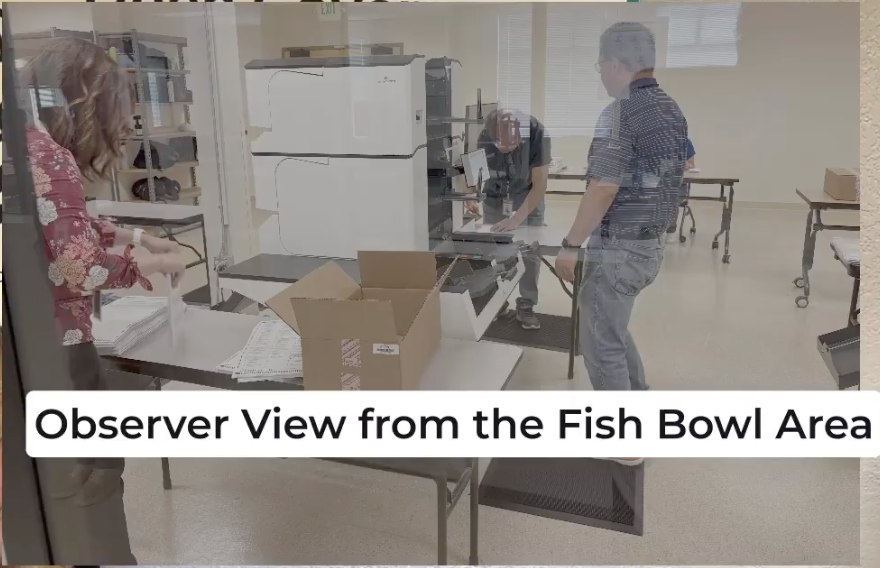
Photo Credit: OpGov.News
Kathrani argued that previous observation methods allowed members of the public greater visibility into vote-counting procedures and believes stronger observation improves public confidence, saying, "You can see people counting, but you can't really observe what is happening."
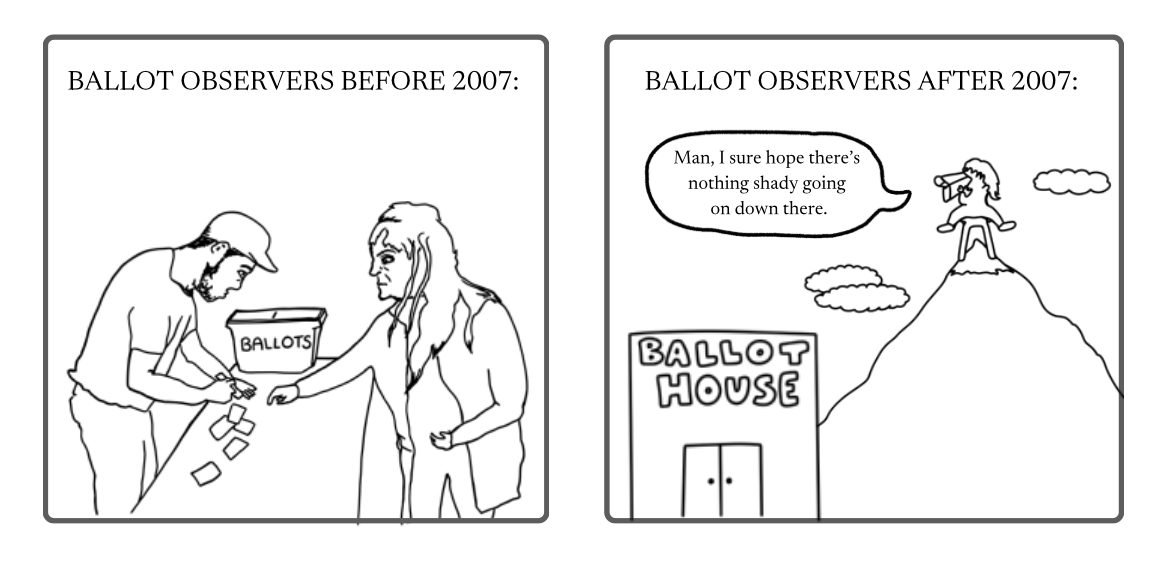
Photo Credit: Naomi Heinen, of OpGov.News
He has since advocated for allowing election observers inside counting rooms while maintaining ballot security and voter privacy.
Seeking Precinct-Level Data
Kathrani also requested precinct-level election data that would allow him to compare reported vote totals with local voter outreach.
County officials initially stated that the requested data were unavailable, shown in email correspondence below.
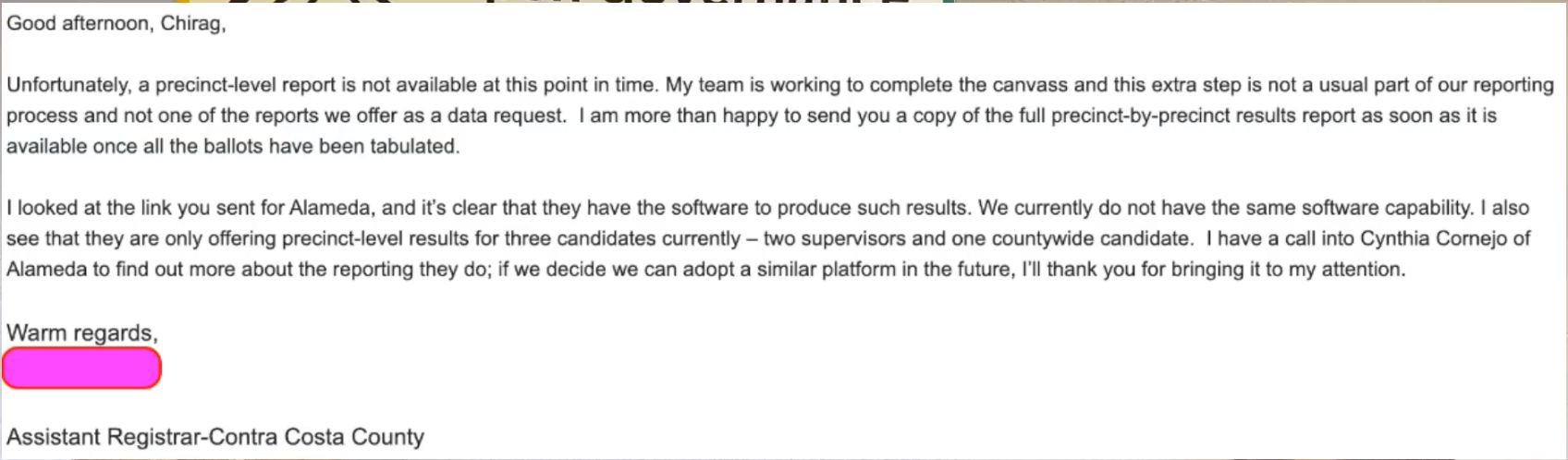
Photo Credit: Chirag Kathrani email correspondence with Contra Costa County.
He said later discussions centered on software limitations before he located examples from Santa Clara, another California county. He demonstrated that Santa Clara county used similar election software, but displayed much more detailed reporting, showing evidence that in Contra Costa County, the more detailed overview was intentionally disabled.
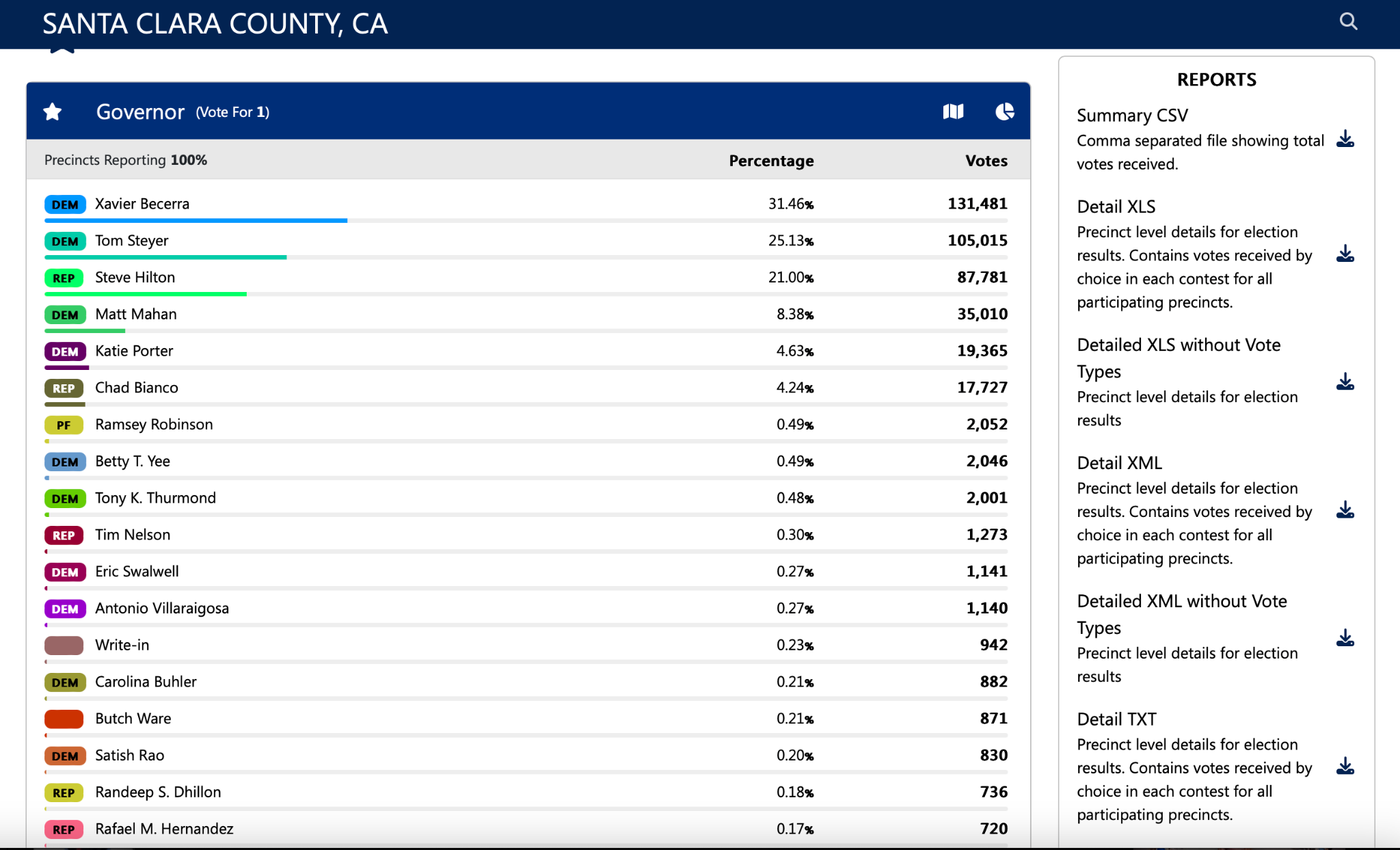
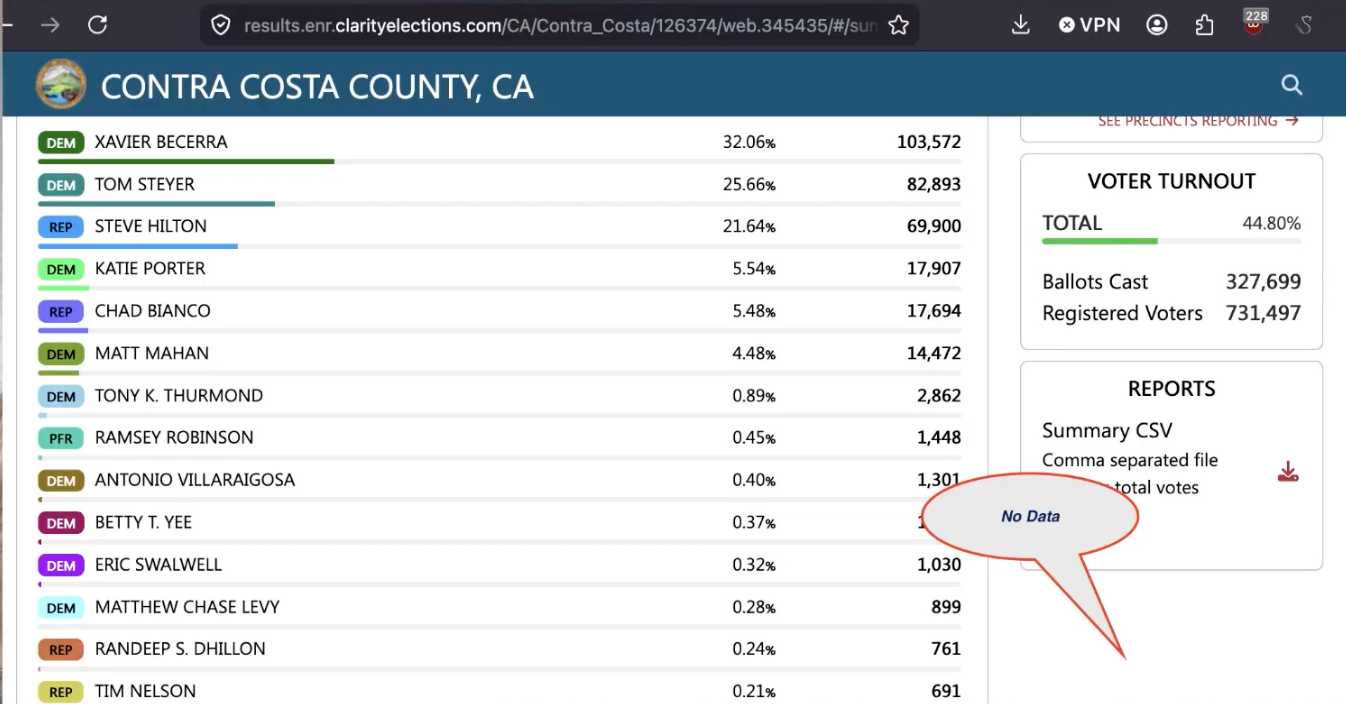
Shown above, the differences in transparent election data available on the Contra Costa and Santa Clara sites.
Kathrani maintains that greater transparency in election reporting would allow campaigns and the public to independently verify election patterns.
The High Cost of a Recount
One of the most striking aspects of Kathrani's experience has been the financial cost of requesting a recount.
He said a full recount in Contra Costa County involving approximately 115,000 ballots would require an upfront payment exceeding $110,000.
The interesting part, says Kathrani, is that in the breakdown 60,000 of those dollars goes to just finding the ballots.
County officials also offered an alternative process involving printed ballot images generated from digital records, which Kathrani said would cost $8,011.
He also compared this to the cost of the recount in Alameda County, comparable in size to Contra Costa County, and yet the cost was vastly lower, at $10,000.
Rather than viewing the recount solely as an attempt to change election results, Kathrani described it as an opportunity to better understand election administration, stating, "It's a cost of learning."
He added that even if a recount changes only a small number of votes, he believes the experience could help identify ways to improve transparency for future elections.
Looking Ahead
Kathrani says his immediate focus is completing the recount process and continuing to document what he learns.
He hopes those findings will contribute to broader discussions about election observation and public transparency.
As both a journalist and political candidate, Kathrani argues that public confidence depends not only on accurate election outcomes but also on public understanding of how those outcomes are produced.
Whether the recount changes any vote totals remains uncertain. However, the larger objective behind his mission extends beyond the numbers.
Kathrani’s goal, he says, is to better understand the system, and to encourage more citizens to become active participants in both journalism and local democracy.
0
0

Comments