SACRAMENTO, Calif. — California's recent shift toward strengthening public safety while preserving alternatives to incarceration continued Monday as Governor Gavin Newsom signed Assembly Bill 46 into law, giving judges broader discretion when determining whether criminal defendants should receive mental health diversion.
The bipartisan legislation modifies California's Mental Health Diversion Program by establishing what supporters describe as a more workable public safety framework for courts while preserving diversion as an option for defendants whose mental illness contributed to criminal behavior.
"California believes treatment and accountability go hand in hand," Newsom said in a statement announcing the bill's signing. "We are proud to preserve mental health diversion for people who can benefit from it while ensuring judges have the discretion they need to protect victims, safeguard communities, and make decisions based on the full picture before them."
The measure follows several recent criminal justice policy changes in California, including voter approval of Proposition 36 and the Legislature's passage of SB 926 to help counties implement those reforms. Together, supporters say the measures reflect an effort to balance rehabilitation with greater accountability and public safety.

(Credit: OpGov.News, Ai Graphic.)
Strengthening Judicial Discretion
AB 46, authored by Assemblymember Stephanie Nguyen, updates California's mental health diversion statute by clarifying the standards judges use when deciding whether diversion is appropriate.
Among other changes, the law:
Establishes a revised public safety framework for courts evaluating diversion requests.
Requires more current clinical documentation supporting a defendant's qualifying mental health condition.
Requires mental health experts to explain why a proposed diversion treatment plan is clinically appropriate.
Requires judges to place their reasons on the record when denying diversion.
Supporters said the legislation responds to court decisions that limited judicial discretion under California's existing diversion law.
"The signing of AB 46 into law marks a significant milestone in our efforts to strengthen public safety while ensuring mental health diversion continues to serve those it was designed to help," Nguyen said in a statement.
"I am deeply grateful to our co-sponsors, district attorneys, legislative partners and Governor Newsom for their partnership and commitment to ensuring California's laws reflect accountability and compassion."
Nguyen's office said the bill reflects years of collaboration among prosecutors, criminal justice stakeholders, advocates, legislative partners, and mental health organizations to strengthen the diversion program while preserving access to treatment.
Prosecutors Say Bill Closes a Dangerous Loophole
The legislation was co-sponsored by the California District Attorneys Association and district attorneys' offices across California, reflecting broad support among prosecutors for changes to the state's mental health diversion law. While not every district attorney issued a separate public statement after the bill was signed, the legislation's official co-sponsors included prosecutors from multiple counties who worked with lawmakers over the course of the bill's three-year development.

(Image credit: Sacramento County District Attorney's Office.)
Sacramento County District Attorney Thien Ho, whose office co-sponsored the legislation, called the bill's signing "a great day for public safety across California."
"AB 46 is now law, closing the dangerous loophole in Mental Health Diversion while allowing diversion for those who truly need it," Ho said. "After this three-year journey, we thank Assemblymember Stephanie Nguyen for her continued leadership throughout the process and the entire Legislature for passing the bill with bipartisan support."
Greg Totten, chief executive officer of the California District Attorneys Association, said the measure restores judges' ability to rely on their experience when evaluating diversion requests.
"By allowing judges to use their experience, knowledge, and judgment when evaluating a defendant's dangerousness, this legislation will protect vulnerable victims of crime and safeguard the communities we serve," Totten said.
Opponents of AB 46 argued the measure could make it more difficult for eligible defendants with mental illness to access diversion and treatment programs. According to CalMatters, critics contended the bill relies on a small number of high-profile cases to justify restricting diversion more broadly. They warned the changes could reduce judicial flexibility and limit access to treatment for people who would otherwise qualify for diversion.
The Ella Baker Center for Human Rights, in a letter opposing the bill, called the measure "a step backward for California," arguing it would eliminate "much-needed flexibility and discretion."
CalMatters also reported that opponents said mental health diversion programs help reduce the long-term consequences of criminal convictions by allowing eligible participants who successfully complete treatment to avoid a criminal record, improving their opportunities for housing, education, and employment while helping address disparities in the criminal justice system.
Sheriff Cooper: "A Big Day for Public Safety"
Sacramento County Sheriff Jim Cooper praised the legislation following its signing.
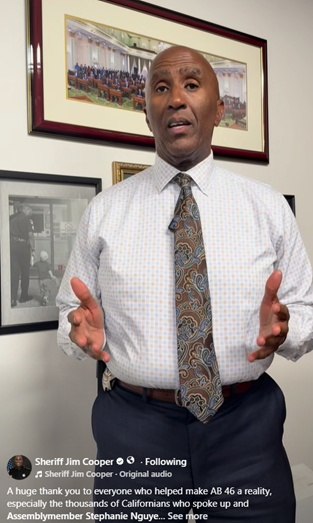
(Image credit: Sheriff Jim Cooper’s Facebook post.)
In a video posted to the Sacramento County Sheriff Jim Cooper's Facebook page, Cooper praised the Governor for the signing of the bill by stating it as "a big day for public safety in California."
"The governor signed AB 46, which brings back common sense to our laws," Cooper said. "AB 46 on mental health diversion now gives the judges more discretion in sentencing. That is so important."
Cooper said supporters had worked for years to pass the legislation and credited Californians for helping bring about the change.
"For many, many years, we've been fighting this bill, and really the citizens of California spoke up," Cooper said. "You're upset about it, and we changed it."
The sheriff has previously advocated for criminal justice policies that preserve treatment opportunities while emphasizing judicial discretion and public safety.
A Continuing Shift in California Criminal Justice Policy
AB 46 is the latest in a series of measures reflecting California's evolving approach to criminal justice.
After voters approved Proposition 36 to increase penalties for certain repeat theft and drug offenses, lawmakers approved SB 926 to help counties implement the voter-approved changes. With Newsom's signature on AB 46, supporters say California has now taken another step toward restoring judicial discretion while maintaining access to diversion for defendants who can safely benefit from mental health treatment.
Whether viewed as a refinement of existing law or a broader recalibration of criminal justice policy, AB 46 continues a trend of state leaders revisiting public safety policies through the dual lenses of accountability and rehabilitation.
If you’d like to add or correct anything in this report, feel free to reach out to me or leave a comment below. Submit Sacramento County tips and story ideas to Sarah Denos at sarahkdenos@gmail.com.
0
0

Comments