Bay Area transit measure leads comfortably, while Propositions 4 and 5 remain closely divided
California voters appear set to approve major spending measures for housing and medical research, preserve higher income-tax rates on top earners and expand the state’s budget reserves. At the same time, voters are rejecting a voter-identification requirement, a proposed billionaire tax and several measures designed to limit future taxes.
The results remain preliminary. Approximately 64% of the statewide vote was estimated to have been counted as of Thursday evening, and several close contests have not been called.
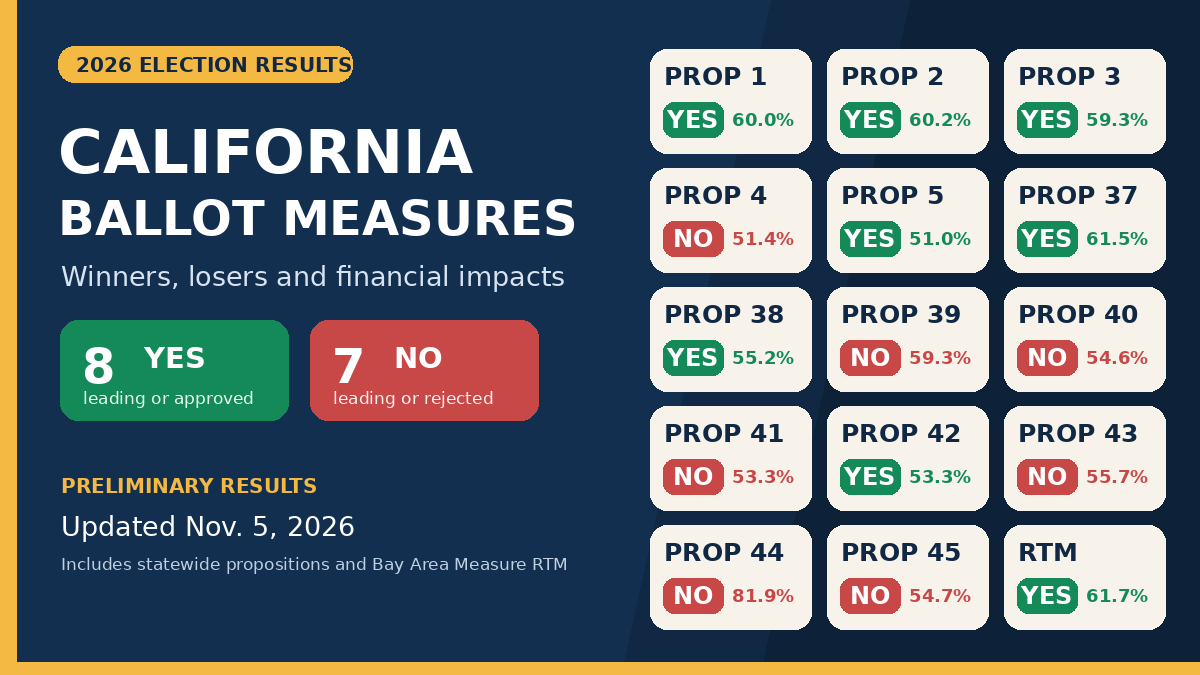
Housing and state reserves receive strong support
Proposition 1, which authorizes $11.25 billion in bonds for affordable housing and veterans’ housing programs, has been called as approved. It leads with approximately 60% voting yes.
The measure includes $10 billion in General Fund-supported housing bonds. Repaying those bonds is expected to cost the state between $500 million and $600 million annually for approximately 25 years. Another $1.25 billion would support veterans’ mortgages and is expected to be repaid through borrowers’ loan payments.
Proposition 2 has also been called as approved, with 60.2% support.
It raises the maximum balance of California’s principal rainy-day reserve from 10% to 20% of General Fund tax revenue and extends requirements for additional debt payments.
The measure does not impose a new tax. It will direct more state revenue into reserves during stronger budget years, leaving California with a larger financial cushion during economic downturns but potentially reducing money available for immediate spending.
Higher taxes on top earners become permanent
Proposition 3 has been called as approved, with 59.3% voting yes.
The measure makes permanent the higher income-tax rates currently paid by approximately the top 2% of California taxpayers. Those rates had been scheduled to expire in 2031. The measure is expected to preserve between $5 billion and $15 billion in annual state revenue, depending largely on high earners’ income and stock-market performance. Approximately 40% of the revenue would support schools and community colleges, with the remainder available for healthcare and other state programs. lao.ca.gov
Most taxpayers will not experience a direct income-tax change. The measure maintains existing rates rather than introducing an immediate new rate.
Public campaign financing measure trails
Proposition 4 is not leading. Approximately 51.4% are voting no, while 48.6% support it.
The measure would repeal California’s existing prohibition against state and most local governments establishing publicly financed campaign programs. It would not itself create or finance a statewide program. Instead, it would allow governments to establish such programs through future legislation.
The immediate statewide administrative cost would be a few hundred thousand dollars annually. Larger financial effects would depend on whether the state or individual local governments later established campaign-financing programs. test.lao.ca.gov
Recall-election proposal remains close
Proposition 5 is narrowly leading, with 51% voting yes and 49% voting no.
California’s current recall ballot asks voters whether an official should be removed and who should replace that official. Proposition 5 would separate those decisions. If an official were recalled, a later election would determine the successor. A recalled official could run in that election.
The financial effect would depend on future recalls. Holding a separate successor election could increase election costs, although the amount would vary according to the office involved and whether the election coincided with another scheduled vote.
Homebuyer loan measure approved
Proposition 37 has been called as approved, with 61.5% support.
The measure creates a program through which the California Housing Finance Agency can issue as much as $25 billion in revenue bonds. Eligible middle-income purchasers of qualifying newly constructed homes could receive a fixed-rate second mortgage covering up to 17% of the purchase price.
Borrowers would repay the loans through monthly payments. The Legislative Analyst’s Office found that the program should have no direct state or local fiscal cost because borrower repayments would finance the bonds.
Medical-research bond leads
Proposition 38 is leading with 55.2% voting yes.
It authorizes $8.4 billion in general-obligation bonds for immunology and immunotherapy research. Half would support a qualifying University of California-affiliated research institute, while the remaining money would fund grants to selected universities and nonprofit institutions.
State repayment is estimated to cost $500 million to $600 million annually for approximately 20 years. California would receive 10% of revenue generated from discoveries until the bond and interest were repaid, but the amount and timing of any recovery remain uncertain. \
Together, Propositions 1 and 38 could require approximately $1 billion to $1.2 billion in annual General Fund bond payments during the years when their repayment schedules overlap.
Voter-identification requirement decisively rejected
Proposition 39 has been called as defeated. Approximately 59.3% are voting no.
The measure would have required government-issued identification for in-person voting and identifying information on mail-ballot envelopes. It would also have directed election officials to expand citizenship-verification procedures.
Implementation was projected to cost state and local governments between tens of millions and the low hundreds of millions of dollars annually. Its defeat means California’s existing voter-identification and signature-verification system will remain in place.
Billionaire tax and audit proposal trail, but property-tax restriction leads
Proposition 40, the proposed one-time 5% tax on California billionaires, is trailing, with 54.6% voting no. If the result holds, the tax will not take effect, and its proposed funding for healthcare, education and food assistance will not be collected.
Proposition 41 is also trailing, with 53.3% voting no.
It would require state audits of programs financed by new special taxes and subject new special-tax revenue to the state spending limit.
Proposition 42, however, is leading. Approximately 53.3% are voting yes, contrary to earlier returns indicating that it was failing. The measure would prohibit new state taxes based solely on ownership of personal property, including financial assets and business interests, and restrict certain retroactive taxes.
Propositions 41 and 42 were designed partly to block or supersede Proposition 40. With Proposition 40 itself trailing, the immediate conflict may become irrelevant, but Proposition 42 would still limit future wealth-tax proposals if its lead holds.
Voters oppose higher approval threshold for local taxes
Proposition 43 is trailing, with 55.7% voting no.
The measure would require local special taxes proposed through citizen initiatives to receive two-thirds voter approval rather than a simple majority. Its defeat would preserve the existing majority threshold, leaving citizen-led local tax measures easier to pass than taxes placed on the ballot directly by local governments.
Clinic-spending and environmental-review measures rejected
Proposition 44 has been called as defeated, with approximately 82% voting no, the widest margin among the statewide measures.
It would have required qualifying community clinics to spend at least 90% of annual revenue on patient services. Its defeat leaves existing clinic financial rules unchanged.
Proposition 45 is also trailing, with 54.7% voting no. The measure would impose deadlines on environmental reviews and related litigation for housing, transportation, school, broadband, wildfire and other projects designated as essential. If the result holds, existing California Environmental Quality Act procedures will remain in place.
Bay Area transit sales tax leads across five counties
Regional Measure RTM is leading with approximately 61.7% support across Alameda, Contra Costa, San Francisco, San Mateo and Santa Clara counties. The result remains preliminary, but the measure holds a substantial advantage.
The measure would establish a 14-year sales tax of 0.5% in Alameda, Contra Costa, San Mateo and Santa Clara counties and 1% in San Francisco. It is expected to generate approximately $980 million to $1 billion annually.
The revenue would support BART, Muni, Caltrain, AC Transit and other transit providers, as well as fare assistance, accessibility, passenger information and selected road improvements. Unlike the state bond measures, RTM would directly increase the sales-tax rate in the participating counties.
0
0

Comments