(CALIFORNIA) — California regulators unanimously approved new efficiency standards for replacement tires Monday, a move state officials say will save drivers money on fuel, while tire industry representatives warn it could increase the cost of replacing tires and reduce affordable options.
The California Energy Commission approved the Replacement Tire Efficiency Program on Aug. 17, establishing the nation's first minimum energy-efficiency standards for replacement tires sold for passenger vehicles and light-duty trucks. Phase 1 begins in 2029, with stricter requirements taking effect in 2033.
The regulations target rolling resistance, or the energy lost as tires roll. Reducing that resistance can improve fuel economy in gasoline-powered vehicles and increase the range of electric vehicles.
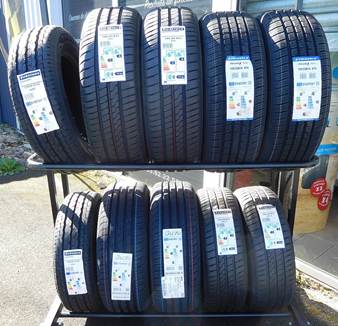
New replacement automobile tires are displayed for sale. California regulators approved new efficiency standards that will determine which replacement tires can be sold in the state beginning in 2029. (Photo credit: Cjp24 / Wikimedia Commons, CC BY-SA 4.0)
The CEC estimates the rules will eventually save California drivers nearly $1 billion annually in gasoline and electricity costs and reduce gasoline consumption by about 141 million gallons each year.
According to the commission, Phase 1 will add approximately $1.50 to the cost of each tire. Under the stricter Phase 2 standards, the CEC estimates the added cost at about $6.50 per passenger tire, or $26 for a set of four. The state projects a typical gasoline driver could save about $179 in fuel over the life of those tires.
However, the Tire Industry Association questioned whether the state's estimate reflects what consumers could actually encounter at tire shops.
Using a common 2017 Honda Civic tire size, TIA compared publicly available prices from major California retailers with tire efficiency testing referenced by the commission. The association found CEC-tested tires meeting Phase 1 averaged $117.36 each, compared with $81.30 for entry-level all-season tires not marketed as low-rolling-resistance. Tires specifically marketed as fuel-efficient averaged $157.37.
“In some cases, consumers could face an increase of more than $300 for a complete set of four tires if affordable entry-level replacement options are displaced by more expensive compliant products,” TIA wrote.
The association also warned that higher prices could lead some drivers to delay replacing worn tires or purchase used tires instead, potentially creating an unintended safety concern.
The CEC maintains that compliant tires already exist at competitive prices and that its testing found the efficiency standards can be achieved without adversely affecting safety or tire life. The regulations also include minimum wet-grip requirements.
Tire manufacturers offered differing assessments of the final proposal.
Pirelli told regulators that the Phase 2 rolling-resistance thresholds are “disproportionately stringent compared to other regulations worldwide” and warned that manufacturers need sufficient time to redesign and validate tires without compromising other performance characteristics.
Bridgestone, however, said the CEC addressed most of its earlier concerns and described the revised program as “technically feasible—albeit challenging.”
The final regulations also exempt several categories of tires, including certain competition, winter, off-road and specialty tires.
Drivers will not be required to replace tires already on their vehicles. Instead, the rules will determine which new replacement tires can be sold in California as the standards take effect.
With Phase 1 still three years away, the central question for consumers will be whether the state's projected fuel savings outweigh higher prices at the tire shop — and whether today's lower-cost tire options remain available once the standards take effect.
If you’d like to add or correct anything in this report, feel free to reach out to me or leave a comment below. Submit Sacramento tips and story ideas to Sarah Denos at sarahkdenos@gmail.com.
0
0

Comments