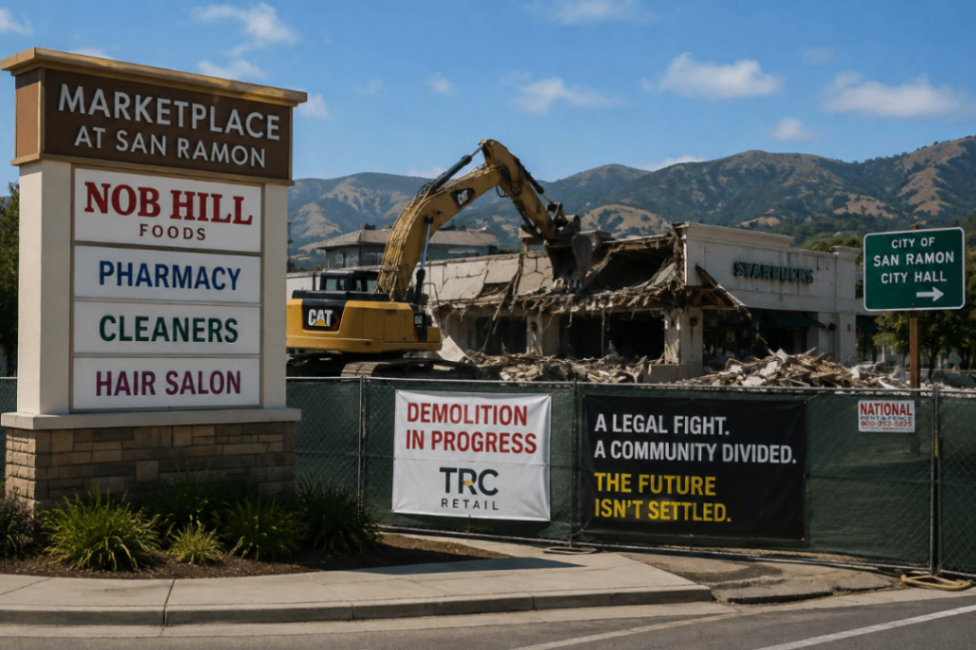
(SAN RAMON, Calif.) — The storefronts that once held Nob Hill Foods, a pharmacy, a dry cleaner and a hair salon are coming down this summer at the Marketplace shopping center, even as a group of residents fighting the redevelopment waits to learn whether California's highest court will take up their case.
The demolition marks the most visible step yet in a dispute that has worked its way through San Ramon's planning commission and city council, a Contra Costa County courtroom, a state appellate panel and now the California Supreme Court. Property owner Marketplace at San Ramon LLC, which does business as TRC Retail, is clearing the site for a 40-unit condominium project that has divided the community since it was first proposed in 2021.
The reason demolition can move forward while litigation is still pending comes down to one fact: no court has ordered a stay blocking construction. The California Court of Appeal's First District ruled against the residents' group in April. Unless the Supreme Court grants review and that ruling is overturned, the appellate decision stands, and TRC is free to build.
How the project got here
Marketplace Center sits at the corner of Alcosta Boulevard and Bollinger Canyon Road, across from San Ramon City Hall. The city has zoned the site for mixed commercial and residential use since 2006, though it operated for decades mainly as a retail strip anchored by Nob Hill Foods. The grocery chain declined to renew its lease and closed in mid-March 2022; TRC had already opened a Trader Joe's elsewhere in the center the year before.
TRC's first redevelopment proposal, filed in November 2021, called for a five-story, 284-unit apartment complex with 32 units set aside as affordable housing, on land that would require demolishing roughly 57,500 square feet of retail space. Planning commissioners at the time said the design was out of scale with the surrounding neighborhood, and TRC withdrew the plan.
The company returned in 2022 with a smaller proposal: 40 single-family detached condominiums and four junior accessory dwelling units on about 4 of the site's 12.47 acres, with the existing Starbucks renovated and kept in place as the project's retail component. Rather than build affordable units on site, as its earlier plan had, TRC chose to pay an in-lieu fee into the city's affordable housing fund.
(Photo Credit: Marketplace at San Ramon)
Why neighbors are fighting it
Citizens Against Marketplace Apartment/Condo Development, known as CAMPAD, formed to oppose both versions of the project and says it has drawn support from thousands of area residents. The group argues that TRC let a once-thriving shopping center fall into disrepair to justify replacing it with low-density, high-priced housing that will serve only its future residents while offering nothing back to the surrounding neighborhood.
CAMPAD members have told the city council that calling the project "mixed use" stretches the term past its breaking point, since it amounts to housing for roughly 120 people with a single coffee shop as its only commercial tenant. Others, including longtime residents who spoke at planning hearings, have said the community needs a working grocery store back, not a nearby Trader Joe's that can't handle a full weekly shopping trip for a family.
CAMPAD's legal case, brought by the firm Greenfire Law, rests on two main arguments. First, the group contends the city's general plan requires TRC to prepare a formal "master plan" for the site before redeveloping it, a requirement CAMPAD says the city and TRC treated as optional when it was not. Second, CAMPAD argues that the traffic study behind the project's environmental exemption never accounted for where former Nob Hill Foods customers would go, or how many additional miles they might now have to drive to buy groceries elsewhere.
The fight has been costly. After losing at the trial court level, CAMPAD was ordered to pay the city more than $38,000 to cover the cost of preparing the administrative record used in the case.
Why the city and developer say the project is lawful
City planning commissioners approved the project in 2023 while making clear, on the record, that they had reservations about it. Commission Chair Gary Alpert said at the time that state law had tied the panel's hands, telling the public the commission could no longer weigh in based on feelings about a project, only on measurable standards written into the general plan.
That law is the 2018 Housing Accountability Act, which bars cities from denying or scaling back a housing project unless officials can point to a specific, objective conflict with existing zoning or general plan policy. City staff, and later the city council, concluded the condo project met those standards and qualified for a routine state exemption from environmental review that applies to in-fill housing projects.
The First District Court of Appeal agreed with the city in its April ruling. The court found that the general plan's master-plan language was written as encouragement for future redevelopment, not a binding mandate, and that courts must defer to a city's interpretation of its own planning documents "unless no reasonable person could have reached the same conclusion." On the traffic question, the court pointed to two expert studies showing an overall drop in vehicle trips once the retail space converts to housing, and called CAMPAD's theory about displaced grocery shoppers speculative and unsupported by any specific evidence. The court also noted that five other grocery stores sit within two miles of the site, in addition to the on-site Trader Joe's.
In the same ruling, the court flagged a separate problem with CAMPAD's briefing: one filing attributed a quotation to an earlier case that does not actually appear in that opinion. The justices warned CAMPAD's attorneys that similar errors in the future could lead to sanctions.
What happens next
CAMPAD filed its petition asking the California Supreme Court to review the case on June 3, docketed as case No. S296920. An outside party filed a letter supporting the petition on July 7, and CAMPAD filed its written reply on July 9. The court's original Aug. 9 deadline to decide whether to hear the case was pushed back on July 22 to Sept. 4. CAMPAD's leaders note that such extensions happen often regardless of the outcome, but say they view it as a sign the petition is being taken seriously by the court.
Unless the Supreme Court intervenes before then, demolition and construction at the Marketplace site are expected to continue. CAMPAD says it remains optimistic the court will grant review, and that it is continuing to raise money for its legal costs through its nonprofit fund.
Neither the city of San Ramon nor TRC Retail had issued a public statement on the demolition as of this writing.
0
0

Comments