(Auburn, CA.) – The Auburn City Council moved efficiently through a full agenda on March 23, advancing routine business, examining ongoing challenges, and laying groundwork for future policy decisions. While much of the meeting was procedural, several discussions highlighted areas where the city continues to adapt to evolving needs.
The session opened with a proclamation recognizing March as Women’s History Month and April as Parkinson’s Awareness Month, continuing the council’s recent focus on community health and awareness initiatives. As reported by OpGov.news, earlier this month the council also established March as Nutritional and Trisomy Awareness month.
Two lease amendments—related to agreements with Almost Free To All (AFTA) on Almond Street and the Auburn Chamber of Commerce—were pulled from the consent agenda without immediate resolution. In explaining to the council, City Manager Sean Rabé says, “we need to work through some…issues.” These agenda items will be heard at a later date.
The council also delayed adopting a formal Artificial Intelligence (AI) Acceptable Use Policy, reflecting both caution and concern. Vice Mayor Radell-Harris says the policy should be a “living document,” acknowledging that AI technology is “changing weekly.” Additionally, the Vice Mayor raised questions about implementation, noting the challenge of relying on a city manager without specialized AI expertise and the absence of dedicated technical resources to support complex decision-making.
The Vice-Mayor did not, however, address financial or environmental costs associated with the dominance of AI.
Economic development emerged as a central focus of the meeting. Director Jonathan Wright presented an update on Auburn’s vacant commercial properties, an issue he described as both visible and impactful. Director Wright says the numerous empty storefronts “are major sources of blight” that “[deter] would be customers and investors.”
Director Wright also described this as a long-standing issue, saying, “I recall sitting here…about three or four years ago listening to testimony” regarding the issue.
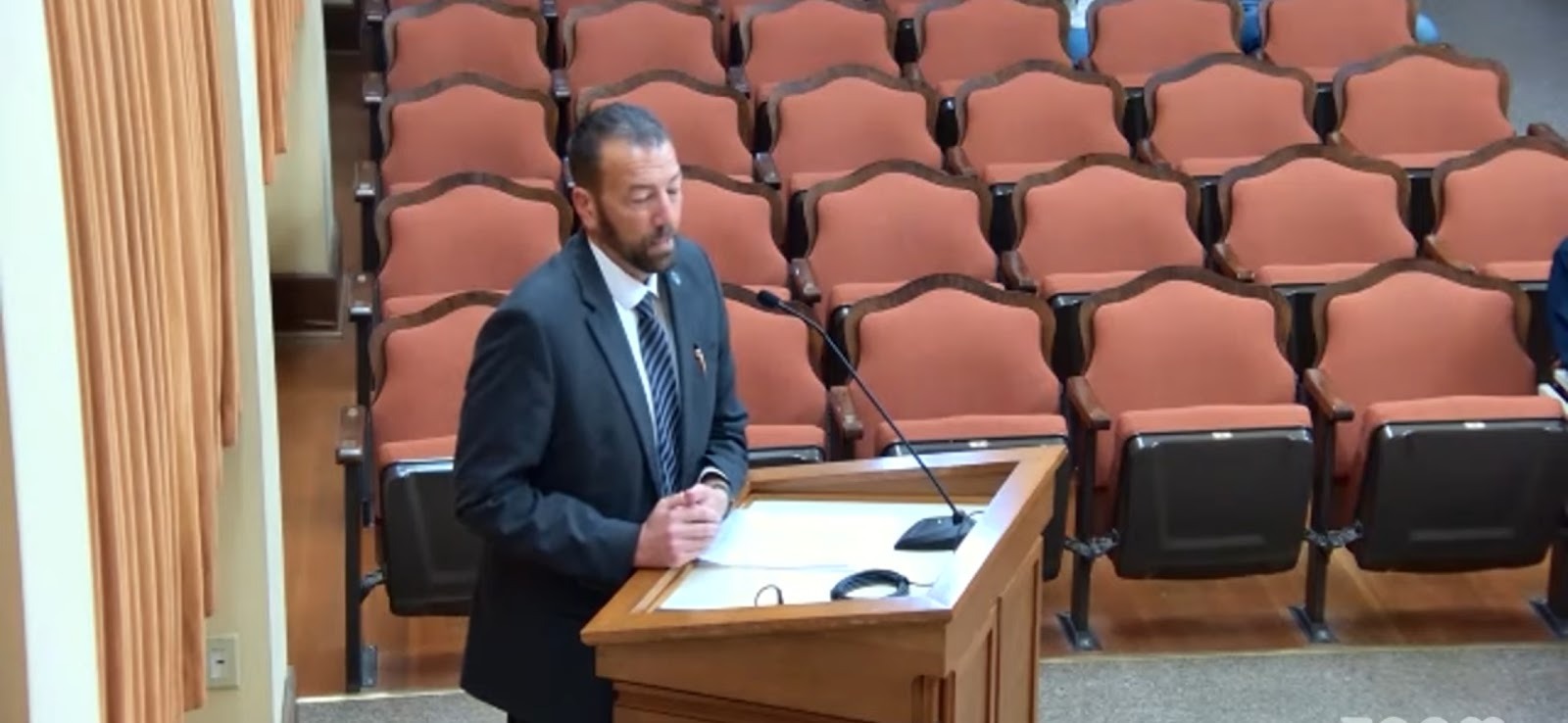
Photo Credit: City of Auburn / YouTube / Economic Development Director Jonathan Wright addressing Auburn City Council with empty chairs on March 23, 2026.
Within the past year, the city has worked with property owners, hosted public workshops, and compiled data to better understand the scope of the issue. Proposed solutions include strengthening nuisance codes for long-term vacancies, minimizing signage, expanding marketing support, and introducing creative approaches such as art to enhance the appearance of underutilized properties.
While these efforts are ongoing, the report indicated limited progress to date. Council discussion pointed to challenges in enforcement and responsiveness from some property owners, as well as the absence of stronger measures—such as a vacancy fee—as a potential gap in the city’s current approach. An economic development Town Hall is set for May 12.
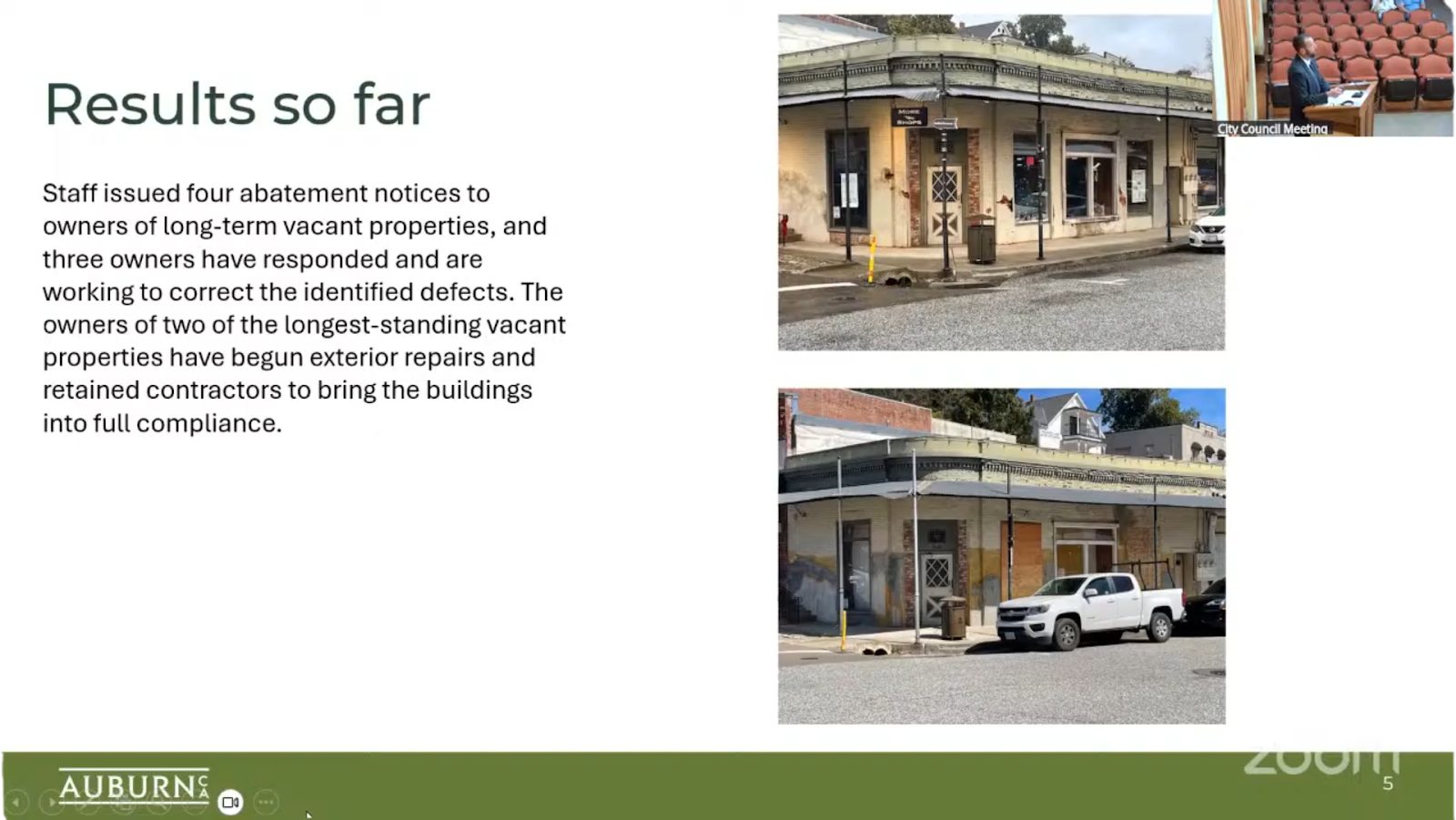
Photo Credit: City of Auburn / YouTube / An image from Director Wright's presentation to the council, illustrating some results to vacant commercial blight.
Public opinion was a forethought as safety updates provided insight into city operations. Fire Chief John Rogers delivered the Auburn Fire Department’s 2025 annual report, noting that crews responded to “2,311 incidents” in 2025. Of those, Chief Rogers says, more than 64 percent were, “EMS related incidents” with only 60 involving fires. All incidents, Rogers explains, excepting EMS services have decreased, reflecting the department’s growing role in emergency medical response.
Video Credit: City of Auburn / YouTube / Chief Rogers presenting to the Auburn City Council on March 23rd.
Public comment during the meeting was virtually absent, excepting from council members, who at times blended open input with internal updates.
This included quality-of-life concerns. For example, Councilmember Sandra Amara raised issues regarding AI inaccuracies in city bus schedule information and the lack of late-night transit options, noting the potential impact on both accessibility and public safety.
Looking ahead, councilmembers voiced support for expanding community engagement opportunities. Councilmember Alice Dowdin Calvillo introduced the idea of “Coffee with a Council Member”—informal gatherings at local businesses designed to foster direct conversation between residents and city leaders. While details have yet to be finalized, the concept received broad support.
With several items set to return for future consideration—including lease agreements and AI policy—the council signaled a deliberate approach to decision-making. As Auburn continues to navigate economic development challenges and emerging technologies, upcoming meetings are expected to build on this foundation while addressing the concerns raised during this session.
To add to or correct any information in this report, please contact me at robert.m@lead4earth.org or leave a comment below with your thoughts.
1
0

Comments