SAN RAMON, Calif. — Ask almost any teacher what their biggest headache is right now, and you won't hear about new curriculum standards or stacks of ungraded essays. You'll hear about the glowing screens sitting inside students' pockets.
Over the past decade, smartphones have quietly taken over the modern classroom. Depending on who you ask, they're either pocket-sized supercomputers that belong in a 21st-century school or slot machines engineered to hijack teenage attention. By late 2026, more than 40 states, including California under its Phone-Free School Act (AB 3216), have passed rules telling schools to rein them in. Locally, the San Ramon Valley Unified School District (SRVUSD) rolled out its own updated policy (BP/AR 5131.8) to comply.
On paper, these policies look like an easy win. In reality, anyone who has spent time inside a school knows the truth: Passing a rule means nothing if teachers are left alone to enforce it.
What the Data Actually Shows About Test Scores
For years, teachers didn't need a research paper to tell them that phones were hurting grades. They could see it on their students' faces every day. Still, a major study published in November 2026 by researchers at Harvard's Center for Education Policy Research, Dartmouth College and NWEA put hard numbers behind what educators have been saying all along.
Tracking math and reading scores for more than 3.3 million students across five school years, the researchers found a pattern:
Real, measurable gains: Schools that locked phones away from the morning bell to dismissal saw students gain the equivalent of one to two extra weeks of learning every year.
Reversing a decade of decline: Since smartphones flooded hallways around 2013, students have steadily lost about two to three weeks of learning annually, adding up to nearly a full grade level by eighth grade. Strict bans may help recover part of that loss.
The boost sticks: Test score gains held steady and compounded for up to three years after schools adopted strict bans.
Cheap and effective: At around $25 per student for lockable pouches, lead researcher Tom Kane pointed to the potential academic return from restricting phone access compared with more expensive interventions.
Why Some Still Defend Phones in Class
To be fair, the pushback against banning phones isn't just coming from teenagers glued to TikTok or the latest social media trend. When used with the right intention, smartphones really can do things a textbook can't.
A research tool in every pocket: Instead of waiting 20 minutes for a cart of half-charged school laptops to boot up, students can look up definitions, run calculations or check breaking news in seconds.
Helping quiet kids speak up: Apps like Kahoot! and Quizlet turn dry review sessions into fast-paced games, giving shy students a low-pressure way to participate without raising their hands.
Built-in support: For students learning English or navigating learning differences, features like instant translation, voice-to-text and digital reminders can be genuine lifelines.
Learning self-control: Some educators argue that banning phones completely misses a teaching moment. Kids need to learn how to manage distractions before they reach college or their first job.
Peace of mind for parents: For many moms and dads, the phone isn't about apps at all. In an era of lockdowns and unpredictable emergencies, knowing they can reach their child directly feels nonnegotiable.
Happens When the Screen Wins
The catch is that a smartphone isn't a neutral tool like a calculator. It's built by thousands of engineers whose job is to keep eyes glued to the glass. Inside a classroom, that creates constant friction.
Even when a phone sits face down on a desk, just knowing a text or Snapchat notification could pop up can pull mental energy away from the lesson.
Worse, unchecked phones mean hallway drama doesn't stay in the hallway. Kids film each other between classes and in restrooms, and the fallout spills straight into third-period math.
Between group chats, search engines and AI apps, snapping a photo of a quiz and sending it to a friend in the next period takes seconds.
And if you walk through almost any high school cafeteria today, you'll see tables full of kids sitting shoulder to shoulder, staring silently at separate screens instead of talking to one another..
Teachers Shouldn't Be Phone Police
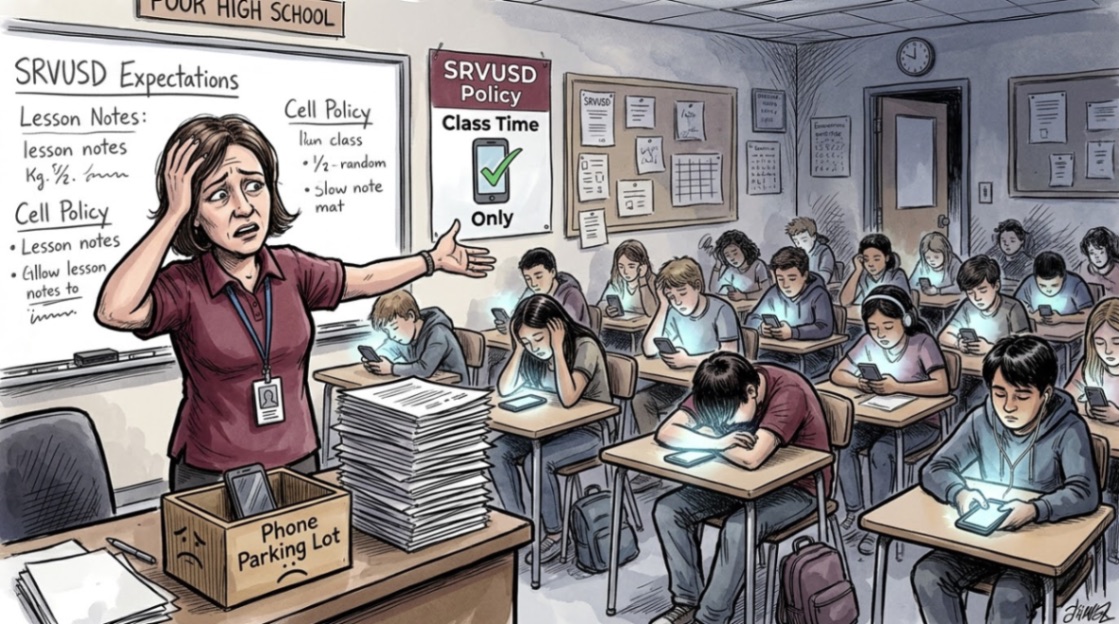
Ask any veteran teacher why cellphone rules usually fall apart by October, and you'll get the same answer: Districts dump the enforcement on teachers.
When a school tells kids to keep phones in their backpacks or drop them in a wall pocket at the door, it sounds simple enough.
In practice, it turns teachers into full-time security guards and damages the relationships they need to do their jobs.
Every time a teacher stops mid-sentence to say, "Put it away," the entire class loses its train of thought. Multiply that by five periods a day or more, and valuable instructional time disappears.
Even more damaging, constantly policing teenagers can turn a mentor into an adversary. Once a teacher has to argue with a student or confiscate a phone in front of classmates, trust can suffer. That student may become less willing to engage with the teacher.
When one teacher enforces the rule strictly while the teacher next door lets it slide out of sheer exhaustion, kids spot the gap immediately.
"My last teacher let me have it out" becomes a daily battle.
Half-measures simply don't work. If high schoolers are allowed to pull their phones out during passing periods or at lunch, they don't magically power down when the bell rings.
They come into class distracted by whatever just happened on social media, ask to use the bathroom to scroll in a stall or hide phones inside sweatshirts.
The strongest approach to taking the weight off teachers is a true bell-to-bell ban, from the moment students arrive on campus until the final bell, backed by administrators and campus supervisors.
Principals, vice principals and campus monitors need to be out in the hallways, checking common areas and stepping into classrooms regularly to handle violations.
When administrators own the enforcement, teachers get to go back to doing what they were hired to do: teach.
SRVUSD’s Crossroads: Doing the Minimum, or Leading the Pack?
Right now, the San Ramon Valley Unified School District is sitting at that crossroads.
Under Board Policy 5131.8, adopted ahead of California's AB 3216 deadline, SRVUSD split its rules by grade level.
Elementary and middle school students generally must keep phones off and put away all day, including at lunch and between classes.
High schoolers, however, only have to put their phones away during instructional time and are still allowed to use them during passing periods and at lunch, subject to school restrictions.
For parents and educators who have watched SRVUSD operate over the years, this middle-of-the-road approach may feel familiar.
The concern is that the district is doing the state minimum to check the compliance box without rocking the boat or inviting pushback from vocal parents.
The problem is that a minimum policy still leaves high school teachers policing classroom phone storage every period, watching for students who might use decoy phones while keeping their real ones and dealing with distractions that carry over from lunch.
SRVUSD has a rare chance here to stop following and start leading.
Instead of settling for a policy that looks good in a board packet but frays in the classroom, the district could set a real benchmark for the Bay Area:
Make it bell-to-bell for high schools, too. Hold high schoolers to the same all-day standard as middle schoolers, closing the lunch and hallway loopholes that keep screens front and center.
Use campuswide storage, not classroom caddies. Invest in lockable pouches or entryway lockers. At an estimated $25 per student for pouches, the approach deserves consideration given the academic gains reported in the Harvard-led study.
Put administrators in the halls. Have principals, vice principals and campus supervisors walk hallways and visit classrooms regularly so teachers don't have to get into a tug-of-war over a phone.
Keep consequences consistent. If a phone comes out in violation of the policy, a campus supervisor should handle the situation under clearly established rules, including parent notification when appropriate. Required exceptions for emergencies, medical needs and student accommodations must remain in place.
From the initial look of things, the district is failing to do what is really needed on several levels and is continuing to do the bare minimum with this new policy.
Until SRVUSD is willing to go beyond state minimums and put real administrative support behind its rules, teachers will keep paying the price, and students will keep losing out on the focused classrooms they deserve.
Sources & Further Reading
National Test Score Study (Nov. 2026): Turner, Cory. "Does locking up a student's cellphone improve test scores? A new study suggests so." NPR / Center for Education Policy Research at Harvard University, Dartmouth College, and NWEA (November 17, 2026) — Read via NPR | Harvard CEPR Summary
K-12 Policy & Data Breakdown: "Are strict school cellphone bans working?" K-12 Dive (November 17, 2026) — Read via K-12 Dive
California State Mandate: California Assembly Bill 3216 (The Phone-Free School Act) / California Education Code Sections 48901.5 and 48901.7 — Read via California Legislative Information
SRVUSD District Policy: San Ramon Valley Unified School District Board Policy & Administrative Regulation 5131.8 (Mobile Communication Devices) — View SRVUSD Policy Overview
Local Broadcast Coverage: "New cellphone ban goes into effect for Bay Area school district on 1st day of school" — Watch on YouTube
Photographs
0
0

Comments