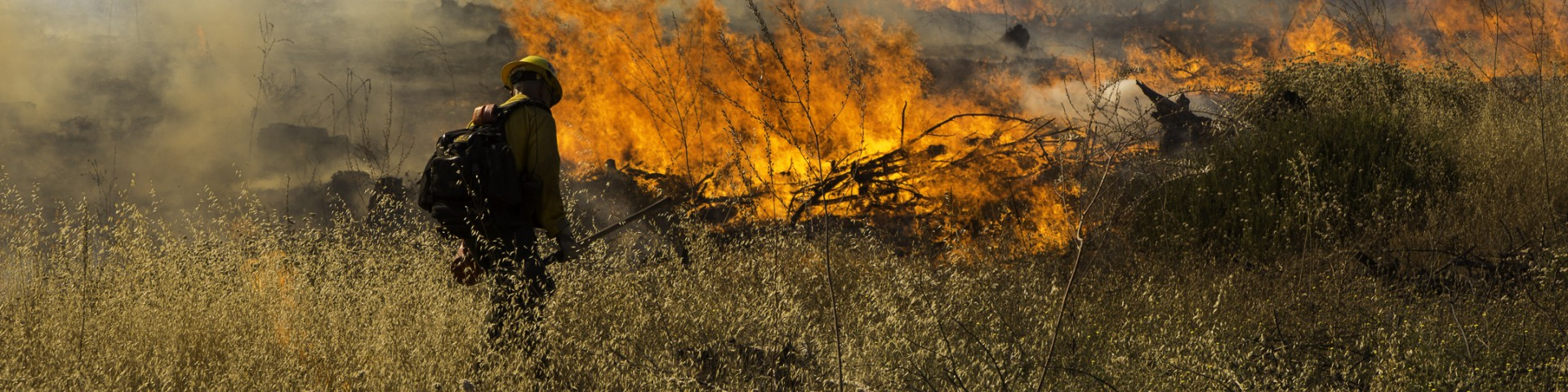
Img Source: USDA Forest Service
(Rocklin, CA) — A sweeping reorganization of the U.S. Forest Service is raising cautious concern in California, where stakeholders weigh potential benefits in a more localized structure but warn of risks to research capacity, funding, and long-term forest management.
The move comes weeks after the White House ordered increased timber production and days before the President’s proposition of a historic $1.5 trillion in military spending.
Announced by the U.S. Department of Agriculture last month, the overhaul includes relocating the agency’s headquarters to Salt Lake City and shifting to a state-based management model intended to bring decision-making closer to the land. With a majority of the nation’s forests covering western states like California, federal officials say the relocation from Washington DC will improve efficiency while reflecting tighter budget realities.
In the Golden State, where vast federally managed forests face mounting pressure from wildfire, drought, and development, the response has been cautious.
On the ground, early signals point to continuity. Reports from the Shasta-Trinity National Forest indicate staffing tied to forest management and wildfire response remains unchanged, and federal officials say fire operations will continue without disruption during the transition. Concerns, however, are emerging beyond frontline operations—particularly around how budget constraints may shape the broader restructuring.
The USDA plans to close 57 research facilities nationally, including six of eight such facilities in California, with research centralized in Fort Collins, Colorado. Federal officials maintain that “In many cases ‘closure’ refers only to individual buildings currently housing small teams,” noting that, “[s]taff and programs will continue their work” utilizing “fewer facilities.” Still, as with many policy shifts in the Trump administration, uncertainty and scrutiny remain defining features.
Advocates, such as Public Employees for Environmental Responsibility (PEER), warn that forest ecosystems across the nation differ in their makeup and that the administration is “weakening its ability to understand forest diversity.” Closer to home, the loss of a research presence in places such as Vacaville has raised questions about whether cost-saving measures could come at the expense of locally driven science and firefighting innovation.
That uncertainty is particularly significant in California, where forests face some of the most complex environmental pressures in the country, including extreme wildfire behavior, prolonged drought, and ecosystem stress. Some advocacy groups, such as the Union of Concerned Scientists and PEER, warn that reducing in-state research infrastructure could limit the ability to quickly adapt management strategies to rapidly changing conditions.
On March 31st, the USDA said that consolidating research under a centralized structure in Fort Collins, will not only “unify research priorities, accelerate the application of science…, and reduce administrative duplication,” it will also “boost timber production.” The latter in direct alignment with the President’s order dated March 1st.
The restructuring also includes the creation of operational service centers, including one in Placerville, intended to handle administrative and technical support. Officials say this shift will allow more focus to flow toward on-the-ground forest management and wildfire mitigation. Even so, questions remain about whether efficiency gains can be balanced with the loss of regional expertise.
The financial backdrop adds another layer to the debate, particularly the contrast between increasing state funding and declining federal allocations. Last year, Governor Newsom said, “California's spent $350 million on taking care of forests that the federal government is responsible for managing.” This year, the USDA Budget Justification shows a sharp drop in Forest Service funding—from nearly $16 billion in available funds in 2025 to around $3 billion in 2026.
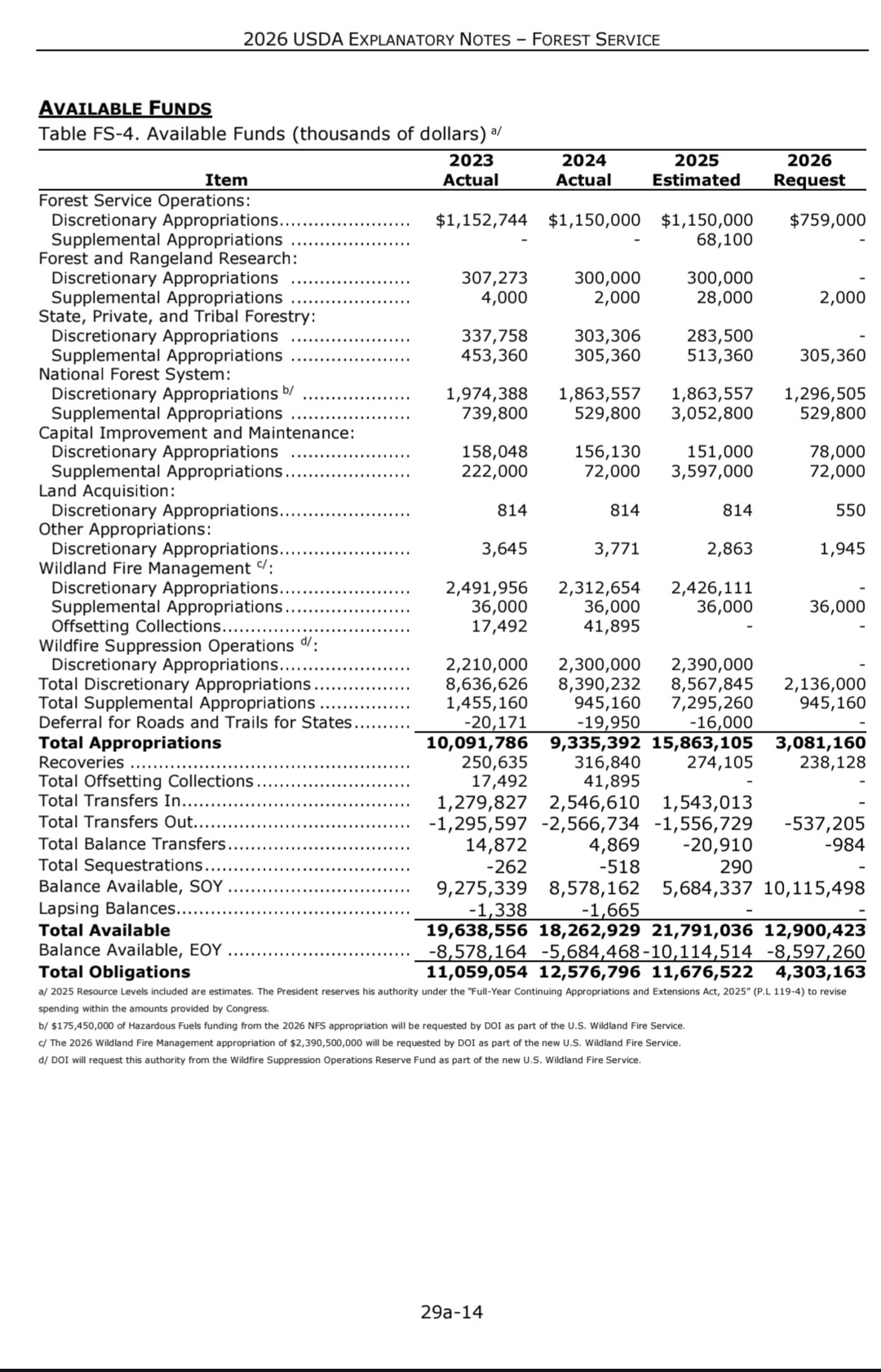
Screenshot of the 2026 USDA budget justification. Image Source: USDA
Federal officials emphasize that core services—including wildfire response, forest restoration, and recreation management—will continue uninterrupted as the transition unfolds over the coming year.
As a factor in the shift, the USDA says, “the Forest Service’s facilities footprint is significantly larger than can be supported under current congressional appropriation.” It warns that maintaining infrastructure beyond available funding would not represent “responsible stewardship of taxpayer dollars.” At the same time, the administration requested $1.5 trillion in defense spending, there is $85 billion in approved annual and supplemental funding for ICE, and $65 billion is allocated to the US Customs and Border Protection (CBP).
As restructuring moves forward in stages, California’s response will likely hinge on whether the new model can deliver efficiency without weakening the state’s ability to manage increasingly complex forest challenges under tightening fiscal conditions.
Ultimately, the question may be less about structure and more about priorities: whether long-term investment in forest health and resilience will keep pace with the scale of the risks ahead—and what that balance says about the nation’s direction.
To add to or correct any information in this report, please contact me at robert.m@lead4earth.org or leave a comment below with your thoughts
2
1

Comments