(ASBURY PARK, N.J.) — Attorney Thomas De Seno says the City of Asbury Park accepted the 2004 Clarke Caton Hintz report through its own actions, even though no separate written agreement adopting the report has been identified. He points to five pieces of evidence that, in his view, demonstrate the report became part of the parties' contractual obligations governing the Casino redevelopment.
The comments come in response to the legal interpretation recently outlined by the City's redevelopment attorney, Joseph Maraziti, who told OpGov.news he has found no evidence that the City and Asbury Partners ever executed the additional agreement contemplated by Section 3.5 of the 2002 Redeveloper Agreement.
The dispute centers not on whether the Clarke Caton Hintz report contained a detailed renovation schedule—it did—but on whether the parties ever agreed to make that schedule contractually binding.
Maraziti argues that without the additional agreement contemplated by Section 3.5, the approximately $33.6 million rehabilitation program identified in the Clarke Caton Hintz report never became an enforceable redevelopment obligation.
De Seno disagrees. Instead, he argues the City accepted the report through its contractual performance, public actions, and subsequent redevelopment documents.
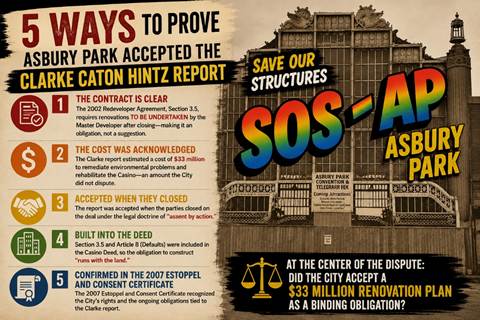
(Image Credit: Image on right courtesy of Save Our Structures – Asbury Park.)
De Seno identifies five legal and factual arguments supporting his interpretation of the redevelopment agreements. Each is followed by Maraziti's response explaining the City's competing legal position.
1. The contract became effective through the closing
De Seno's first argument is that Section 3.5 of the 2002 Redeveloper Agreement is self-executing. He argues the agreement required the Clarke Caton Hintz report to be prepared before the Casino property could be conveyed. According to De Seno, the report was submitted with a detailed schedule of renovations and repairs running from 2004 through 2007. Because the City ultimately proceeded with the closing, De Seno contends the contractual process contemplated by Section 3.5 was completed, making the report part of the redevelopment obligations.
Maraziti does not dispute that the Clarke Caton Hintz report included a detailed renovation schedule. However, he argues Section 3.5 required the City and Asbury Partners to agree to implement that schedule. According to Maraziti, no such agreement was ever executed, so the schedule never became contractually binding.
2. Acceptance can occur through conduct
Second, De Seno argues contract law does not always require a separate written agreement when the parties demonstrate acceptance through their actions. He cites the legal principle commonly referred to as "assent by conduct," arguing that by completing the conveyance without rejecting or modifying the Clarke Caton Hintz report—which contained a detailed renovation schedule extending from 2004 through 2007—the City accepted its recommendations even without executing a separate stand-alone agreement.
Maraziti argues the doctrine of assent by conduct does not apply because Section 3.5 required an agreement between both parties to implement the renovation schedule. In his view, the City's decision to proceed with the conveyance could not substitute for the mutual agreement contemplated by the contract. He also points to the exhibits attached to the 2007 Estoppel and Consent Certificate, which he says reflect the parties' actual agreed-upon scope of work rather than implementation of the Clarke Caton Hintz schedule.
3. The City discussed the report before closing
Third, De Seno points to the public record surrounding the Casino conveyance. According to De Seno, the City Attorney stated during the public meeting authorizing the sale that the Clarke Caton Hintz report had been accepted and referenced it in connection with adjustments to the purchase price. De Seno argues those statements demonstrate City officials treated the report as part of the redevelopment transaction.
Maraziti disputes that characterization, saying the $1.5 million sale price for the Casino was negotiated at least two years before the Clarke Caton Hintz report was completed. He argues the report therefore played no role in establishing or adjusting the purchase price.
4. The deed preserved redevelopment obligations
Fourth, De Seno argues the deed conveying the Casino incorporated the redevelopment obligations contained in the 2002 Redeveloper Agreement. He notes the deed references Section 3.5 and preserves the City's contractual default remedies. In De Seno's view, those provisions would have little purpose if the redevelopment obligations identified in the Clarke Caton Hintz report had not already become part of the parties' agreement.
Maraziti responds that after title transferred, the parties executed the 2006 Dispute Resolution Agreement, which amended portions of the 2002 Redeveloper Agreement and established a substantially scaled-back rehabilitation program for the Casino. He notes that the agreement includes attached exhibits describing the specific scope of work and implementation schedule.
5. The 2007 Estoppel and Consent Certificate reaffirmed the obligations
Finally, De Seno points to the 2007 Estoppel and Consent Certificate. He argues the document repeats key elements of the Casino rehabilitation program and states those obligations "remain" the responsibility of Asbury Partners. According to De Seno, that language demonstrates the redevelopment obligations continued after execution of the 2006 Dispute Resolution Agreement rather than being extinguished by it.
Maraziti argues the Estoppel and Consent Certificate supports the City's position rather than De Seno's. He notes the document distinguishes between the immediate 2007 scope of work and a separate "Long Term Vision" for the Casino, which he says reflects the broader concepts outlined in the Clarke Caton Hintz report. According to Maraziti, that long-term vision was expressly made subject to future negotiations and a subsequent developer agreement, with the document stating that Asbury Partners "shall not be liable to perform or complete" that work.
Maraziti also notes the Estoppel and Consent Certificate identifies only two operative agreements between the parties—the 2002 Redeveloper Agreement and the 2006 Dispute Resolution Agreement—and makes no reference to an agreement implementing the Clarke Caton Hintz renovation schedule as contemplated by Section 3.5. He further points to language stating that no defaults then existed or were contemplated against Asbury Partners, which he argues confirms the parties never agreed to implement the Clarke Caton Hintz report as an enforceable redevelopment obligation.
UPDATED 7/6/26: Both attorneys rely on the same provision of the 2007 Estoppel and Consent Certificate but disagree over whether it should be read in isolation or together with the surrounding language and related provisions.
Separate dispute over the documents provided to Judge Solomon
Apart from the parties' disagreement over whether the Clarke Caton Hintz report became contractually binding, De Seno also criticizes the City's handling of the documents provided to retired Superior Court Judge David Solomon during the recent legal proceedings.
De Seno says the City originally represented that Solomon would review "the contracts," but did not provide him with the 2007 Estoppel and Consent Certificate. According to De Seno, the City now argues the certificate is one of the controlling agreements governing the redevelopment obligations, yet it has not provided the document to Solomon to correct what De Seno characterizes as the original omission.
The City has consistently maintained that the 2006 Dispute Resolution Agreement, the 2007 Estoppel and Consent Certificate, and subsequent agreements govern its current legal interpretation of the remaining redevelopment obligations.
OpGov.News continues reviewing the redevelopment agreements, public meeting records, deeds, and related documents as part of its ongoing coverage of the legal dispute surrounding Asbury Park's historic Casino and Power Plant.
If you’d like to add or correct anything in this report, feel free to reach out to me or leave a comment below. If you have any Asbury Park story tips or ideas, please reach out to Sarah Denos at sarahkdenos@gmail.com.
Solomon.Slides
Solomon.Slides.pdf
0
0

Comments