(OPGOV GLOBAL) – Some of the most widely-known environmental impacts of data centers include their high water and electricity usage, noise pollution and water pollution.
These are the impacts that residents around California spoke out about during city meetings in Hayward, San Francisco and many more.
But there are other harmful effects that AI data centers bring to the environment.
These include the emission of Electromagnetic Fields (EMF) and the release of heat into their surroundings.
Not only are these things dangerous to humans, but they are also potentially dangerous to one insect that is essential to many lifeforms: bees.
Bees are crucial to the pollination of numerous different flowers, food crops and other plants.

Photo Credit: Madison Vinas
According to the Center For Food Safety, “honey bees alone pollinate nearly 95 kinds of fruits, such as almonds, avocados, cranberries and apples [in North America].”
And that’s just one type of bee.
The U.S. Geological Survey reported that there are over 20,000 known bee species, 4,000 of which are native to the U.S. They also state that these native bee species are the primary insect pollinators for most of the agricultural plants in the country.
Without them, food production would decrease significantly.
Unfortunately, bee populations as a whole have been on the decline for years.
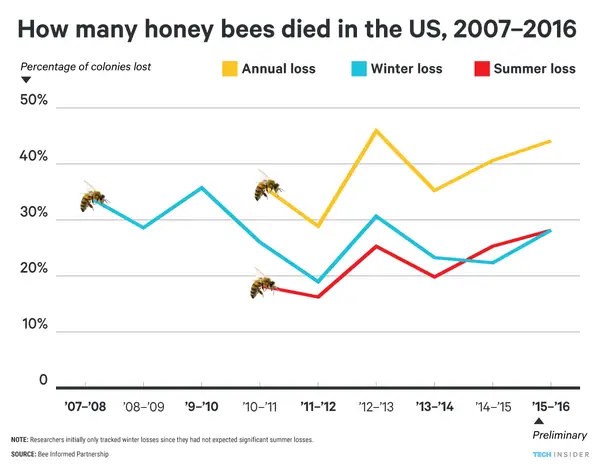
Photo Credit: Business Insider / Skye Gould
This can be attributed to things such as pesticides, habitat loss, global warming and more.
But the rapid increase in the construction of AI data centers is relatively new compared to the initial decline of bee populations.
Therefore, both the potential impacts of AI data centers on bees and the number of other environmental impacts these data centers can bring have yet to be studied in-depth.
Even so, there are qualities that AI data centers possess that have the potential to negatively impact bee populations in their surroundings.
Electromagnetic Fields (EMF)
AI data centers rely on a large amount of electrical infrastructure to both run and provide power to their facilities.
Some examples of this infrastructure include high-voltage power lines, substations, cooling systems and various other structures.
All of these structures emit different kinds of EMFs, some of which are pictured below.
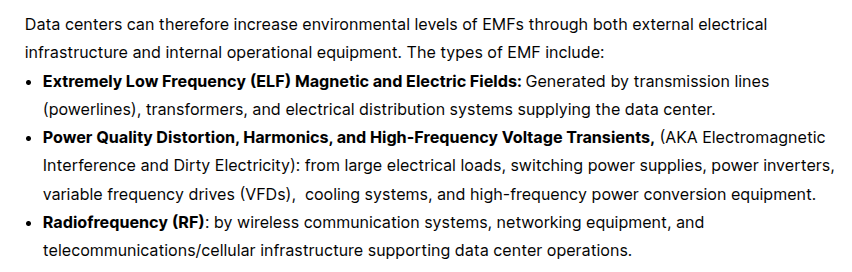
Photo Credit: ehsciences.org
A study published by iScience revealed that even weak EMFs pose a threat to the natural patterns of bees.
“Weak [EMFs ...] significantly alter honeybee floral landing behaviors. [They] reduced landings by [up to] 71%,” it stated. "These findings underscore the potential for [EMFs] to disrupt plant-pollinator interactions, threatening pollination efficiency, a cornerstone of agriculture and biodiversity.”
According to a research article published on ScienceAdvances, EMFs are also capable of interfering with a bee’s learning, navigation system, flight and decision-making.
Heat Concerns
Global warming is one of the already known threats to bees.
Partly due to their novelty, it has been difficult to accurately estimate the carbon footprint of AI data centers.
Published in A Cell Press journal, Alex de Vries-Gao was still able to come up with a rough estimate of what these numbers could look like.
“The carbon footprint of AI systems alone could be between 32.6 and 79.7 million tons of CO2 emissions in 2025.”
Additionally, a study conducted by Andrea Marinoni estimated that “the land surface temperature increases by 2°C on average after the start of operations of an AI data centre.”
In other words, the temperature of the land surrounding an AI data center increases by 3.6°F, on average.
According to Misfit Animals, the ideal temperature for a beehive is around 95°F.
As temperatures in these environments rise due to global warming and the increase in land surface temperature from AI data centers, temperatures can likely surpass this number.
This can be especially true on unusually hot days.
Research conducted by Ehsan Rahimi and Chuleui Jung predicted the impacts that climate change will have on bee populations.
“[Our] study revealed the anticipated significant impact of climate change on global bee populations, indicating that a majority of species, roughly 65%, are likely to witness a decline in their distribution and suitable habitats.”
To add or correct any information in this report, please contact me at madison.v@lead4earth.org.
1
2

Comments