(SAN RAMON, Calif.) – At the September 21 special meeting of the San Ramon City Council, a public speaker identified as American Intelligence addressed the council six times, raising concerns about transparency, spending, and public-record procedures.
“It is illegal for you to deny me to pull a consent agenda when the public suspect that there [is] corruption or shady business going on,” Intelligence said during opening public comment, alleging violations of the Brown Act—state legislation governing local government proceedings—and the council’s “own rules.”
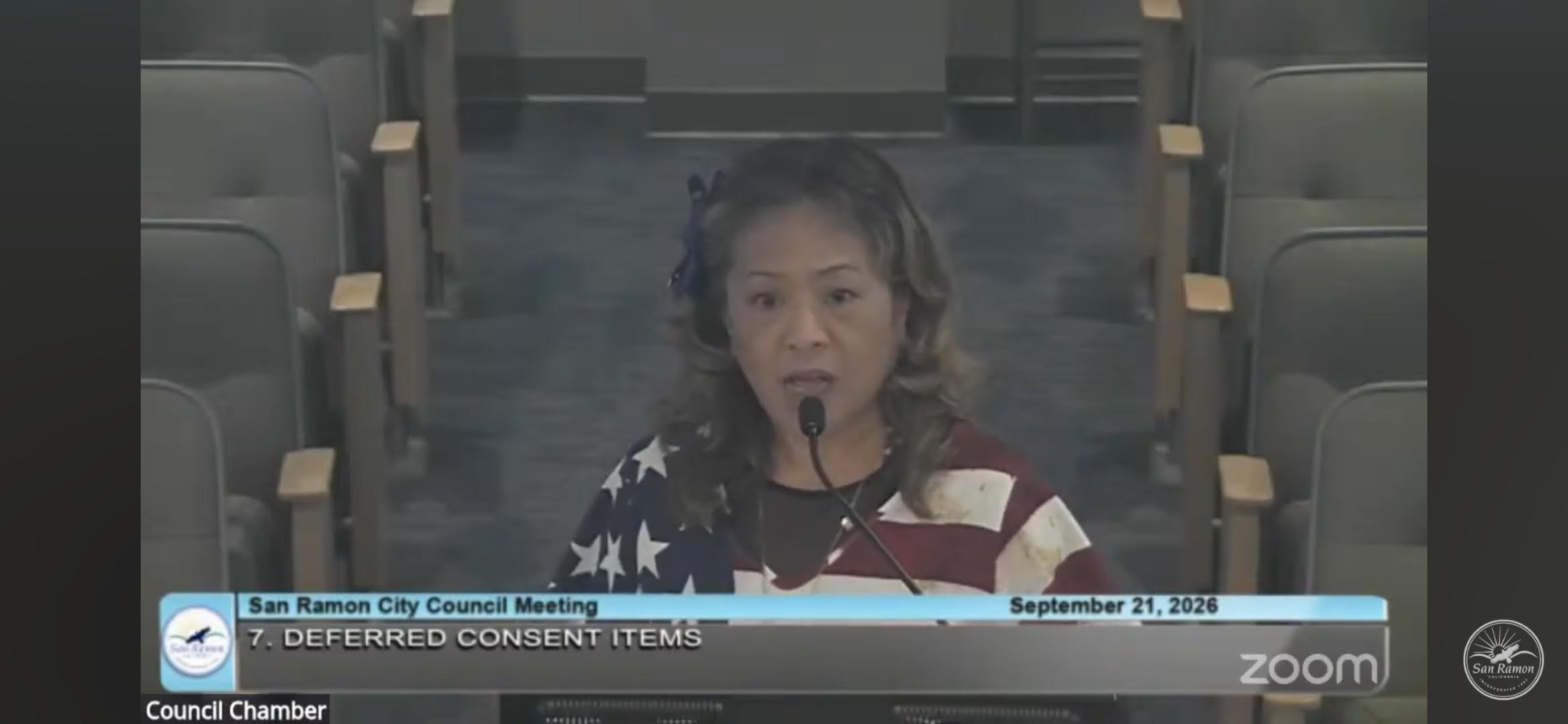
Photo Credit: City of San Ramon / YouTube / American Intelligence addresses the San Ramon City Council on September 21.
Her comments continued throughout the meeting, touching on the city’s Register of Demands, the proposed Iron Horse Trail overcrossing and a veterans’ banner program.
During discussion of item 5.4, concerning the Register of Demands, Intelligence argued that the city’s financial records were notated too vaguely. She said she was “Taiwanese,” claimed the records did not meet “American accounting” standards and alleged that city staff were “educated in communist China.” She said she had brought the issue before the council multiple times, but had been “ignored…repeatedly.”
Councilmember Sridhar Verose acknowledged that “people do like to have more details.” City Treasurer Wakeman explained that, “for the sake of transparency,” the report contains itemized lists of invoices and payments “so that the public may see how we are spending their tax dollars.”
Following the explanation, Verose responded, “That sounds good…That’s more transparency…It’s better.”
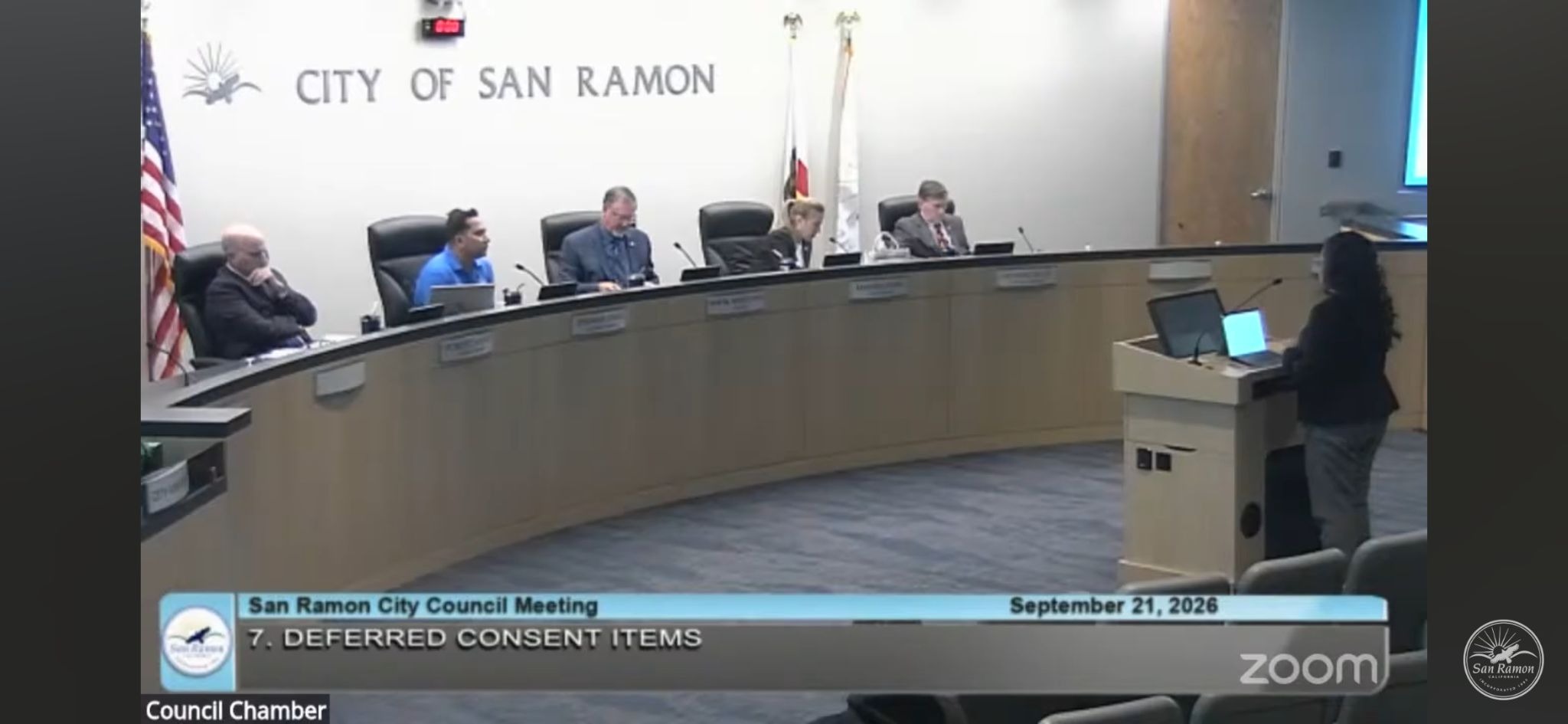
Photo Credit: City of San Ramon / YouTube / City Treasurer Jennifer Wakeman addresses the San Ramon City Council on September 21.
The evening’s discussion of item 5.6, the proposed Iron Horse Trail bicycle and pedestrian overcrossing, centered largely on the project’s cost and potential burden on city taxpayers. Council members questioned whether 20% or 30% of the project could ultimately come from the General Fund. Staff said no percentage had been determined because the city’s contribution would depend on outside funding and future council decisions.
A presenter at the meeting, Brian Morsy, pointed to the Bollinger Canyon Bridge as an example of assembling multiple funding sources. Morsy said completing the design would make the Iron Horse project “shovel ready” for future grants. Another official offered 20% as a historical estimate for local contributions to grant-funded projects.
The design phase was estimated at approximately a year and a half to two years, potentially longer, while construction funding remains unresolved.
Officials also described the Iron Horse Corridor as a regional transportation route. “It is a transportation corridor,” one council member said, recounting discussions with the U.S. Department of Transportation during a trip to Washington, D.C. Officials said the approximately 30-mile corridor serves communities beyond San Ramon and could make the project eligible for broader funding.
Intelligence objected during public comment, saying, “No bridge plans were attached with the packet,” and questioning why information about traffic and the number of residents affected had not been provided.
“Pleasanton is the beneficiary of this bridge,” she said, asking whether Pleasanton had been asked to contribute. She also questioned the city’s priorities, citing police funding, roads and other municipal needs while asking why San Ramon residents should pay for the project.
The council ultimately approved the bridge design contract unanimously.
Later in the meeting, Intelligence questioned a proposed veterans’ banner program under Resolution 2026-120, a co-sponsorship agreement with American Legion Mount Diablo Post 246.
The initial program would provide up to 10 commemorative banners honoring local veterans. The American Legion would handle applications and verify military service, while the city would coordinate production and installation. The Legion would reimburse direct costs.
“Why are we charging our veterans fees?” Intelligence asked, citing fees ranging from $225 to $750 per flag pole and arguing that money raised by the American Legion could instead support youth sports, Gold Star families and other community programs.
The discussion revealed that the city’s banner policy is approximately 20 years old. The city attorney said changes in the law concerning “government speech” meant the policy should be reviewed and updated.
The resolution authorizing the veterans’ banner program passed unanimously.
Other members of the public also sought to pull agenda items, including the Crow Canyon Road widening project and Iron Horse Trail. Verose called for items 5.4 through 5.6 to be pulled, while Mayor Mark Armstrong and Vice Mayor Marisol Rubio called for item 5.6.
Throughout the meeting, Intelligence returned to the question of whether residents receive enough information before the council acts and whether public concerns receive meaningful answers.
The public podium is but one of many avenues of democracy. Public discourse, that First Amendment right, is also represented at the ballot box. But at a city council meeting, the podium is where residents can put their questions—and their objections—into the public record.
On September 21, American Intelligence used it six times.
To add to or correct any information in this report, please contact me at robert.m@lead4earth.org or leave a comment below with your thoughts.
0
0

Comments