
Photo Credit: fountainsthoughts.co.uk
There have been proposals for keeping Daylight-Saving Time (DST) dating back to 1784. It all started when Founding Father Benjamin Franklin wrote a satirical letter about walking earlier in the day. It has been 242 years since a permanent agreement has been settled on across the globe, “moving your clocks back an hour.”
The opposite of DST is Standard Time. Standard time moves the time back one hour when DST ends (fall back an hour). This aligns more closely with the sun’s natural position, and days have earlier sunrises and sunsets.
Below is a brief timeline of Daylight Saving Time:
1784: Benjamin Franklin's satirical letter about waking earlier
1895: George Hudson proposes two-hour seasonal shift in New Zealand
1907: William Willett publishes "The Waste of Daylight" in Britain
1916: Germany and Austria-Hungary adopt DST (first countries)
1918: US adopts DST; repealed 1919
1942-1945: US "War Time” year-round DST during WWII
1966: US Uniform Time Act standardizes DST
1974-1975: US year-round DST trial during oil crisis
1996: EU standardizes summertime across member states
2007: US extends DST by four weeks (current schedule)
2014: Russia moves to permanent standard time
2016: Turkey adopts permanent summertime
2022: Mexico abolishes DST for most of the country
2022: US Sunshine Protection Act passes Senate, stalls in House (DST vs. Standard Time: What's the Difference? (2026 Guide)
As of July 14, 2026, the United States House of Representatives passed a bill, The Sunshine Protection Act of 2025, by a 308-117 margin to make daylight saving time permanent across most of the United States.
The bill was sent to the Senate on July 15, 2026, and then referred to the Committee on Commerce, Science, and Transportation. There is no scheduled Senate floor vote currently.
With that being said, be prepared to set your clocks back an hour on November 1, 2026, at 2:00 a.m., marking the end of Daylight-Saving Time.
Gulf Coast weekly conducted a poll with Pensacola residents and, by the results, it seems that the majority would vote to keep daylight savings time. The poll asked 50 residents if they preferred daylight saving time to stay year long. Thirty (30) stated yes, 10 (ten) stated no, and the remaining ten (10) stated that it does not matter to them.
Many voiced concerns and why they wanted to keep daylight savings time, and hope it will be passed into law.
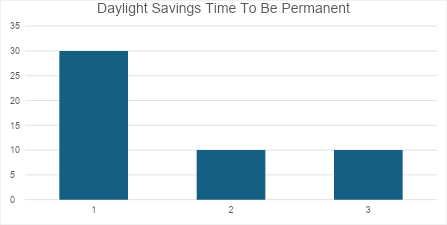
Graphic: James Borchardt from a poll conducted in Pensacola. 60% for DST, 20% against, and 20% undecided or had no opinion.
Shireen Merrill, a Pensacola resident, stated, “Daylight savings time all year around please! As a senior I don't drive in the dark anymore but do like to go out for an early dinner and not have to get dark before I leave the restaurant. Also, if a movie starts at 3 pm, it's hard to get home before dark.”
Patty Chavis, a resident of nearby Lillian, went on to say, “Change it to one time. I don't like leaving home in the dark and coming home in the dark on the same day. Nothing to do but work. No sunlight to enjoy after work.”
Pamela O of Pensacola seemed not to agree with changing the times at all during the year by saying, “Daylight Saving Time is an artificial construct that is extremely disruptive to the sleep cycle of humans and other creatures for a few weeks twice a year. It doesn't change the number of hours of daylight in a 24-hour period.”
Finally, Peggy Walsh of Nine and a Half Mile, Pensacola, stated why she felt there should not be daylight savings time: “No, no, no more daylight savings time. So many of us struggle losing or gaining the hour. I lived in Hawaii & Guam where there were no daylight savings. It was the best. Moving back to the States took a bit of time for me to get used to it. Honestly, I don’t think I will ever get used to daylight savings.”
At the time of this publication, Pensacola Mayor Reeves has not made any public comment indicating whether he supports or opposes the bill. However, more prominent Florida politicians, including Representative Vern Buchanan and U.S. Senator Rick Scott both champion the measure.
President Trump has stated on Truth Social that seasonal clock shifts are “foolish, inconvenient and, in some cases, very costly. Trump noted that Americans are “sick and tired of having to change their clocks twice a year.” He went on to state that stopping the time changes would reduce traffic accidents, lower crime rates, save energy, and alleviate the health and anxiety issues associated with shifting the clocks.
Trump has called the current system “ridiculous” and aggressively urged the Senate to pass the bill immediately so he can sign it into law. Trump framed the issue as a “popular alternative” that gives families a “longer, brighter day.”
From the poll conducted by Gulf Coast Weekly, it seems as if Pensacola agrees with the President as well as other prominent state officials. Only time will tell if the “Sunshine Act” is adopted into law.
To add to or correct any information in this report, please contact me at james.b@lead4earth.org.
0
0

Comments