(PENSACOLA) --- Affordable housing density is key.
The Pensacola Affordable Housing Authority met on Tuesday to discuss this, with board members noting that Pensacola permitting is a "hot-button" issue in their discussions on density and accessory dwelling units (ADU).
Board members discussed Florida Housing Coalition incentive plans with Keith Branch of Good Foundations Inc., who came right out of the gate.
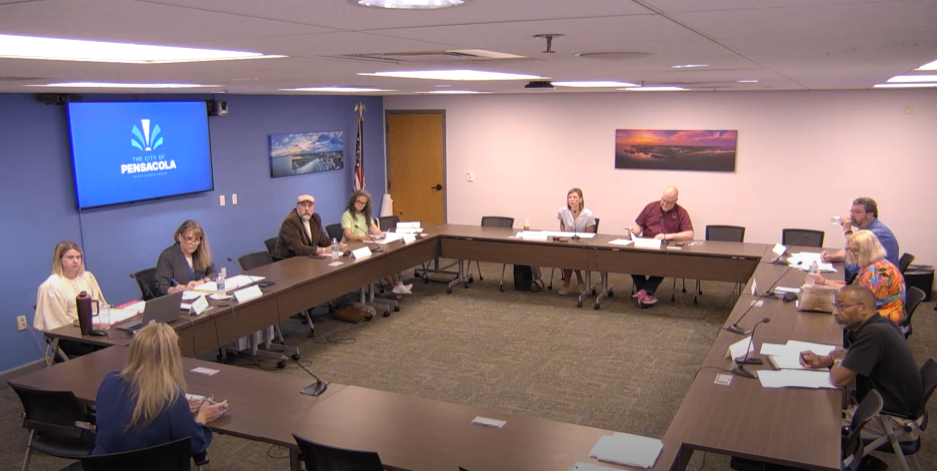
(Photo: Pensacola Affordable Housing Authority Meeting, May 5)
"I have a feeling that there's a lot of money out there not being taken advantage of, not just by individual property owners, but builders themselves, whether they're developing land at scale or they're working with an individual landowner," Branch said.
Branch is on the right track, according to incentive findings.
"As an affordable housing incentive, a jurisdiction may increase the maximum units allowable if a builder develops affordable housing units in exchange," according to attached staff reports.
It's the next line that matters the most.
"The presence of bonus units will allow a developer to sell more homes or rent more apartments and thus help meet various financial criteria," according to the staff report.
"I think that mainly what we're doing is trying to look at those incentives and figure out how we can help staff get some more active use within the city," Branch said.
Staff reports use many Florida cities as examples, including Jupiter and Orlando, which offer developers the opportunity to provide "in-lieu" compensation to the City of Orlando Trust Fund for Low- and Very-Low-Moderate Housing.
The staff research also pointed to examples of density and ADUs in Palm Beach and Pinellas counties, as well as in St. Petersburg. But it's here that matters most, according to Chair Crystal Scott.
"I'm curious about the lender's appetite for projects," Scott said. "Are they wanting to be built on existing (structures) and then also for new construction; I just don't know."
But Scott does know, "it's hard for people to secure funding to build here."
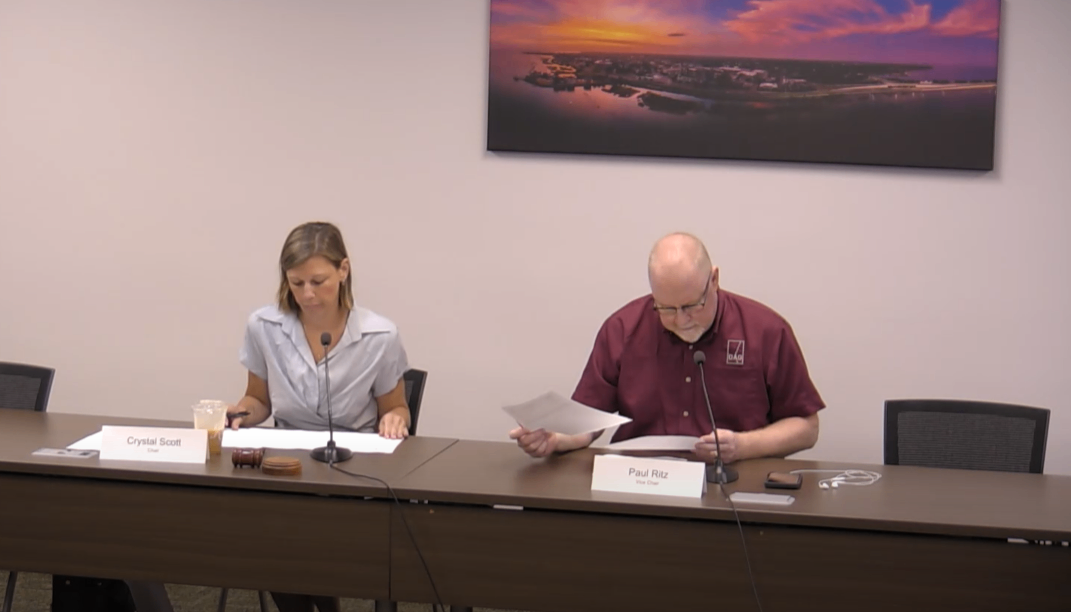
(Photo: Pensacola Affordable Housing Advisory Board Chair Crystal Scott, Vice Chair Paul Ritz)
While Vice Chair Paul Ritz notes he is not in the lending business, he did say, "For an ADU, the credit capacity of the homeowner."
"It's what they can afford, what they can't afford, or what their bank or lending institution will allow them to have," Ritz said.
ADUs, a.k.a. granny flats or mother-in-law suites, were discussed alongside density, with staff findings indicating that Pinellas County's ordinance exempts ADUs from density calculations.
"Further, Pinellas County allows the owner of the property to occupy either the primary unit or the ADU. This flexibility in owner-occupancy is essential to a successful ADU Ordinance," according to the staff report, adding that the ADU cannot exceed 50% of the primary living area.
Discussions on density and the creation of a model ADU ordinance lasted about an hour. In the end, officials made it clear it's a matter of getting the word out to the public and developers on the findings and opportunities, including exploring a housing trust fund.
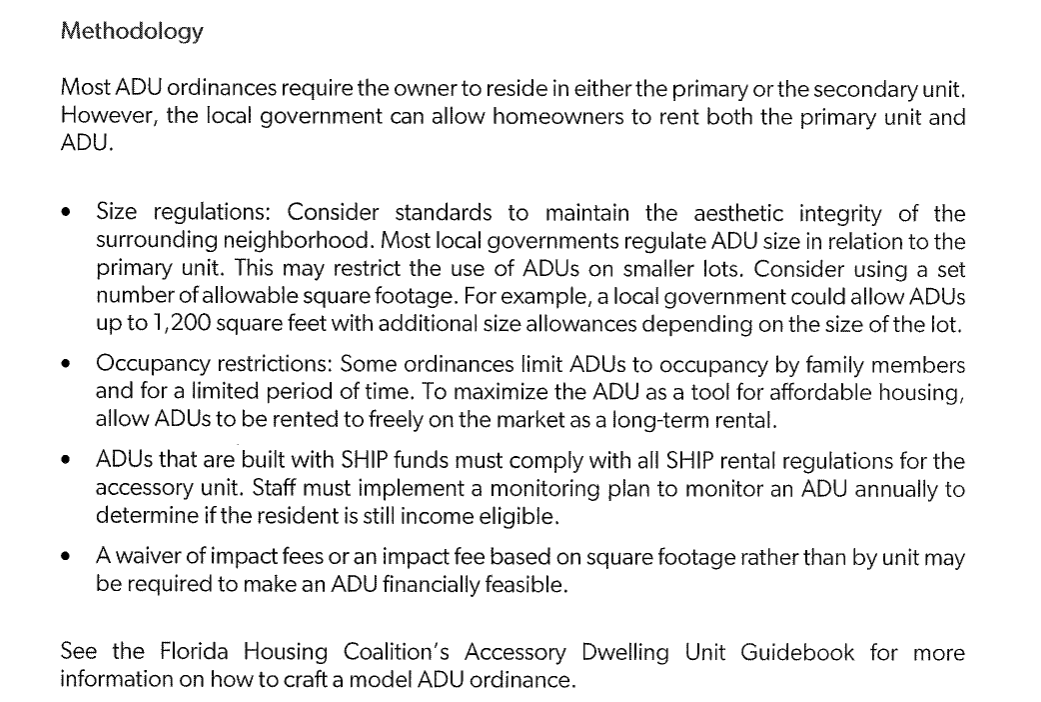
(Photo: Florida Housing Coalition's Accessory Dwelling Unit staff incentive report)
"There is a lot of information that the builders don't have," Branch said.
While this reporter watched the meeting, the OpGov.News platform did the same, picking up "discussions frequently highlighted existing bureaucratic hurdles, such as complex permitting processes in the City of Pensacola (especially within CRAs), and difficulties in securing lending for ADUs."
It's correct.
Branch said so himself.
"The permitting process in the city of Pensacola is a hot-button issue with local builders," Branch said. "They find it easier to get permitted in Escambia and Santa Rosa County than in the City of Pensacola by a significant margin."
Vice Chair Paul Ritz disagrees.
"That is impressive because I have never found that to be the case," Ritz said. At the same time, permits can be expedited, "there are few people actually making use of affordable housing, specifically."
I will leave it up to the platform to end, noting, "overall, the meeting reflected an early-stage exploration of solutions rather than concrete strategic planning, with many proposals requiring further staff investigations."
It did.
0
0

Comments