Editorial note, June 8, 2026: When this article was first published, cross-district comparisons relied on early estimates for other assembly districts that have since been corrected by official data. As more complete data became available, we shifted the primary comparison to AD16's own historical record across the 2022, 2024, and 2026 primaries — a cleaner and more defensible basis for the anomaly claim. The cross-district county comparison table is retained as published for reference. The Clarity Elections finding reported below is new and stands independently.
The Anomaly — AD16's Own History
Assembly District 16's voter participation has grown every primary cycle. But the 2026 acceleration is unlike anything in the district's recent record:
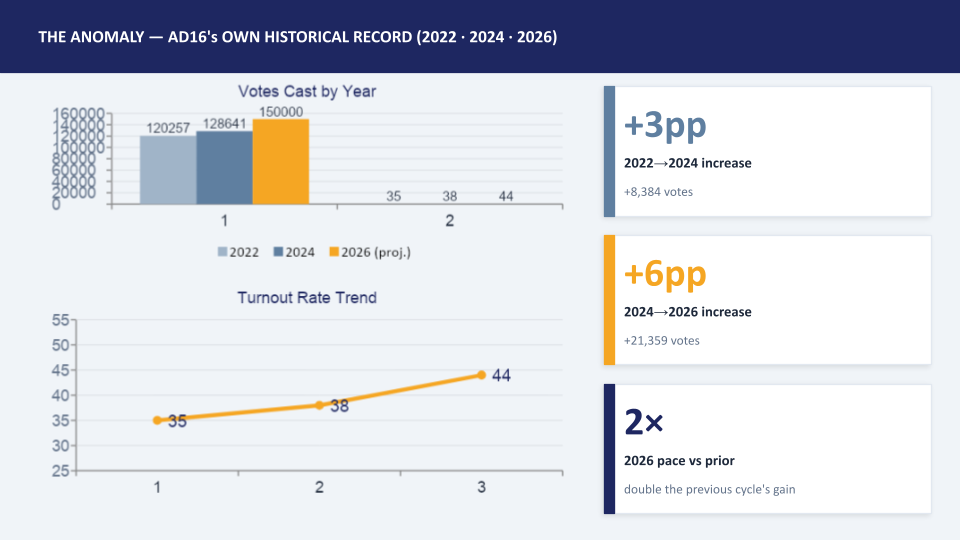
The 2026 jump is double the pace of the previous cycle — in both percentage points and absolute votes. No candidate ran an active campaign. The Democratic, Republican, and No Party Preference candidates each made no significant voter outreach. The NPP candidate, Chirag Kathrani, received 3.5% of the vote — far too small to account for a district-wide acceleration of this scale.
AD16's 2026 participation is approximately 9 percentage points above the average of comparable assembly races held the same day. The question is not whether the surge happened. It did. The question is what caused it — and that question cannot be answered without precinct-level data.
What Has Been Ruled Out
Analysis of available data has eliminated the most common explanations for a primary turnout surge.
Active campaigning. None of the three AD16 candidates ran a meaningful campaign. Turnout surges in primary elections are typically associated with competitive, well-funded races with significant voter outreach. That condition was absent here.
Third-party candidate mobilization. In races where a minor-party candidate drives outsized enthusiasm, the candidate's vote share usually reflects that energy. The AD16 NPP candidate received 3.5% of votes across both counties — inconsistent with a district-wide mobilization effect.
Candidate mix. Assembly District 24 carried an identical DEM-REP-NPP ballot configuration and returned approximately 32.6% turnout — around 11 points below AD16's projected final. The presence of a third-party candidate on the ballot does not appear to explain the result.
County composition alone. Assembly District 14 spans the same Alameda and Contra Costa counties as AD16. With official data, both districts project to approximately 44% — essentially the same. The notable difference is that AD14 featured an active incumbent campaign; AD16 had no meaningful voter outreach from any candidate. AD16 matched a full campaign effort with none.
What the County Comparison Shows
With Alameda County counting substantially complete and Contra Costa County reporting approximately 55,200 ballots remaining, here is where the four comparable assembly districts stand:
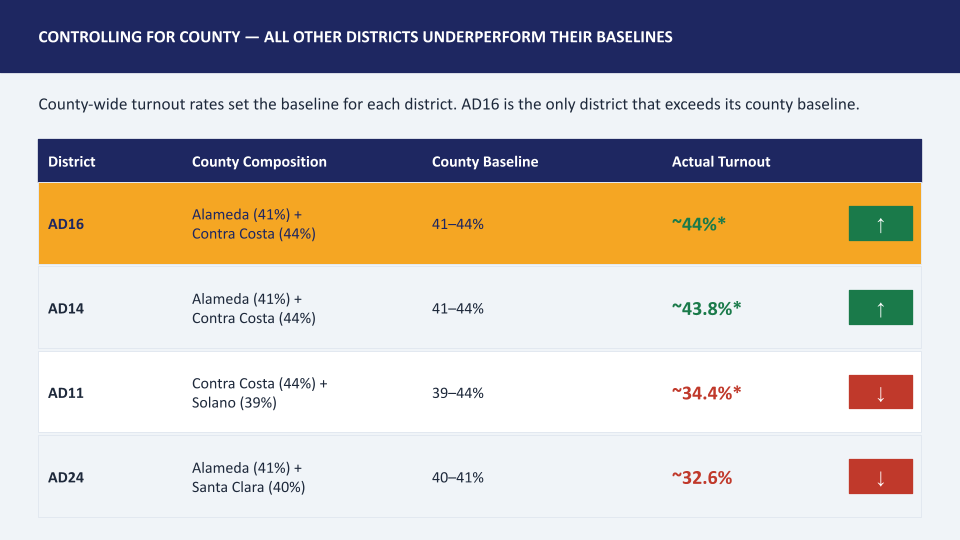
This is no longer a project but a fact based on the latest updated count and about 16K votes in Alameda remains to be counted will only push the participation higher.
AD16 and AD14 are essentially tied. AD11 and AD24 are significantly underperforming their county baselines — by 5 and 8 percentage points respectively. No candidate ran an active campaign in AD16; AD14 featured an incumbent running a full campaign.
What the data does not change: the county-level baseline comparison holds. AD11 and AD24 each underperform their constituent counties substantially. And within AD16, freely accessible data from tracker.politicaldata.com shows the Contra Costa portion of the district returned ballots at a significantly higher rate than its Alameda portion — a geographic pattern without an obvious explanation.
The More Significant Finding
While investigating these numbers, a candidate in AD16 — Chirag Kathrani — submitted a public records request to the Contra Costa County Elections Division on June 5, 2026, seeking precinct-level results.
Assistant Registrar Helen Nolan responded the same day. "Unfortunately, a precinct-level report is not available at this point in time," Nolan wrote, adding that precinct-level reporting is "not one of the reports we offer as a data request." She further stated: "We currently do not have the same software capability" as Alameda County, which publishes a precinct-level map for some races.
The county's own election results website tells a different story.
Contra Costa County publishes its results through Clarity Elections, a widely used election reporting platform, at results.enr.clarityelections.com/CA/Contra_Costa. That website includes a "Precinct Turnout" tab that currently displays ballot return counts and turnout percentages for every one of the county's 938 precincts individually — the exact data Nolan described as unavailable.
Santa Clara County uses the identical Clarity Elections software and platform. Its results page — results.enr.clarityelections.com/CA/Santa_Clara — offers the following downloads, listed explicitly on the page:
Detail XLS — "Precinct level details for election results. Contains votes received by choice in each contest for all participating precincts."
Detail XML — "Precinct level details for election results. Contains votes received by choice in each contest for all participating precincts."
Detail TXT — "Precinct level details for election results. Contains votes received by choice in each contest for all participating precincts."
Contra Costa County is running the same software. Santa Clara County has enabled the precinct-level export features that software provides. Contra Costa County has not.
The county's own published election summary report adds a further data point. The document — ElectionSummaryReportRPT-112.pdf, available at contracostavote.gov — includes the line "Precincts Reported: 236 of 236 (100.00%)" for the AD16 race. The aggregate totals in that report were computed from precinct-by-precinct data that already exists in the county's system.
Nolan also noted in a follow-up exchange that the county sells its Voter By Mail return file — precinct-level participation data — to commercial data brokers including PDI, whose public tracker at tracker.politicaldata.com displays that data freely to anyone. The same data is not published as a matter of routine county transparency.
What Remains Unexplained
The precinct-level vote results — how many votes each candidate received in each precinct — are distinct from the return data and turnout figures already published. According to Nolan, those results are transmitted to the state only at the conclusion of the canvass. She has committed to providing them once tabulation is complete.
Questions that remain open until then:
Within the Contra Costa portion of AD16, which specific precincts drove the higher return rate — and what do they have in common?
Why did AD14's Alameda voters turn out at 49% while AD16's Alameda voters returned only 38.5%, given both districts span the same two counties?
Why do AD11 and AD24 each fall 5–8 points below their county baselines when AD16 and AD14 do not?
The Ask
Contra Costa County already has the Clarity Elections software. The precinct turnout data is already published on its website. Santa Clara County, using the same platform, makes full precinct-level vote results downloadable in multiple formats.
Enabling the same export features in Contra Costa requires a configuration decision, not a new software purchase. Whether the county will make that decision — and whether the precinct-by-precinct results Nolan has promised will be made available publicly rather than only to candidates who formally request them — remains to be seen.
All figures are based on vote counts available as of June 10, 2026, and are subject to change as the canvass continues.
Figures cited in this article are based on vote counts available as of publication date and are subject to change as the canvass continues.
0
0

Comments